Skyrocketing Survey Fees Disrupt Property Title Updates
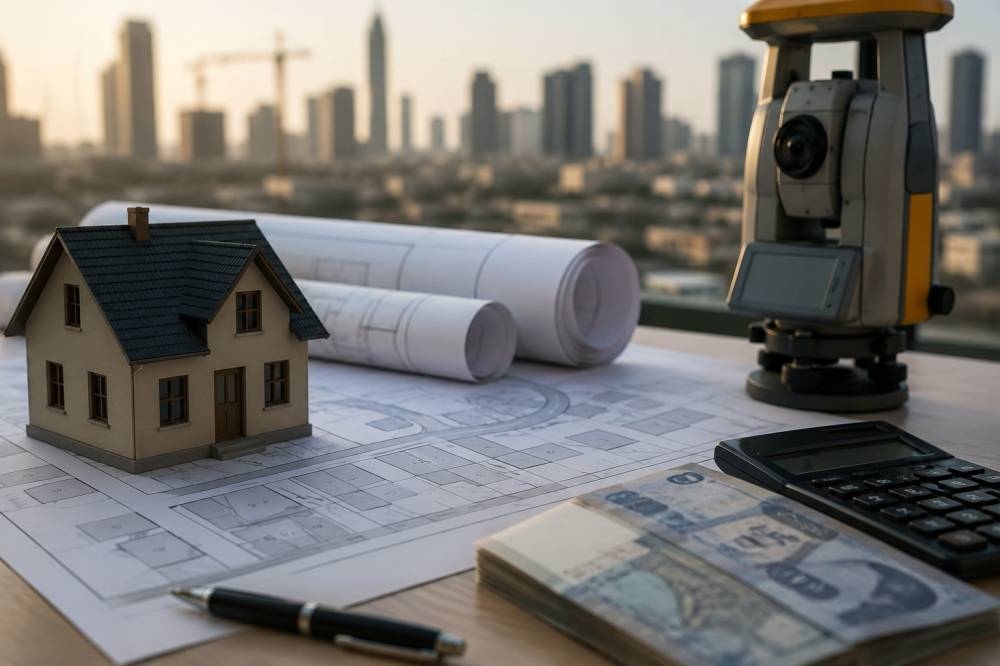
The increase in fees for obtaining a regulatory survey (Kroki), required for converting paper property titles to electronic ones, has sparked controversy among property owners and stakeholders, especially in Jeddah, Mecca, and Taif. The survey is a key requirement for verifying property data before issuing e-titles, but its cost at engineering offices has risen from around 1500 to between 2500 and 3000 riyals, prompting calls for a review of the pricing mechanism.
The increase in fees for obtaining the regulatory survey (Kroki), required to complete the process of updating property deeds from paper to electronic, has sparked a wave of controversy among property owners and those interested in real estate affairs, especially in the cities of Jeddah, Mecca, and Taif. The regulatory survey is one of the basic requirements for accurately proving property data before issuing the electronic deed. However, the high cost of obtaining it from engineering offices, which ranges between 2,500 and 3,000 riyals, after it was around 1,500 riyals, has prompted a number of beneficiaries to demand a review of the pricing mechanism. An additional burden: A number of citizens confirm that the new fees constitute an additional financial burden, especially for owners of old properties who wish to update their deeds to benefit from electronic judicial and real estate services, considering that the high cost may delay the completion of updating procedures for many owners. In contrast, others see that the high fees are not proportionate in all cases to the nature of the service, especially when the property boundaries are clear or survey plans have already been prepared. They called for setting a price ceiling or indicative prices to limit disparities among engineering offices, achieving justice and protecting beneficiaries from overpricing. Citizen Saeed Al-Shahrani said the problem lies not in paying fees for the service, but in the variation in prices from one office to another, where a beneficiary may pay a much higher amount than another for the same service. He called for a regulatory mechanism that enhances transparency and clarifies to beneficiaries the reasons for price differences and the calculation method. Devices and technologies: In contrast, workers in engineering offices confirm that preparing the regulatory survey is not limited to an engineering drawing, but relies on precise technical and field work. Engineer Ashraf Abdel-Baqi explained that preparing the survey requires carrying out a topographic survey using modern devices and techniques, in addition to reviewing property data and ensuring its compliance with approved regulations and requirements before approval. He added that the quality of real estate data contributes to reducing ownership disputes, enhances the reliability of electronic deeds, and improves the efficiency of the real estate market, which justifies the fees charged by offices for the amount of technical and field work involved. Quality and cost: For his part, engineering office owner Faisal Al-Yami pointed out that the difference in survey prices between offices is linked to several factors, including the property's area, location, difficulty of survey work, and the time required to complete the task. He explained that some sites require significant field efforts and special equipment, which is reflected in the cost of the service, emphasizing that each property's nature differs. Meanwhile, real estate expert Mohammed Bilal believes that the electronic deed update project represents an important step in developing the real estate sector, but he stressed the importance of balancing service quality and cost. He said high fees may lead some owners to delay updating their deeds, which could affect the achievement of digital transformation targets and increase the proportion of electronic deeds, affirming that facilitating procedures must be accompanied by providing support services at reasonable prices. Transformation targets: Engineers and specialists agree that updating deeds electronically is one of the most prominent projects for developing the judicial and real estate system in the Kingdom, due to the speed it provides in completing procedures, ease of verifying ownership, and linking data between government agencies. However, they also affirm that the success of this system requires addressing challenges related to the costs of support services, foremost among them the fees for obtaining the regulatory survey. Specialists believe that setting clear pricing standards, enhancing competition among engineering offices, and utilizing modern technologies in survey work can help reduce costs in the future, achieving a balance between the rights of engineering offices to fair compensation and the rights of citizens to obtain services at reasonable prices, thus supporting digital transformation targets and enhancing beneficiary satisfaction.
< Previous PageNext Page >
Original source: Al-Watan




Comments (0)
Be the first to comment.