Specialists to Asharq Al-Awsat: Nuclear Agreement Bolsters Saudi Arabia’s Global Credibility
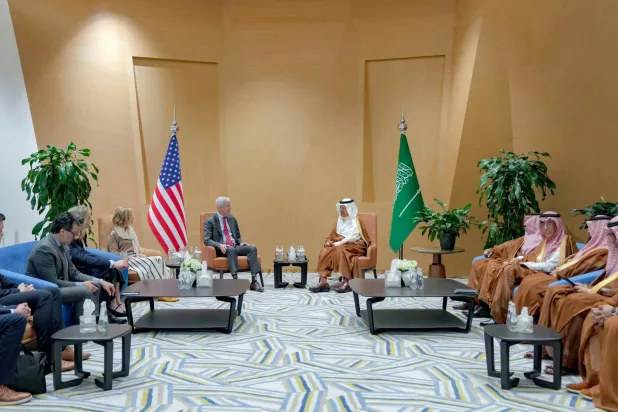
Economic experts and specialists confirmed to Asharq Al-Awsat that the nuclear agreement between Saudi Arabia and the United States inaugurates a new and unprecedented phase of strategic and qualitative cooperation.
Economic experts and specialists confirmed to Asharq Al-Awsat that the peaceful nuclear agreement between Saudi Arabia and the United States inaugurates a new and unprecedented phase of strategic and qualitative cooperation between the two countries. They explained that the agreement is not limited to technical and developmental aspects in the energy sector alone, but also enhances the Kingdom's credibility in international markets as an attractive hub for cross-border investments, granting its economy greater immunity and assurance against unexpected global shocks, along with achieving a qualitative leap in local manufacturing and consolidating the goals of Saudi Vision 2030.
In his analysis of the agreement's gains, Shura Council member Fadl bin Saad Al-Buainain told Asharq Al-Awsat that the agreement carries major strategic and economic importance; strategically, it contributes to deepening the historical partnership and framing cooperation between Riyadh and Washington over extended periods, achieving vital aspects of comprehensive national security.
Al-Buainain stressed the need to read the agreement with a panoramic vision that goes beyond direct cost-benefit calculations; it includes the vast, extended economic returns for all sectors, water security, energy security, and regional stability, of which the Kingdom is the main pillar.
Gains for the national mix: Regarding the direct impact on the energy and resources system, Al-Buainain pointed out that introducing peaceful nuclear energy will enhance the efficiency of production directed to vital economic sectors, foremost electricity and water desalination, which constitute a strategic priority for water security in the Kingdom.
He added that relying on nuclear energy for electricity generation will contribute to saving huge quantities of oil and gas currently used in local generation plants, allowing them to be directed to external exports to boost government revenues and meet growing domestic demand, especially in the sectors of industry, mining, and advanced technologies. He also noted the Kingdom's aspiration to optimally utilize its uranium reserves and develop enrichment processes to achieve self-sufficiency in nuclear fuel and enhance the sovereignty of the energy sector.
Localization of precision technologies: In the context of the agreement's time span, Al-Buainain explained that the agreement, which extends for about 30 years, establishes a long-term partnership that ensures the flow of investments, technology transfer, and strengthening ties with advanced American companies.
Al-Buainain expected that this partnership would form a bridge for the transfer of modern technologies and advanced industries related to the nuclear sector, and the qualification of young national talents, enhancing the diversification of the economic base and creating a new developmental sector on which various productive sectors rely, with the possibility of exporting energy to neighboring countries through regional electrical interconnection networks.
Attracting foreign investments: For his part, Dr. Abdulrahman Baeshen, head of the Al-Shorouq Center for Economic Studies in Jazan, told Asharq Al-Awsat that the agreement lays the most important strategic cornerstone for a bilateral cooperation that is the first of its kind, raising the ceiling of industrial and technological cooperation between the two sides.
He explained that the agreement accelerates the Kingdom's steps towards improving energy efficiency, providing clean energy, achieving environmental protection, and the goals of 'reaching net-zero emissions' within the commitments of Vision 2030.
He added that this partnership opens broad horizons for introducing and localizing advanced and complementary industries for strategic sectors, such as artificial intelligence, electronic chip manufacturing, and advanced semiconductors, raising the competitiveness of Saudi products in global markets and enhancing the stability of the industrial system.
Baeshen concluded by noting that the most important direct repercussions of the agreement lie in raising the comprehensive credibility of the Saudi economy among investment institutions and global companies, which stimulates foreign direct investment appetite and opens the door to international and regional cooperation projects that grant the national economy solid immunity against economic shocks and global fluctuations.
Original source: Asharq Al-Awsat



Comments (0)
Be the first to comment.