Israeli Opposition: US-Saudi Nuclear Agreement a Resounding Failure for Netanyahu
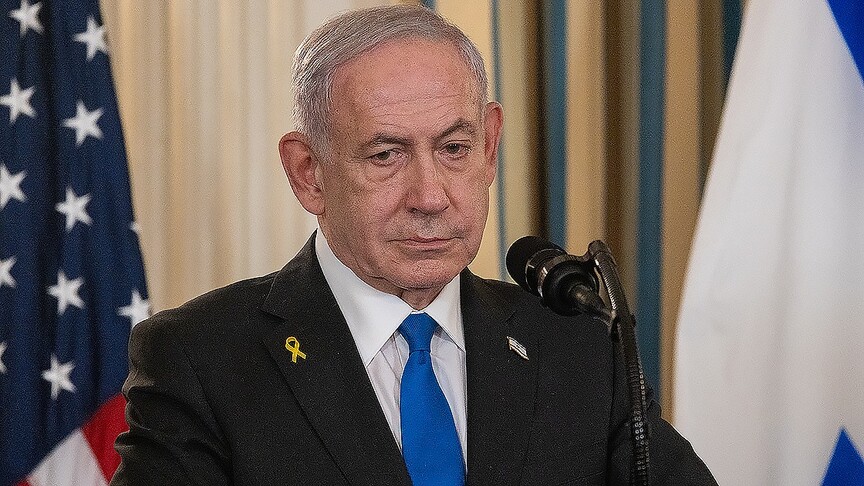
Opposition leaders said the deal was signed without linking it to normalization with Israel.
JERUSALEM / Anadolu
The Israeli opposition on Thursday considered the US-Saudi civilian nuclear cooperation agreement a major political loss for Prime Minister Benjamin Netanyahu, because it was signed without including any condition for normalization between Saudi Arabia and Israel.
The agreement comes as the kingdom seeks to develop a civilian nuclear program with American assistance, amid Israeli sensitivity over any uranium enrichment in the region.
The US Department of Energy announced on Wednesday the signing of what it called a 'historic' agreement with Saudi Arabia for cooperation in nuclear energy for peaceful purposes.
In a statement, the ministry said US Energy Secretary Chris Wright and his Saudi counterpart Prince Abdulaziz bin Salman signed a civilian nuclear cooperation agreement, known as the '123 Agreement,' which sets the legal framework for cooperation between the two countries in the field of peaceful nuclear energy.
It added that the agreement represents an important step in enhancing peaceful nuclear cooperation between Washington and Riyadh, noting that it will be submitted to the US Congress for review according to approved procedures before entering into force.
Following the announcement of the agreement, leaders in the Israeli opposition considered it a failure for Netanyahu and his government.
In a statement to the Israeli Broadcasting Corporation, former Prime Minister Naftali Bennett, leader of the opposition Yamina party, described the agreement as a 'stunning diplomatic failure for our government.'
He added: 'The agreement was signed without our knowledge, and we are excluded because we are not an active party in the negotiations between the United States and Iran.'
For his part, former Defense Minister and leader of the opposition Yisrael Beiteinu party, Avigdor Lieberman, in statements to '103 FM' radio, described the agreement as a 'stunning and catastrophic failure for Netanyahu, who has always prided himself on his mastery of English and his knowledge of the American establishment.'
Lieberman added that the agreement 'pushes the Middle East toward a nuclear arms race,' noting that allowing the kingdom to enrich uranium without a normalization quid pro quo with Israel is an 'accumulated failure' for the Israeli government.
Similarly, Israeli opposition leader Yair Lapid, in a post on the American company 'X', described the agreement as a 'stunning failure for Netanyahu.'
Israel is considered the most prominent regional ally of the United States and the only country in the Middle East that possesses an undeclared nuclear arsenal not subject to inspection by the International Atomic Energy Agency.
The agreement comes as US reports revealed expanded details regarding the framework of nuclear cooperation between Washington and Riyadh.
The Wall Street Journal reported Tuesday that US President Donald Trump approved a civilian nuclear cooperation agreement with Saudi Arabia, spanning 30 years and valued at billions of dollars, describing it as a 'big win for the kingdom.'
It explained that it gives US companies a central role in building the Saudi civilian nuclear program, while excluding foreign competitors.
It includes building nuclear reactors using American company Westinghouse technology, including the AP1000 reactor, which produces about 1,100 megawatts of electricity.
It also stipulates a joint US-Saudi study over two years to assess the commercial viability of uranium enrichment within the kingdom.
Saudi Arabia commits under the agreement not to turn to any other partner for 10 years if the United States objects.
According to The Wall Street Journal, the Trump administration intends to submit the agreement to Congress in the coming days, and blocking it would require passing legislation with a two-thirds majority to override any presidential veto.
Once the agreement is submitted to Congress, a review period of about 90 calendar days begins, during which lawmakers can object; otherwise, it enters into force.
Analysts say this agreement could complicate normalization efforts between Riyadh and Tel Aviv, which were a priority for Netanyahu. Moreover, granting Saudi Arabia the right to enrich uranium raises Israeli fears of a regional nuclear arms race. The US Congress is expected to review the agreement in the coming weeks, during which questions may arise about security guarantees for Israel. In contrast, the United States stresses that the agreement aims to enhance peaceful nuclear cooperation and prevent proliferation.
Original source: Anadolu Agency


Comments (0)
Be the first to comment.