3 Killed in Israeli Strike on Gaza City
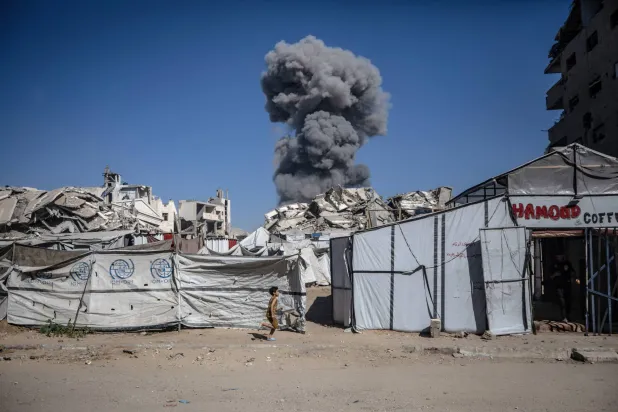
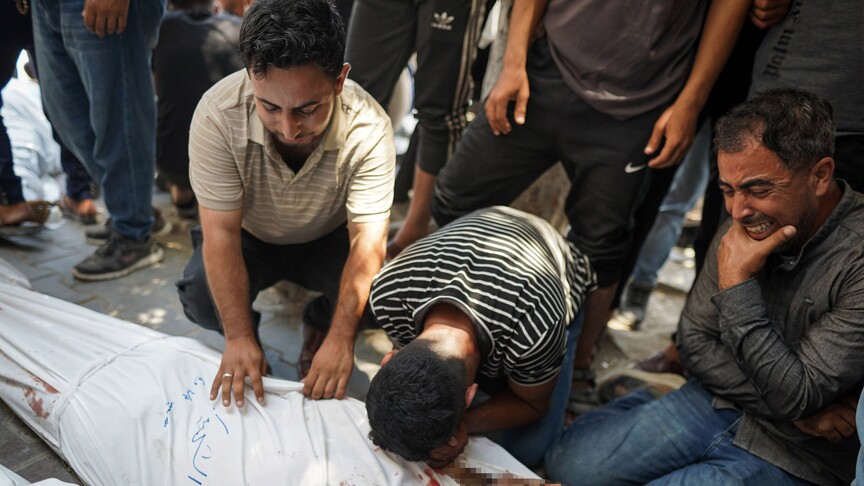
Three Palestinians were killed and others injured this morning in an Israeli strike on Gaza City.
War impacts Gaza's heritage... Volunteers race against time to save it
With a paintbrush, a young woman wearing surgical gloves carefully removes dust and impurities from a stone mosaic piece inside a tent in southern Gaza, as part of volunteers' efforts to preserve cultural heritage affected by the Israeli war.
According to a report published by Agence France-Presse, more than 160 historical and cultural sites have been damaged during the Israeli war on the Gaza Strip, according to the United Nations. Many of these archaeological sites date back thousands of years.
Visual artist Muhammad Abu Lahya, a volunteer in a heritage preservation campaign, says the war has led to 'the loss of many paintings and mosaics, which were either completely or partially destroyed.'
He adds: 'It is important to revive this art, remind our children and community of it, and send a message to the world that we are attached to our heritage and our Palestinian cause.'
He continues: 'We focus on mosaics and cultural heritage. We started our journey by rescuing and preserving artworks and heritage pieces inherited from our ancestors through the historical periods that Palestine has witnessed.'
Losses were not limited to archaeological treasures; contemporary pieces are also threatened by artillery shelling and Israeli airstrikes.
More than 90 percent of buildings in the Gaza Strip have suffered partial damage or total destruction during the war, according to the United Nations.
Gaza was distinguished by a rich historical heritage dating back centuries, as Persians, Greeks, Romans, Byzantines, and Ottomans left their mark, from ports and churches to mosques and archaeological artifacts.
Volunteers collect archaeological pieces, document them, and store them on wooden shelves in plastic containers inside a tent set up in Khan Younis in the southern Gaza Strip.
Inside the tent, Muhannad Abu Lahya, a cultural heritage guide at the Miasma Association for Culture and Arts, a non-governmental organization leading heritage preservation efforts, points to a stone piece and says: 'This stone is called a jurn, used for grinding grains and herbs, and it is about 5,000 years old.'
Preserving the past for the future
At one table, three women are arranging hundreds of small pieces to recreate a contemporary mosaic painting, using a printed image of the original, while removing stone excess using carpenter's pliers.
Volunteers insist on working to preserve their heritage despite lacking professional equipment for antiquities preservation under the strict restrictions imposed by Israel on the entry of goods into the Gaza Strip.
Volunteers use ordinary paintbrushes and a primitive scanner consisting of a camera mounted above a box lined with black paper.
This device enables digitizing images and old paper documents before uploading them to a computer for archival preservation.
Many of these images date back to the late Ottoman era, the British Mandate, and the Egyptian administration.
Taghreed Hijazi (29), a volunteer in the archive department, told Agence France-Presse while showing some of her documents: 'These are structural maps of Khan Younis from the British Mandate period. We have newspapers and documents from the British Mandate and the Egyptian era,' adding: 'We are working to preserve them from loss and damage.'
Volunteers say many artifacts remain out of reach, lying beyond the so-called 'yellow line' separating areas controlled by Hamas from those under Israeli army control.
Israel says it now controls more than 60 percent of the Gaza Strip, compared to about half the territory when the ceasefire took effect last October.
But despite the volunteers' awareness of the difficulty of recovering these pieces, Hijazi affirms that 'efforts are ongoing to preserve everything still within reach.'
Original source: Asharq Al-Awsat


Comments (0)
Be the first to comment.