Thought He Was Killed.. Gaza Family Embraces Son After Year as Prisoner
GAZA/ Ramzi Mahmoud / AA
** Freed prisoner Hamada al-Bana:
- All I wished for during my detention in Israel was to reassure my family that I was still alive
- I saw in prison kinds of psychological and physical torture that words cannot describe
** Hamada's father, Yasser al-Bana:
- We held a funeral tent for him after we could not find any trace of him
- Even his fiancée sold her gold jewelry searching for any information about him
** Hamada's mother, Widad al-Bana:
- A strange feeling overcame me on the night of his release, and I did not sleep until dawn
- I fainted when I heard his voice, then lost consciousness when I hugged him
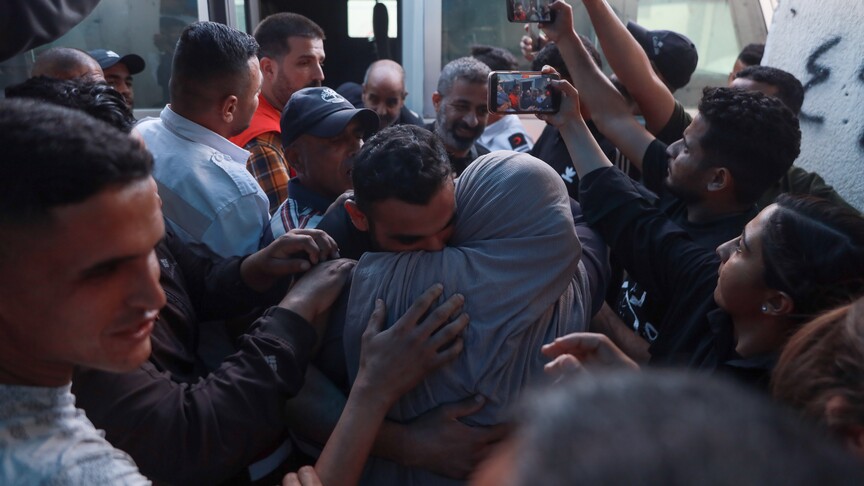
After a year of his family believing he was killed by Israeli army fire, the young Palestinian Hamada al-Bana returned to his home in Jabalia town in the Gaza Strip, turning the mourning ceremony his family had held into an extraordinary joy, after it became clear he had been detained in Israeli prisons all that time.
Inside the house cracked by Israeli shelling, tears of joy flowed, and the family embraced their son who returned unexpectedly, after having lost hope of seeing him again.
The family believed that Hamada (23) was killed alongside his brother Adham by Israeli army fire, while they were heading to get food aid during the peak of the famine that struck the Gaza Strip in the summer of 2025.
On Monday, Israeli authorities released Hamada, along with 16 other Palestinians, and the International Committee of the Red Cross transferred them to Al-Aqsa Martyrs Hospital in the city of Deir al-Balah in the central Strip, before he returned to his family in the northern Gaza Strip.
His mother Widad could not control herself when she heard his voice for the first time on the phone after his release; she fainted from the shock, and the scene repeated hours later when she hugged her returning son.
An AA correspondent documented the family's reception of their son, in a story that embodies a part of the suffering of hundreds of Palestinian families who do not know the fate of their children since the start of the genocide committed by Israel since October 8, 2023.
** The search for a livelihood
Hamada recounts that his journey began in August 2025, when he and his brother Adham headed to the aid distribution point in the "Zikim" area north of the Strip, due to the famine that pushed thousands of Palestinians to risk their lives to obtain food.
He told AA: "I got separated from my brother in the crowd, and after I managed to get a bag of flour with great difficulty, someone told me that Adham had been martyred, so I went back to look for him."
During that period, aid distribution points witnessed repeated shooting incidents at gatherings of civilians waiting for aid, resulting in thousands of deaths and injuries.
This sparked human rights accusations against Israel of targeting aid seekers and turning aid distribution centers into extremely dangerous areas.
During his return, Hamada was injured in an Israeli shelling and lost consciousness, before waking up inside an Israeli hospital, where he underwent treatment for several months for injuries to his feet, hand, and other parts of his body.
After his treatment ended, he was transferred to the "Sde Teiman" prison, affiliated with the Israeli army, where he spent nearly a year without being able to contact his family or a lawyer, according to his account.
He says: "I saw there kinds of psychological and physical torture that words cannot describe, then I was transferred to solitary confinement for about two and a half months, during which I could not meet anyone or a lawyer to check on my condition and reassure my family."
Al-Bana added: "My family knew nothing about me throughout my detention, so they thought I had been killed with my brother, and I was not charged with anything. All I wanted was to reassure them that I was still alive."
He describes his first call to his family after being informed of his release, saying: "I told my father: Yes, Dad.. I am Hamada. He did not believe me at first and hung up, then he called back to confirm my voice and burst into tears."
The Sde Teiman prison witnesses widespread violations against Palestinian prisoners, including severe beatings, long periods of restraint, and medical negligence, causing deaths, according to Palestinian and Israeli press and human rights reports.
Sde Teiman means in Arabic "Field of Yemen," and it is an Israeli military base in the Negev desert in southern Israel, whose interrogators became notorious for physical and sexual abuse of Palestinian prisoners from Gaza, earning it the nickname "Israel's Guantanamo," referring to the infamous US detention camp.
** Father's shock and futile efforts
His father Yasser al-Bana recalls the moment he received the call and told AA: "We thought Hamada had been killed and we held a funeral tent for him. We searched for him everywhere, even with the International Committee of the Red Cross, but we found no information about him."
He says the family spared no effort in searching for him, even his fiancée sold her gold jewelry to help cover the cost of hiring a lawyer hoping to obtain any information about him.
He added: "But we were told there was no data about him in the occupation's prisoner lists, which reinforced our belief that he had been killed."
Al-Bana continues: "Even now I can hardly believe he is sitting in front of me. A full year of waiting ended with a phone call that brought life back to us."
** Hope after despair
His mother Widad says: "When I heard his voice on the phone, I fainted from the shock, then I lost consciousness again when I hugged him after his arrival. I ask God to reassure the heart of every mother who does not know the fate of her son."
She adds: "I had lost hope of seeing my son again, but a strange feeling overcame me on the night of his release, and I could not sleep until dawn as I prayed for him, without knowing he was still alive."
As the family tries to make up for lost time, they are preparing to hold Hamada's wedding to his fiancée, who remained committed to waiting for him for a whole year.
** An open wound
Hamada's story is not an isolated case; the Palestinian Center for the Missing and Forcibly Disappeared says hundreds of Palestinian families believe their children were killed during the war, while they are held in Israeli prisons.
The center (non-governmental) said in a statement on Tuesday that Hamada's story "reveals a systematic crime of enforced disappearance committed by Israel against civilians in Gaza, constituting a flagrant violation of international humanitarian law."
Meanwhile, the Independent Commission for Human Rights says Israel pursues a policy of enforced disappearance through mass arrests and holding Palestinians in secret locations, often without charges or allowing lawyers and human rights organizations to visit them.
The commission, a Palestinian non-governmental human rights organization, mentions in a previous report that it received around 1,067 official reports of cases of missing persons or enforced disappearances in the Gaza Strip from October 2023 to the end of April 2025.
It says Israel cites amendments to what is known as the "Unlawful Combatant Law" to justify open-ended detentions, "which has led to legalizing enforced disappearance and depriving detainees of any form of legal protection."
Around 9,500 Palestinian prisoners are held in Israeli prisons, including children and women, suffering harsh conditions including starvation, torture, and medical neglect, which have led to the deaths of dozens of them, according to Palestinian and Israeli human rights reports.
Original source: Anadolu Agency


Comments (0)
Be the first to comment.