First is ending occupation.. Aoun sets 3 conditions for disarming Hezbollah
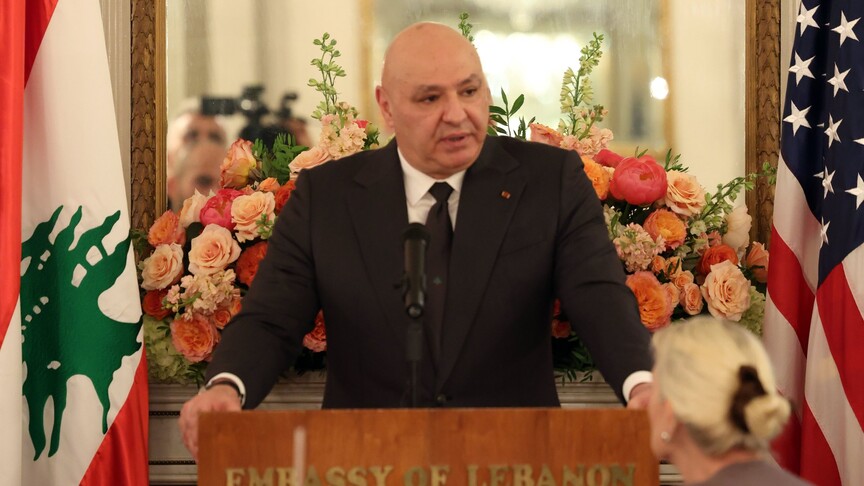
The Lebanese president linked the issue to ending Israeli occupation, full army control, and reconstruction managed solely by the state
Istanbul / Anadolu
Lebanese President Joseph Aoun set three requirements for the possibility of disarming Hezbollah, the first of which is ending the Israeli occupation of areas in southern Lebanon.
This came during a dinner hosted by Beirut's Ambassador to Washington, Nada Hamadeh Maawad, in honor of President Aoun and the accompanying delegation, attended by members of Congress and US administration officials, according to a statement from the Lebanese presidency on Wednesday.
The dinner was held on Tuesday evening, the last day of the official visit to Washington, during which Aoun met with US President Donald Trump.
Aoun linked the disarmament of Hezbollah to 'ending the (Israeli) occupation, the Lebanese army assuming full control, and a reconstruction program managed solely by the state.'
Addressing the audience, he said: 'Let me directly address the question I know is on everyone's mind tonight: Is the disarmament of Hezbollah actually achievable?'
He answered: 'Yes, but only if we are honest about what it truly requires.'
He added: 'The armed group we are talking about (Hezbollah) is not a foreign mercenary force. It is comprised of Lebanese citizens who, over forty years, have been shaped by a massive and ongoing investment on ideological, social, and military levels, turning them into a non-state armed group operating outside government control.'
He continued: 'This reality does not make the goal less urgent; it makes the approach more important.'
Speaking about resistance movements, Aoun added: 'History offers us a proven path, from the Revolutionary Armed Forces in Colombia to the Irish Republican Army in Northern Ireland.'
He added that this path 'is not a mystery: disarmament, demobilization, and reintegration. It begins with removing the root cause that Hezbollah has long cited as justification for its existence: Israeli occupation of Lebanese territory.'
The Lebanese government is implementing a program to restrict weapons, including Hezbollah's, to the state, but the party clings to its weapons, emphasizing that it is a 'resistance movement against the Israeli occupation.'
Israel occupies areas in southern Lebanon, some for decades, others since the previous war between 2023 and 2024, while it has advanced more than 10 kilometers during the current aggression.
Since March 2, Israel has been waging aggression on Lebanon, resulting in 4,328 deaths and 12,230 injuries, in addition to more than one million displaced, according to the Lebanese Ministry of Health.
Aoun continued: 'It continues with the Lebanese army assuming full and exclusive control, which requires immediate and unconditional support for our military, the only legitimate defender of this country.'
He considered that the matter 'ends with reintegration: a reconstruction program managed by the Lebanese state alone, coupled with real economic opportunities, so that weapons are no longer the only option.'
** The Strong State
Aoun went on: 'The equation is simple: a political path without an economic path leads to a state that cannot compete. The strong state is the only alternative to a vacuum; if the state does not fill it, others will take that responsibility.'
He stressed that 'at every stage of this path, the Lebanese state must be the one to extend its authority over its land, control its borders, and monopolize the decision of war and peace on its territory.'
Addressing the audience, he said: 'This is the path I have chosen, and it is the path I came to Washington to ask you to walk with us.'
He added that 'the United States under President Trump's leadership, and through the tripartite framework his administration mediated between Lebanon and Israel last June, we now have the most serious American commitment to Lebanon's stability in decades.'
On Tuesday, the Israeli army withdrew from the town of Zoutar al-Gharbiyeh in the Nabatieh district of southern Lebanon, allowing the Lebanese army to deploy as the beginning of implementing what is known as the experimental zones, stipulated in the 'Framework Formula' agreement.
This agreement did not set a timeline for the Israeli withdrawal, linking it to the Lebanese army assuming full security responsibility in the areas from which it withdraws and disarming armed groups, especially Hezbollah.
While Lebanese officials considered the agreement a 'first step' toward restoring state sovereignty over its entire territory, Hezbollah deemed it 'nonexistent' and 'humiliating,' and considered linking the withdrawal to its disarmament a 'crossing of red lines.'
Aoun said that 'this framework was not reached by chance; it happened because your administration pushed for it, and because Lebanon came ready to turn it into reality.'
He said that 'rarely does internal will, regional support, and American leadership intersect at the same moment,' adding: 'Tonight, they intersect.'
He stressed that 'Lebanon cannot be safe or united unless it is one state with one army protecting all Lebanese without discrimination.'
He considered that 'the Lebanese model deserves protection, not only for Lebanon itself, but for the region, because it is based on the same foundation upon which you built your nation,' referring to the United States.
Original source: Anadolu Agency


Comments (0)
Be the first to comment.