Aoun: Disarming Hezbollah Requires Israeli Withdrawal from Lebanon

Lebanese President Joseph Aoun stressed that disarming Hezbollah is possible if we are honest about what it actually requires, namely removing the Israeli occupation.
Lebanese President Joseph Aoun affirmed that disarming Hezbollah is possible if we are honest about what it actually requires, namely removing the Israeli occupation, the Lebanese army assuming full control, and a reconstruction program managed by the state alone.
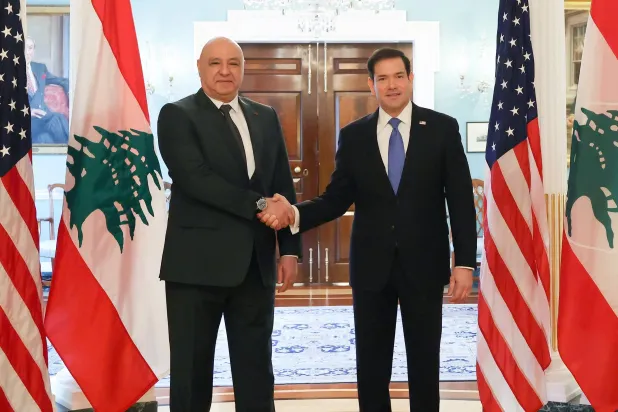
On the last day of his official visit to the United States, he said: 'Let me address directly the question I know is on everyone's mind tonight: Is the disarmament of Hezbollah actually achievable? Yes, but only if we are honest about what it actually requires.' He continued: 'It begins with removing the root cause that Hezbollah has long cited as a justification for its existence, the Israeli occupation of Lebanese territory. It continues with the Lebanese army assuming full and exclusive operational control, which requires immediate and unconditional support for our military forces, the sole legitimate defender of this country, and it ends with reintegration: a reconstruction program managed by the Lebanese state alone, coupled with real economic opportunities, so that arms are no longer the only option, but rather a choice between arms and an effective state that fulfills its promises.'
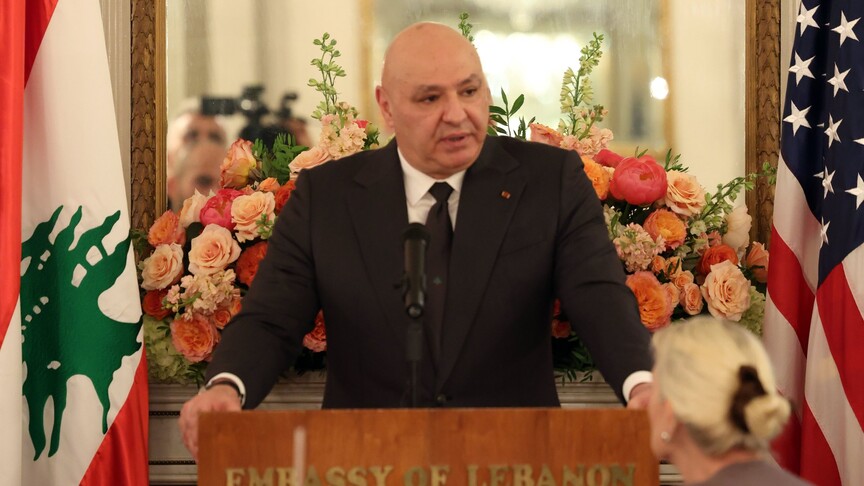
Ambassador Hamada Mouawad hosted a dinner in honor of President Aoun and the accompanying Lebanese delegation, attended by a number of members of Congress and officials in the US administration. - The President of the Republic: Lebanon cannot be secure nor unified unless it is one state with one army that protects all Lebanese without discrimination. - President Aoun:... pic.twitter.com/cqWfi82mZl
— Lebanese Presidency (@LBpresidency) July 22, 2026
Political and economic path
He pointed out that 'the armed group we are talking about is not a foreign mercenary force; it consists of Lebanese citizens who, over forty years, have been shaped by a massive and ongoing investment on ideological, social, and military levels to turn them into a non-state armed group operating outside government control. This reality does not make the goal less urgent, but rather makes the approach more important.'
Aoun considered that 'the equation is simple: a political path without an economic path is a state that cannot compete. A strong state is the only alternative to a vacuum, and if the state does not fill it, others will take on that responsibility.' He said: 'At every stage of this path, the Lebanese state must be the one that extends its authority over its land, controls its borders, and alone monopolizes the decision of war and peace on its territory. This is the path I have chosen, and it is the path I came to Washington to ask you to take with us.'
One army
Aoun announced that 'Lebanon cannot be secure, nor can it be united, unless it is one state with one army, protecting all Lebanese without discrimination.' He said: 'This conviction is not a slogan for me; it is the mission of my presidency, and through it I bear the responsibility of ending this war, helping those families return to their homes, rebuilding their communities, looking to the future with hope, permanently ending the state of hostility with Israel, and consolidating the sovereignty of the Lebanese state.' Regarding relations with Syria, Aoun said: 'We are building a relationship with Damascus on the basis of what it should always have been: a state-to-state relationship, exclusive, based on mutual respect, sovereignty, and non-interference in internal affairs.' He added: 'For nearly fifty years, Lebanon has been a battlefield for the conflicts and interests of others: Palestinian, Syrian, Israeli, Iranian, and yes, sometimes our own conflicts. But something new is happening today,' adding: 'Since assuming power, the state has worked decisively towards one goal: one state, one army, and an end to illegal armed groups operating outside the state framework.' He said: 'Lebanon has always been known as a battlefield for the wars of others. I want the next generation to remember Lebanon not as a place where wars never ended, but as a place where peace finally prevailed.'
Hezbollah's rejection
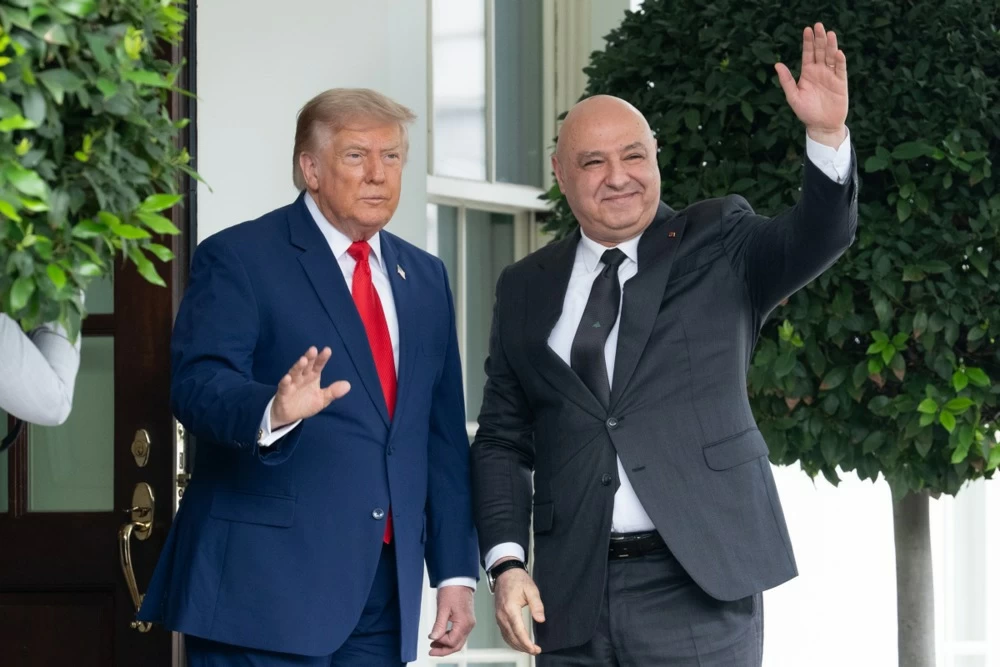
The meeting of the Lebanese president with US President Donald Trump at the White House on Tuesday was met with broad Lebanese welcome, in contrast to condemnation from Hezbollah. Hezbollah MP Hussein al-Hajj Hassan said: 'What happened in Washington during the meeting did not exceed general American talk and promises without guarantees, without specifying any timeline for redeployment, and without any progress or achievements.'
Al-Hajj Hassan explained in a radio interview that 'the US president's invitation for the Syrian side to intervene in Lebanon constitutes a violation of Lebanese sovereignty, without any comment from the Lebanese president or from those claiming sovereignty in Lebanon.' He also rejected any communication between Hezbollah and the US administration. He said: 'No talk with those who attack us, destroy our lands and homes, and kill our people.'
Original source: Asharq Al-Awsat


Comments (0)
Be the first to comment.