War of Narratives Between Inside and Outside... Who Protects Lebanon?
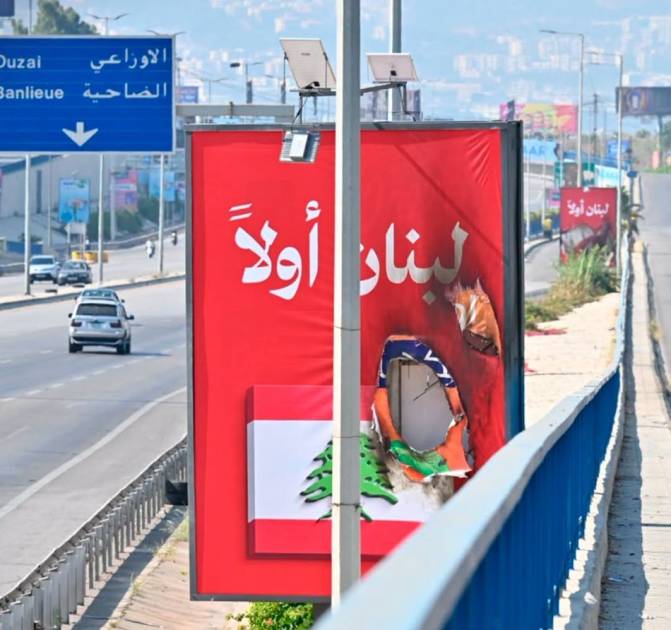
Summary: A person may reject a tank on his land, but he may listen to an idea that enters his phone every day, and he may reject an official discourse in his own language, while being influenced by his opponent's discourse if it seems closer and more realistic. Therefore, the most dangerous transformations of the era are not only the penetration of geographical borders, but the penetration of psychological borders. Language has become soft power, algorithms have become spheres of influence, and influence has sometimes become more important than control.
In the midst of a Lebanese scene clouded by political and security tensions, statements by Israeli Prime Minister Benjamin Netanyahu on one hand, and Iranian Parliament Speaker Mohammad Bagher Ghalibaf on the other, deepen internal divisions among Lebanese, through two contradictory discourses competing to address their fears and concerns.
Netanyahu had indicated that some Christian villages in Lebanon "have already asked to join Israel because we protect them from Hezbollah extremists who want to kill them," and that requests for protection "are not limited to Christians, but also include Druze, Sunni Muslims, and a considerable number of Shia Muslims."
Municipalities, mukhtars, and activists of border Christian villages in southern Lebanon denied the content of the statements in a statement, describing the information as "fabricated and having no relation to reality." The statement added that "these villages have been keen, since the outbreak of the war, to coordinate with the Lebanese authorities, spiritual references, and international parties, with the aim of keeping humanitarian corridors open, ensuring continued communication with the Lebanese interior and state institutions and its legitimate bodies."
For his part, Ghalibaf had stated that "avenging our blood requires returning the Shia of southern Lebanon to their lands," and that "those who fought for Iran must return to their places." He continued, "Lebanon has provided 4,000 'martyrs' for Islamic Iran," noting that this number exceeds the total fallen in the recent war on Iran, and that the fighters in Lebanon "fought for 104 days, while we fought for 38 days."
During a phone call made by Ghalibaf with his Lebanese counterpart Nabih Berri, he said that ending the war and preserving Lebanon's sovereignty is an essential part of the first clause of the memorandum of understanding between the United States and Iran, stressing that "ending the war in Lebanon, the return of the displaced, and Israel's withdrawal from southern Lebanon is a goal for Iran, which is following up on it seriously."
Between the narrative of 'protection from Israel' and the narrative of 'protection from Hezbollah,' Lebanon finds itself once again an arena for a conflict of narratives before the conflict on the borders.
Here a question arises: How does the 'enemy' think it can penetrate the popular conscience through narratives designed to reshape collective memory and alter the image of the conflict? And how can a discourse emanating from beyond the borders present itself as protection or salvation, while in essence it remains an extension of political and strategic calculations that primarily serve the interests of those who launch it?
Whoever allows the outside to address the fear of the Lebanese, later allows it to confiscate their decision (AFP)
The battle of the narrative is the most dangerous
Accordingly, the battle does not begin when the opponent or enemy tries to penetrate and occupy the land; rather, the most dangerous is when it tries to penetrate the collective consciousness, and when it seeks to turn fear into a gateway of influence, and internal crises into an opportunity to redefine itself within a society that has long viewed it from a position of enmity or hostility.
Modern wars are no longer measured only by the extent of military control or the ability to impose field facts, but also by the ability to penetrate societies and reshape their view of the conflict. Before countries try to change maps, they try to change convictions, and before they gain land, they seek to win the narrative.
Many examples in history show that the battle of the narrative often preceded or accompanied the battle on the ground, and before military interventions, major powers always tried to build a narrative justifying their presence. During the Cold War, the conflict between the United States and the Soviet Union was not just a missile conflict, but a conflict of two narratives: one speaking about the 'free world' and the other about 'confronting imperialism,' and the goal was to win peoples before winning governments.
Before Iran expanded its regional influence, it did not present its project as geopolitical influence, but through the narrative of 'supporting the oppressed' and 'protecting the resistance.' Thus, political and military influence in some arenas turned into an emotional discourse tied to identity and threat.
After the attacks of September 11, 2001, the United States did not enter Afghanistan and Iraq with a discourse of force alone, but with the narrative of the 'war on terror' and 'spreading democracy,' i.e., an attempt to give the military intervention an ethical and political framework that goes beyond the idea of strategic interest.
Before the Ukraine war, Russia used the discourse of 'protecting Russian speakers' and the existence of historical and cultural ties with Ukrainian regions, in an attempt to present the conflict not just as a military move, but as a responsibility towards groups it considers linked to it.
Even Israel, in its discourse towards some communities in the region, has been trying for years to move from the image of the 'enemy' to the image of the 'partner against a common threat,' i.e., changing the definition of the conflict before changing the political reality.
Hence, major powers do not ask, 'How do we control a space?' Rather, 'How do we make part of the people accept the idea of our existence and role?' And later loyalty to us, because whoever loses the narrative becomes more vulnerable to losing the decision.
The shift from addressing the Lebanese state to addressing the Lebanese directly
Thus, a notable phenomenon on the Lebanese scene can be understood: the shift of competing regional powers from addressing the Lebanese state to addressing the Lebanese directly. Messages no longer pass exclusively through diplomatic channels, but have begun to address groups, environments, identities, and internal fears.
When Iranian officials say they defend Lebanon and preserve its security in the face of Israel, the discourse aims not only to confirm the alliance with Hezbollah, but to build a deeper narrative that Iran's role in Lebanon is not external influence, but 'protection' and an extension of an existential battle. Here, foreign policy turns into an emotional relationship with a specific audience, where loyalty becomes linked to fear and the need for security.
In contrast, when Netanyahu addresses the Lebanese interior speaking about protecting Lebanese groups from Hezbollah, or when he raises the idea that there are Lebanese who view Israel as a party capable of protecting them, he too is not only waging a military battle, but a battle for consciousness, trying to dismantle the image of the 'absolute enemy' and replace it with a different image, namely that 'Israel is not your problem; the problem lies in those who confiscated your decision.'
The fear is not only of losing land, but of losing the narrative. The Israeli flag and the flag of the Golani Brigade are raised above Shaqif Castle in southern Lebanon (AFP)
Original source: Independent Arabia




Comments (0)
Be the first to comment.