Yemeni Prisoner Swap Delayed Amid Mutual Blame for Stalling
The implementation of a prisoner exchange deal involving more than 1,700 detainees between the Yemeni government and Houthis has been postponed, with both sides trading accusations over the delay. No comment has yet been made by the United Nations or the International Committee of the Red Cross.
Hopes for thousands of Yemeni families awaiting the reunion with their loved ones were dashed after the postponement of a prisoner and detainee exchange deal between the Yemeni government and the Houthi group, which was set to be the largest such operation in years, involving more than 1,700 detainees and prisoners from both sides.
As the two sides exchanged accusations over responsibility for the stalling, no immediate comment was issued by the International Committee of the Red Cross or the office of the UN envoy to Yemen explaining the reasons for the delay or setting a new date for implementation.
The postponement came after months of negotiations under UN auspices and facilitated by the International Committee of the Red Cross, based on understandings that began in Muscat late last year, then continued in Riyadh and later in the Jordanian capital Amman, where in May the two sides reached an agreement described as the biggest humanitarian breakthrough in the file of detainees and prisoners in years.
The Yemeni government blamed the Houthi group for obstructing the implementation of the agreement. The head of the government negotiating team on prisoners and abductees, Hadi Haij, said the government team received a notification from the International Committee of the Red Cross and the office of the UN envoy stating that the Houthis had refused to implement the deal on its scheduled date and postponed it indefinitely.
Head of the Yemeni government delegation shakes hands with head of the Houthi delegation after the prisoner exchange agreement in Amman (Reuters)
Haij explained that the government team had completed all technical and administrative procedures for implementing the agreement, including arrangements for releasing and transporting detainees, considering that the obstacles that appeared at the last moment came from the Houthi side.
The government official accused the group of exploiting the file of prisoners and abductees for political and military purposes, and said that postponing the implementation of the deal reflects the continued use of this humanitarian file as a means of extortion and disregard for the suffering of thousands of families who were awaiting the return of their loved ones after years of detention.
The government considered that the stalling of the agreement represents a new setback for humanitarian efforts aimed at alleviating the effects of the war, especially since the exchange process enjoyed broad regional and international support and was seen as a step that could open the door for confidence-building measures between the conflict parties.
Houthi Denial
In response, the Houthi group rejected the government accusations and blamed the government side for the delay.
The head of the group's prisoner affairs committee, Abdul Qader al-Murtada, said that the Houthi prisoner committee had completed all required commitments and was ready to implement the agreement according to the specified timetable, but the other side, as he put it, did not fulfill its obligations.
He added that the dispute revolved around finalizing prisoner lists, accusing the government of refusing to add other names that the group demanded to be included in the deal, which, according to his claim, led to the stalling of implementation.
Previous Yemeni meeting in Amman under UN auspices on prisoners and detainees (United Nations)
Al-Murtada affirmed that his group informed the United Nations and the International Committee of the Red Cross of its readiness to implement the agreement as soon as the other side complies with all agreed terms, accusing the government of trying to mislead public opinion by ignoring the points he said are an essential part of the agreement.
Amid the conflicting narratives, the United Nations and the International Committee of the Red Cross have so far remained silent, issuing no statement to clarify the reasons for the stalling of the agreement's implementation or to assign responsibility for the delay, leaving the fate of the deal unclear despite months of negotiations.
Talk of August
While the government spoke of an indefinite postponement, Yemeni sources circulated information about rescheduling the implementation of the deal during the coming month of August, after completing technical arrangements related to the lists of detainees and flights for the exchange process.
According to these sources, the new proposal stipulates implementing the exchange process over three days, including flights between Aden and Sanaa, Sanaa and Saudi Arabia, Sanaa and Marib, in addition to flights between Sanaa and the west coast. However, this information has not been officially confirmed by the United Nations or the International Committee of the Red Cross.
The agreement announced in May stipulated the release of more than 1,700 detainees from both sides, including seven Saudis and twenty Sudanese, along with the formation of a joint committee to verify the fate of Yemeni politician Mohammed Qahtan, whose death was recently acknowledged by the Houthis, who handed over parts of his body amid doubts from his family.
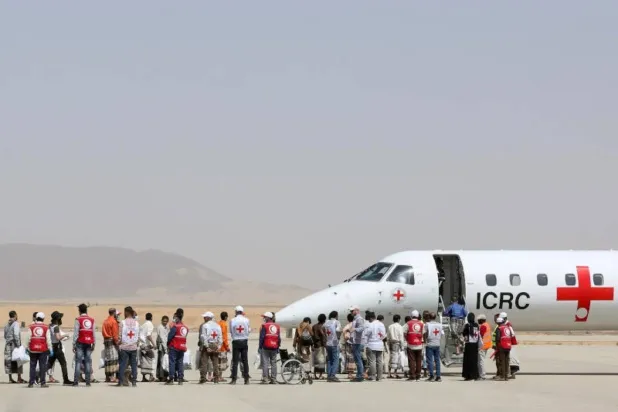
A plane of the International Committee of the Red Cross (X)
The agreement is an extension of efforts that began according to the principle of "all for all" stipulated in the Stockholm Agreement at the end of 2018, but the implementation of this principle has faced repeated obstacles due to disagreements over lists and implementation mechanisms.
Although two previous rounds succeeded in releasing more than 1,900 detainees and prisoners, observers believe that the stalling of the implementation of the new deal reflects the continued lack of trust between the two sides and confirms that humanitarian files remain hostage to political and military differences, despite efforts by the United Nations and regional mediators to push them toward implementation.
Analysts fear that continued postponement could undermine the momentum achieved in recent months, especially as the deal represented one of the most prominent confidence-building steps between the Yemeni government and the Houthi group, and its success would have given additional impetus to efforts to revive the stalled political process, as well as ending the suffering of hundreds of families still awaiting the return of their loved ones after years of detention.
Read also
Original source: Asharq Al-Awsat




Comments (0)
Be the first to comment.