Disappearance of Egyptian Wanted Man in Libya... Conflicting Accounts of His Fate
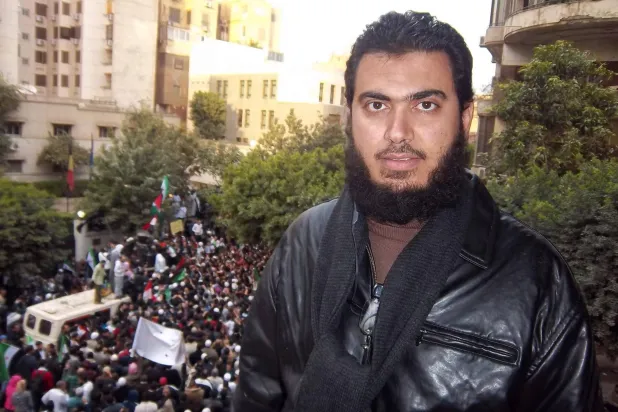
Mystery surrounds the fate of Egyptian wanted man Mahmoud Fathy, who is on 'terror lists' and sentenced to death in the case of the assassination of former Egyptian Attorney General Hisham Barakat.
Mystery surrounds the fate of Egyptian wanted man Mahmoud Fathy, who is on 'terror lists' and sentenced to death in the case of the assassination of former Egyptian Attorney General Hisham Barakat, following media reports and matching testimonies about his 'disappearance' with his wife in the Libyan capital Tripoli since last Sunday.
Authorities in western Libya have not commented on the incident, which has been widely circulated by Libyan and Egyptian media over the past 48 hours, along with rights centers close to the banned Muslim Brotherhood group.
Asharq Al-Awsat reached out to a source in the Government of National Unity in Tripoli, but was unable to obtain a comment.
An Egyptian Foreign Ministry official referred the matter to security agencies, saying in response to Asharq Al-Awsat's question: 'Such cases fall outside the ministry's jurisdiction and are handled by security agencies.'
Former Egyptian Attorney General Hisham Barakat (Getty)
Egyptian Senate member and Brotherhood affairs expert Tharwat al-Kherbawi suggested the hypothesis that Fathy was arrested by Libyan authorities and will be handed over to Egyptian authorities soon to implement judicial rulings issued against him.
Al-Kherbawi told Asharq Al-Awsat: 'This is the most likely scenario within the framework of judicial cooperation and enforcement of rulings agreements between Egypt and Libya.'
In contrast, another account emerged from Egyptian researcher on Islamist groups Maher Farghaly, who said that Fathy, who frequently visits Libya due to owning a contracting company, was 'kidnapped with his wife by masked gunmen,' considering that claims of Egyptian involvement in the incident are 'untrue,' and noting that 'the wife was later released through Turkish mediation.'
Farghaly suggested in a post on his official Facebook page that the incident 'is linked to a financial dispute with a Syrian businessman,' whom he said 'lured Fathy to Libya before his kidnapping with the help of influential Libyan figures,' without providing official evidence to support this account.
The so-called 'Shihab Center for Human Rights,' close to the Brotherhood, stated that Libyan authorities detained Fathy, who holds Turkish citizenship, and his Egyptian-Turkish wife, on July 19 of this year, from their residence at the Al-Tawfiq Hotel in the Dahra area of Tripoli, before Libyan official bodies denied they were in custody, expressing fears they were subjected to 'enforced disappearance.'
Palestinian journalist Nizam al-Mahdawi, close to the Muslim Brotherhood, said his last contact with Fathy was about two weeks ago, adding in a post on platform X: 'He tried to contact him after news of his disappearance in Libya spread, but received no response.'
A hotel in the Libyan capital Tripoli where Egyptian and Libyan media say Fathy was arrested (official page of Al-Tawfiq Al-Dahra Hotel in the capital)
The name of Mahmoud Fathy, an Egyptian lawyer, emerged after the January 25, 2011 revolution in Egypt and was linked to the 'Hazemoon' movement affiliated with detained preacher and politician Hazem Salah Abu Ismail. Fathy left Egypt after the ouster of late President Mohamed Morsi in 2013, before settling abroad, with reports circulating that he later obtained Turkish citizenship.
Egyptian authorities list Fathy on terror lists under judicial rulings and decisions, and he was sentenced to death in the case of the assassination of former Egyptian Attorney General Hisham Barakat, who was killed in a bombing targeting his convoy in Cairo in June 2015. He is among those wanted by Egyptian authorities in terrorism-related cases.
During his stay abroad, Fathy appeared on opposition media platforms and online accounts, while Egyptian authorities say he continued activity linked to the Muslim Brotherhood, designated a terrorist organization in Egypt.
A Common Priority
Al-Kherbawi believes that if the hypothesis of Fathy's arrest and handover to Cairo is correct, it would represent an important development in pursuing Egyptian fugitives accused in terrorism cases. Al-Kherbawi told Asharq Al-Awsat: 'The chances of handing over Fathy to Egypt seem realistic, especially given the security and judicial cooperation frameworks linking the two countries, and the common priority that terrorism cases represent, surpassing traditional political considerations.'
Previously, on May 29, 2019, the Libyan National Army handed over Egyptian wanted man Hisham Ashmawy to Egyptian authorities, about seven months after his arrest in the city of Derna during a military operation, as part of security cooperation between the two sides.
Ashmawy after his arrest in Libya (AFP)
In June of this year, the head of Egypt's General Intelligence Service, Major General Hassan Rashad, visited Tripoli, where he met with the head of the Government of National Unity, Abdul Hamid Dbeibeh, and a number of officials, and discussed with them supporting the political settlement, unifying Libyan institutions, and enhancing security coordination between Cairo and Tripoli.
Original source: Asharq Al-Awsat





Comments (0)
Be the first to comment.