Between De-escalation and Escalation: Key Milestones in Saudi-Houthi Relations
Between De-escalation and Escalation: Key Milestones in Saudi-Houthi Relations
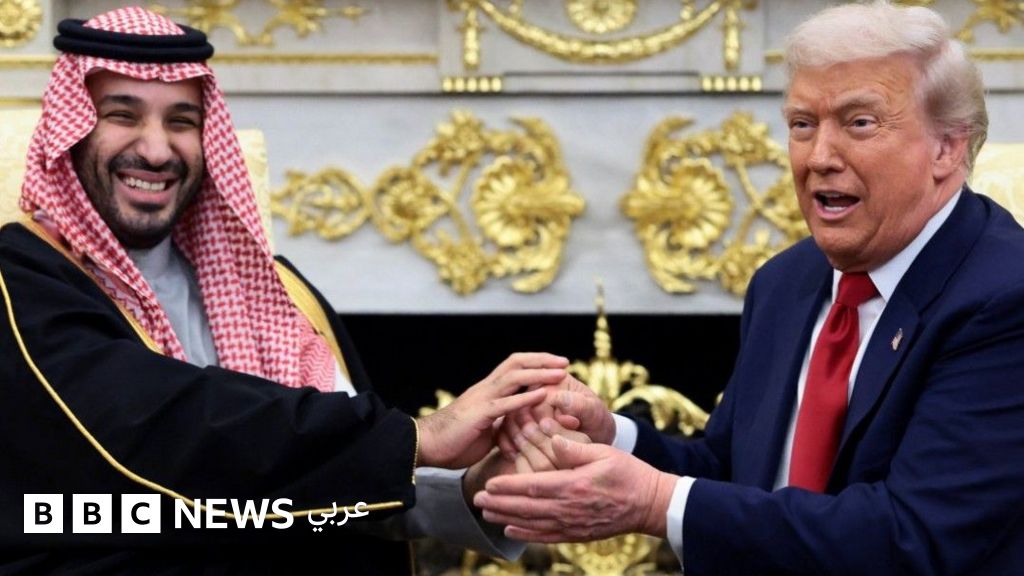
Image caption, Saudi Crown Prince on a visit to the White House in November 2025
Article Information
Author, Nisreen Hatoum Role, BBC Gulf Affairs Correspondent
Published 14 minutes ago
Reading time: 6 minutes
Axios reported that Saudi Crown Prince Mohammed bin Salman sought support from US President Donald Trump for a possible military operation against the Houthis, amid suspicions of an Iranian plane attempting to smuggle weapons and military experts to the group via Sanaa airport.
These developments come in light of the fragile undeclared truce between the two sides that began in 2022.
According to the report, the airport was bombed, and the Houthis retaliated by bombing Saudi Arabia's Abha airport, the first attack they have announced against the kingdom since the start of the undeclared truce in 2022.
These developments have raised questions again about the future of the ceasefire and the possibility of the situation deteriorating once more.
Who are the Houthis?
The roots of the Ansar Allah Houthi movement go back to Saada Governorate in northern Yemen. It was founded by Hussein Badreddin al-Houthi, son of the scholar Badreddin al-Houthi, one of the most prominent Zaydi religious authorities in Yemen. During the 1970s and 1980s, Badreddin al-Houthi emerged as one of the opponents of Salafi thought, facing what the Houthis then described as the spread of "Saudi Wahhabi proselytizing" in Yemen, which according to their narrative led to him being subjected to political harassment.
The movement was initially founded in the early 1990s, when Hussein Badreddin al-Houthi entered political life by contributing with others to establish the opposition "Al-Haq Party", which included political and religious figures. Hussein al-Houthi won a parliamentary seat for the party in Saada Governorate in the 1993 elections.
First direct military confrontation between the Houthis and Saudi Arabia
The "Operation Decisive Storm" launched in 2015 was not the first military confrontation between Saudi Arabia and the Houthis.
On November 5, 2009, elements of the movement infiltrated the border village of Al-Khubah in the Jazan region of Saudi Arabia, as part of an attempt to control Mount Dukhan during what was known as the "Sixth War" between the Houthis and the Yemeni government led by former President Ali Abdullah Saleh.
Image caption, Former Yemeni President Ali Abdullah Saleh, who was killed in 2017 - archive
Saudi Arabia responded by launching an airstrike against hundreds of militants who opened fire on border guard forces, and announced three days later that it had regained control of the mountain. The battles continued until February 2010, and from then on Riyadh began to view the Houthis as a potential security threat on its southern border.
Skip the most read and continue reading
World Cup: Oyarzabal scores Spain's go-ahead goal from the penalty spot
"How did Israel recruit former Iranian President Mahmoud Ahmadinejad?" - New York Times
US blockade on Iranian ports nears implementation, Trump says strait open to navigation except Iran
Houthis target Abha airport and warn against flying in Saudi airspace
From the Arab Spring to the seizure of Sanaa
In 2011, Yemen witnessed widespread protests as part of the Arab Spring, which ended with the resignation of President Ali Abdullah Saleh in February 2012 under the Gulf Initiative, which stipulated a peaceful transfer of power to his deputy Abdrabbuh Mansour Hadi, the formation of a national unity government, and granting Saleh immunity in exchange for relinquishing power.
After Hadi assumed the presidency, the Houthis exploited the state of weakness and political turmoil to expand their military and political influence in northern Yemen, eventually seizing the capital Sanaa in September 2014. This came against the backdrop of their undeclared alliance with former President Ali Abdullah Saleh, which provided them with political and military cover to take over state institutions.
Operation Decisive Storm
After Hadi fled to Saudi Arabia, Riyadh launched an operation in March 2015 called "Operation Decisive Storm" at the head of an Arab coalition to support the Yemeni government. The Saudi Crown Prince Mohammed bin Salman, who was then Minister of Defense, led the military operations.
The coalition included Saudi Arabia, the United Arab Emirates, Bahrain, Kuwait, and Qatar, before the latter withdrew in 2017 after the Gulf crisis, in addition to Egypt, Jordan, Morocco, and Sudan. As for Pakistan, despite talk of its participation, its parliament voted in April 2015 to remain neutral.
Death of Abdrabbuh Mansour Hadi: Former Yemeni president who lived through half a century of upheaval
Image caption, Late Yemeni President Abdrabbuh Mansour Hadi fled to Saudi Arabia after the Houthis seized Sanaa - archive
Missiles, drones, and the humanitarian crisis
During the years of war, the Houthis used ballistic missiles and drones to target airports, oil facilities, and border cities inside Saudi Arabia. Among the most notable of these attacks was the targeting of Aramco facilities in Abqaiq and Khurais in September 2019, an attack that Washington and Riyadh accused Tehran of orchestrating or supporting.
At the time, both Saudi Arabia and the United States did not hide their accusations against Iran of supplying the Houthis with weapons, missiles, drones, and military expertise, while Riyadh saw Iranian influence through the Houthis as a direct threat to its security and its southern borders.
In response, the Saudi-led coalition launched intense airstrikes inside Yemen, and Riyadh faced criticism from international human rights organizations and UN experts due to the humanitarian consequences of the war. UN reports at the time indicated that about 17 million Yemenis were in urgent need of food, including 7 million at risk of famine, in addition to cholera outbreaks and the deaths of about 2,000 people.
Image caption, Malnourished Yemeni girl in Sanaa in 2020
Riyadh's fears and the shift to de-escalation
Saudi concerns during the war focused on the Houthis turning into a permanent military force on its southern border, their growing missile capabilities, Iran's use of them as a regional pressure card, in addition to the threat to navigation in the Red Sea and the Bab el-Mandeb.
On April 1, 2022, UN envoy Hans Grundberg announced the parties' agreement to a two-month renewable ceasefire, which came into effect on the 2nd of the same month. The ceasefire stipulated a halt to offensive operations on land, sea, and air.
Although the ceasefire officially ended later, a state of undeclared truce continued and direct contacts began between the two sides.
Houthis target Abha airport and warn against flying in Saudi airspace
Houthis: who are they and how did their movement originate?
Saudi-Iranian rapprochement and Riyadh talks
Image caption, Former Iranian Foreign Minister Hossein Amir Abdollahian and Saudi Foreign Minister Prince Faisal bin Farhan Al Saud in Beijing with Chinese Foreign Minister Qin Gang in the middle, signaling the return of relations between Riyadh and Tehran. April 6, 2023
The truce was followed by the resumption of Saudi-Iranian relations mediated by China in May 2023, and Riyadh also held direct talks with the Houthis in pursuit of a permanent agreement.
Original source: BBC Arabic




Comments (0)
Be the first to comment.