Crime besieges Arabs in Israel, and victims' children pay the heaviest price

Arab communities in Israel face unprecedented murder and violence, with at least 140 killed this year. Children like Sherin, who lost her father, bear deep trauma. Police are accused of inaction; organizations work to break the cycle.
Arab cities and towns inside Israel are witnessing an unprecedented rise in murders and organized violence, amid repeated accusations against the police of failing to curb the phenomenon and bring perpetrators to justice. As the number of victims increases year after year, the social and psychological repercussions on children and families widen, turning crime from a security crisis into a humanitarian challenge that threatens the future of the entire Arab community.
The feeling of loss clings to the young girl Sherin after she lost her father in a stabbing crime that took place four years ago at the entrance of their home near Haifa in northern Israel, one of the increasing crimes in the Arab community where the police are accused of inaction, something the authorities in the Hebrew state deny.
Sherin (10 years old), a pseudonym for this girl to protect her privacy, told AFP that her father 'was very close to me, I loved to stay with him very much.'
The girl is the eldest of her three siblings, and one of dozens of children and young people facing the devastating effects of rising violent crimes among Israeli Arabs amid the spread of criminal gangs and easy access to weapons, in addition to police inaction in bringing criminals to justice, according to members of the Arab community.
Statistics from the organization 'Abraham Initiatives', concerned with coexistence in Israel, indicate that at least 140 Arab citizens have been killed since the beginning of the year due to the spread of crime, an increase of 12 percent compared to the same period last year.
If killings continue at this rate, the number of victims will exceed the record set last year, which reached 252 deaths.
Sherin's father's killer was a minor, unknown to the family, who attacked him randomly and killed him before being arrested and given a lenient prison sentence.
To address the profound effects on children who have lost a parent, Hadar Kis founded the Israeli association 'Khamaniot' or 'Sunflowers' to provide support for them, as is the case with Sherin.
Kis told AFP: 'Unfortunately, more than 232 children in the Arab community have lost one of their parents in the past year alone due to the spread of crime and violence.'
According to Kis, children who have lost a parent in the Jewish community in Israel are four times more likely to be arrested, and the likelihood of them dropping out of school increases by 13 times compared to others.
In the Arab community, however, the danger facing these children is much greater due to economic conditions and high murder rates, which pushes some young people to consider revenge for the killing of a parent, and this increases the likelihood of them sinking into the swamp of crime.
Three crimes
Most Arabs in Israel identify themselves as Palestinians who remained in the Hebrew state after its establishment in 1948. They make up about 21 percent of its population.
Many members of this minority say they face discrimination from the Jewish majority, and accuse Israeli authorities of not conducting adequate and effective investigations into violent crimes in their community.
According to the 'Abraham Initiatives' organization, only 16 indictments were filed in murder cases between January and June 26, equivalent to just 12.3 percent of the total cases.
Days earlier, five Arabs were killed in car bombs and shootings in several areas, following the killing of teenager Ahmed al-Jaabari (17) by gunfire while working in a store in the coastal city of Jaffa, which he attended after his school day.
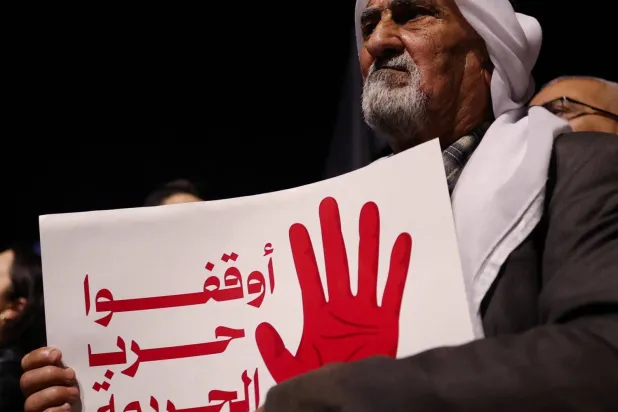
During a mourning vigil held days earlier, participants carried solidarity banners, while tears prevailed among a number of attendees.
The head of the Islamic Authority in Jaffa, Abdel Qader Abu Shhadeh, said: 'Jaffa witnessed three murders in the past three days.'
He added: 'We fully understand that these incidents did not happen by chance, but are part of Israeli policies towards our community.'
"We are not like that"
The organization 'Ajik, the Negev Institute', a joint Arab-Jewish institution concerned with creating a shared and equal space and encouraging youth participation and professional development, believes that building a better future is the way to break the cycle of violence.
Through youth-oriented programs, the organization encourages participants to engage in serving their communities and take advantage of opportunities such as higher education.
Bayan (19), from the city of Kafr Qasim (central), participates in the organization's programs, and she believes that 'circumstances or environment made violence and crime part of our reality, but we are not like that.'
Bayan, who lost a relative in his thirties last year due to the spread of crime, says that the violence in her community stems from a feeling of not belonging, high cost of living, and unemployment.
Najib Abu Baniya (56), in charge of community programs at the 'Ajik - Negev Institute' which operates in Bedouin villages in the Negev in southern Israel, believes that the ages of those involved in crime are getting younger over time.
He explains saying: 'If in the past we were talking about age 16, today we are talking about 14 or even 13.'
He added: 'Violence is spreading and this requires us to unite efforts.'
Sherin feels that her father's death placed an early responsibility on her. Despite her young age, she says: 'I will remain up to the responsibility, to be by my mother's side.'
Original source: Al-Riyadh


Comments (0)
Be the first to comment.