Shin Bet on the 'Arab Crime' Line in Israel
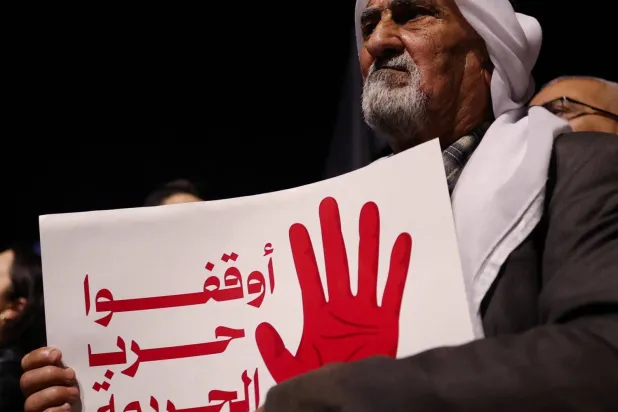
Shin Bet is close to taking over the handling of crime and violence in Arab society, after reaching a mechanism to provide the necessary budget for this step.
The National Investigation Committee into the acts of violence that took place in Syria's Sweida governorate last year affirmed that accountability 'will reach those who ignited the sedition and those who incited it, and there will be no tolerance for anyone who committed a violation.'
The Ministry of Justice had announced the start of trial sessions for the accused as of July 1. Local sources in Sweida considered that accountability 'if it proceeds legally to achieve justice and fairness, it will be an important step towards solving the Sweida problem,' while other sources questioned 'the government's seriousness in prosecuting the accused.'
Additional security measures around the Palace of Justice after the explosion (AFP)
Spokesman for the Investigation Committee, lawyer Ammar Ezzedine, told Syrian News Channel that the committee was keen to adhere to the conditions of fair trials, stressing the importance of public trials.
He announced that the second session of the trials will be on July 13, and attendance at trial sessions is available to those who wish, noting that the number of defendants in the Sweida events 'cannot be counted at the current stage due to the ongoing investigations.'
He stressed that the state 'is serious about holding accountable all perpetrators of violations, and that arresting any person does not mean proving their commission of violations before completing the investigations.'
Azzedine explained that dozens of defendants from various parties 'are currently undergoing trial procedures, and the rule of law applies to everyone without exception regardless of rank or position.' He added: 'Accountability will reach those who ignited the sedition and those who incited it, and we stress that there will be no tolerance for anyone who committed a violation, and we are keen to ensure a fair trial for victims and defendants.'
The Druze-majority Sweida governorate in southern Syria witnessed in July 2025 acts of violence that resulted in the deaths of more than 2,000 people, including 789 Druze civilians, according to Syrian media. The National Investigation Committee formed by the Syrian authorities documented at least 1,760 deaths, according to a report it presented last March.
Elements of gunmen loyal to Sheikh Hikmat al-Hijri during a patrol in Sweida (Archive - AFP)
The committee had announced, after its formation, the preparation of 'a list of suspects from the Ministries of Defense and Interior, Druze factions, and civilians including Bedouins and tribes, for committing grave crimes and violations.'
On Friday, the head of the Investigation Committee, Judge Hatem al-Naasan, said in a statement published by the Ministry of Justice on its accounts: 'The Military Public Prosecution has begun referring a number of individuals to the investigating judge,' noting that some cases have been referred to the 'Military Criminal Court in Damascus.'
Al-Naasan added that the court began considering them 'in public sessions starting July 1, with the presence of defendants and their lawyers, and according to the procedures stipulated in the applicable laws and fair trial guarantees,' explaining that the purpose of these procedures is 'to verify the facts and hold accountable everyone proven responsible for any violations... regardless of their status or the entity to which the acts are attributed.'
For his part, a political activist in Sweida, who preferred not to be named, considered the government's announcement 'a decent attempt, but it is not up to the level of the event because the issue is more complex than a matter of criminal trials, and the scene is more political than criminal.'
Sheikh Hikmat al-Hijri surrounded by his followers from the 'National Guard' (Sweida 24)
The activist added to Asharq Al-Awsat: 'What happened in Sweida was the result of a dysfunction, and all parties bear responsibility for it. The de facto authority in Sweida bears a large part of this responsibility, but the largest part is borne by the state as the guardian of all citizens in the country.'
The activist considered that the implementation of the 'roadmap' announced last September from Damascus to resolve the Sweida crisis with American and Jordanian support 'is a necessary matter, but the implementation of the roadmap is subject to the standards of the conflict with Israel, which uses the governorate as a bargaining chip on issues related to Mount Hermon and its violations in southern Syria.'
A local source in Sweida city, opposed to the policies of the leader of the Druze Unitarian sect, Sheikh Hikmat al-Hijri, and the so-called 'National Guard,' which took control of large parts of Sweida after the crisis erupted, affirmed 'we are in favor of holding accountable those involved in the recent events from both sides, with the exception of those who were defending their homes, families, and country.'
But the source, who preferred not to be named, added to Asharq Al-Awsat: 'We do not see the government as serious in holding accountable those responsible for the crimes committed in Sweida, and it is nothing more than media.' He noted that 'those arrested are a small part of the perpetrators and have incriminated themselves through videos circulated from their mobile phones, and despite nearly a year passing since the events, we have not heard of anyone being tried.' At the same time, the source considered that accountability 'if it proceeds in a fair legal manner, and to achieve justice and fairness, it would be an important step towards solving the Sweida problem.'
Syrian security forces near a road sign in Sweida city on July 15, 2025 (Reuters)
For her part, Ms. Maysaa al-Abdallah, a resident of Sweida city, questioned 'the seriousness of the Syrian government in prosecuting those accused of committing acts of violence in the governorate.'
She told Asharq Al-Awsat: 'My position and orientation regarding what is happening in Sweida is known: I am against the position of the factions here, and at the same time, the authority has not taken any step that would make the locals trust it. It is contributing to alienating Sweida from itself, from Damascus, and from Syrians, and it is unknown whether this is done intentionally or unintentionally,' as she put it.
Original source: Asharq Al-Awsat
Comments (0)
Be the first to comment.