Hezbollah Threatens to Disrupt Beirut Airport in Defense of 'Iranian Aviation'
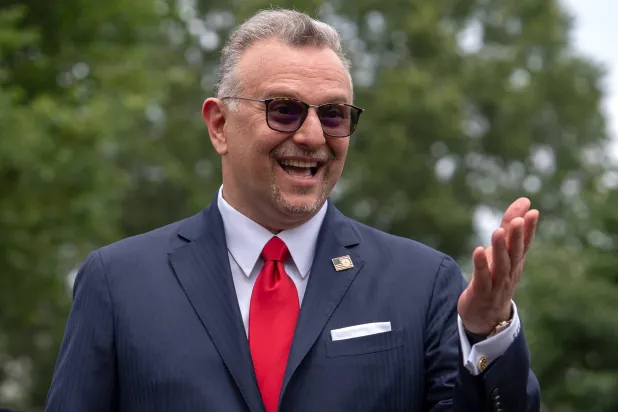
The deputy head of Hezbollah’s political council, Mahmoud Qamati, opened a new front of confrontation with the Lebanese state.
Hezbollah, through its deputy head of the political council Mahmoud Qamati, opened a new front of confrontation with the Lebanese state after threatening to prevent planes from landing at Rafic Hariri International Airport if official measures against Iran continue.
Qamati’s statements came as the party continues to raise the ceiling of its objection to the government’s policy, particularly regarding its pursuit of the framework agreement and indirect negotiations with Israel, while rejecting the separation of the Lebanese track from the Iranian track.
In an interview with Hezbollah’s Al-Manar channel, Qamati considered that granting visas to Iranians and Iranian diplomats has almost stopped, and spoke of the continued ban on Iranian planes landing at Beirut airport, stating that official measures target Iran and its representatives in Lebanon.
After saying that the party is still 'patient' to find a solution, he moved to issuing a direct threat, declaring that if the situation continues as is, the party will resort to 'many peaceful methods,' adding: 'Then no plane will land in Beirut, and no ambassador will remain in Lebanon.' He also called on the General Directorate of General Security to handle the file, and deemed the official performance 'unacceptable.'
This escalation comes as an extension of the party’s rejection of the official trend to separate the Lebanese decision from regional calculations, as it constantly attacks the framework agreement and the negotiations the state is conducting with Israel, and rejects any approach that leads to confining the Lebanese file to the state away from Iran, thus reducing Tehran’s influence in Lebanon.
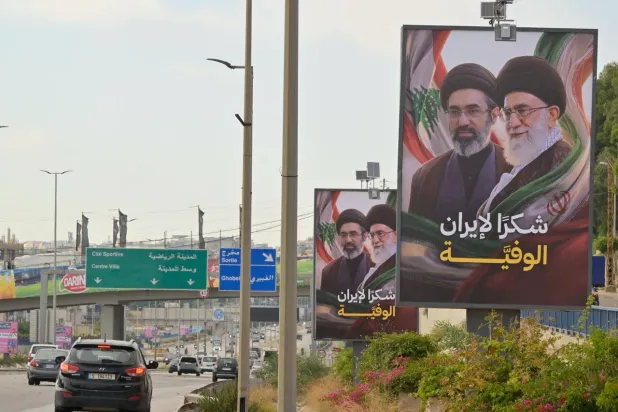
Hezbollah supporters raise the party’s and Iran’s flags in Beirut’s southern suburb during the funeral ceremony of former Iranian Supreme Leader Ali Khamenei last July 8 (AP)
No return from the government’s decision
Despite this escalation, sources at the Ministry of Foreign Affairs confirm to Asharq Al-Awsat that Qamati’s statements will not change anything in the decisions previously taken by the government, and that the authorities continue to implement the adopted measures towards Iran as sovereign and security decisions.
The sources explain that the decision to ban Iranian planes from landing began implementation after Israeli threats to target Beirut airport, while the visa requirement for Iranian nationals was reinstated after incidents revealed the presence of elements and leaders of the Iranian Revolutionary Guard inside Lebanon, which necessitated tightening entry procedures in accordance with national security requirements, without the sources denying that these visas are subject to strict criteria, as a result of the delicate conditions Lebanon is experiencing.
The government had taken the decision to prevent Iranians from entering Lebanon after an Israeli operation targeting Iranians in Beirut, whom Tehran later described as leaders of the Revolutionary Guard.
An old new campaign
Hezbollah’s objection to the government’s decisions regarding Iran is not new; it had launched a political and popular campaign against Nawaf Salam’s government in February 2025 after an Iranian plane was prevented from landing at Beirut airport, organizing protests and movements near the airport demanding the cancellation of the decision, but the government stuck to its position.
It is noteworthy that the decision to ban Iranian planes from landing was taken by the previous caretaker government during the 2024 war, after Israeli threats to target the airport, specifically during the tenure of Minister of Public Works Ali Hamieh, who is close to Hezbollah.
Hezbollah: Disarmament threatens national unity
Meanwhile, Hezbollah continued its campaign against the 'framework agreement,' renewing its rejection of handing over its weapons, which came on Tuesday through Hezbollah bloc member MP Hassan Ezzedine, attacking President Joseph Aoun and the political authority, considering that insisting on disarming the 'resistance' and following the option of direct negotiations threatens national unity and serves Israeli goals.
Ezzedine said: 'Disarming the resistance is equivalent to taking the souls of those who carry this rifle to defend the homeland,' considering that linking the Israeli withdrawal, reconstruction, and economic aid to this condition constitutes pandering to Israeli demands.
He accused the political authority of 'abandoning part of Lebanese territory... and handing over the south to the Israeli enemy,' describing it as 'treason and a heinous crime,' and considered that its performance reflects 'ignorance of the true nature of the enemy and its expansionist projects.'
He argued that the authority 'defeated itself' by making prior concessions before negotiations, holding it responsible for squandering Lebanese sovereignty, and stating that the core goal of the 'framework agreement' is to disarm the 'resistance' in a way that serves Israel's security, according to his expression.
Original source: Asharq Al-Awsat




Comments (0)
Be the first to comment.