Iran's Attacks on Oman Necessitate Review of International Stance on Hormuz Closure
Iran's Attacks on Oman Necessitate Review of International Stance on Hormuz Closure
The world needs to review its policy toward Iran. The Security Council must assume its responsibilities to restore international peace and security, and Russia and China must abandon their opposition to issuing a binding UN resolution that imposes respect and prestige of the international system, especially the United Nations Convention on the Law of the Sea, and grants affected countries the opportunity to ally to restore the strait from Iran's grip.
Iran's attack on Oman this week raised many questions about Iran's plans regarding the Strait of Hormuz and its willingness to achieve peace with its neighbors. The attack came just hours after Iranian Foreign Minister Abbas Araghchi's visit to Oman, one of the closest countries to Iran in the world.
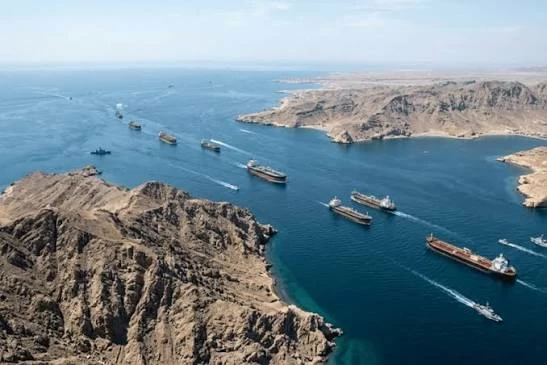
The attack on the ships occurred in Omani territorial waters, in the safe passage provided by the sultanate in the southern part of the strait. It was accompanied by harsh Iranian statements declaring the closure of the entire strait, affirming Tehran's insistence on managing the strait alone, and that it would attack any country or any ship that does not follow Iran's dictates in this matter, demanding all ships obtain permission from it regardless of the route they take in the strait.
In addition to attacking the ships that used the safe passage provided by Oman in its territorial waters, i.e., in the southern part of the Strait of Hormuz, Iran on the same day assaulted six other countries. These attacks came less than a week after it struck the Saudi and Qatari vessels, and ships belonging to other countries, in the same passage.
In Oman, Iran on Sunday was not content with the attack targeting the Omani safe passage, but also attacked Duqm Port, which is located on the Arabian Sea more than a thousand kilometers from the Strait of Hormuz and has no relation to the dispute over the strait.
These repeated attacks reveal several facts:
First, control of the Strait of Hormuz has become Iran's top priority, more important than the nuclear file according to statements by some of its officials.
Second, it is no longer concerned with implementing the Memorandum of Understanding, which it interpreted as giving it the exclusive right to manage the Strait of Hormuz—a mistaken understanding, as confirmed by the other party to the agreement and the mediators. Hence, U.S. President Trump's statement at the NATO summit that the memorandum had become void due to Iran's actions, which he described as insane, in attacking commercial ships that attempted to cross the strait.
Third, it does not believe that the United Nations Convention governs the Strait of Hormuz, but rather only Iran's interests, and it sees no role for the United Nations' International Maritime Organization. This is a continuation of an Iranian belief that applies to most international charters and organizations, where it does not consider itself bound by those agreements.
Fourth, it believes it can dictate its terms to the international community, based on the prevailing belief in Iran that it has won the confrontation with the United States. However, those grounded in strategic knowledge in Iran do not see it that way but believe they have a window before the U.S. midterm elections in November, during which they can do as they please without Trump being able to respond due to his fear of voter backlash.
Fifth, Tehran does not value its neighbors, including Oman, which spent years mediating between Iran and its adversaries, maintained diplomatic and economic relations with it when others boycotted it, and condemned American and Israeli attacks on Iran without hesitation. This is evident from the fact that the recent attacks came hours after Omani officials met with the Iranian foreign minister.
Sixth, Tehran follows international developments but interprets them incorrectly. It sees the disagreement that emerged at the NATO summit held in Turkey last week as meaning that Western countries that differ with the United States over NATO's role agree with Iran regarding the strait.
These facts mean that Iran will not open the strait except on its own terms and after recognition of its right to manage the strait as it wishes.
Therefore, the world needs to review its policy toward Iran. This is directed in particular at the Security Council to assume its responsibilities toward restoring international peace and security, meaning that Russia and China must abandon their opposition to issuing a binding UN resolution that imposes respect and prestige of the international system, especially the United Nations Convention on the Law of the Sea, and grants affected countries the opportunity to ally to restore the strait from Iran's grip. Without that, the region and the world are heading toward a dark period of destruction and economic recession.
Original source: Al-Riyadh



Comments (0)
Be the first to comment.