Libya Faces Cyber Threats Targeting Banking Sector
Libya is on guard against cyber threats that may target its banking sector, about a month and a half after the Central Bank of Libya's systems were hacked, followed by a leak of a 'sample of the bank's data' on the so-called 'dark web', amid official moves to bolster protection systems and raise banks' readiness to face any potential attacks.
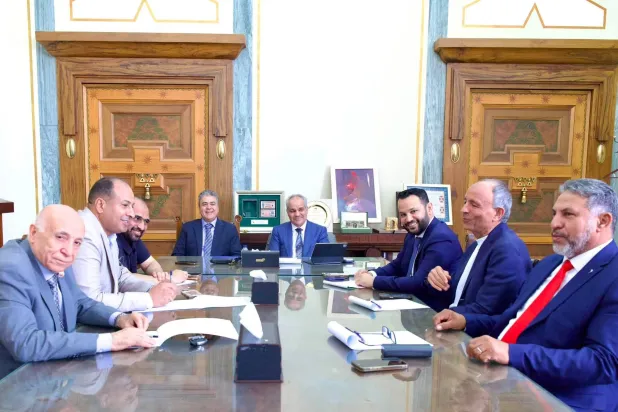
Central Bank of Libya Governor Naji Issa stressed the need to give cybersecurity systems top priority during an expanded meeting he held on Monday with commercial bank directors and representatives of electronic payment companies, which he included in 'enhancing the banking sector's readiness to face digital threats'.
Central Bank of Libya Governor Naji Issa in a meeting with officials from Libyan banks on Monday (Bank's page)
Issa issued instructions to take all necessary measures to enhance the protection of banks' digital infrastructure, and raise their readiness to counter cyber risks and threats, ensuring the security of banking systems, maintaining customer data, and securing the continuity of service provision.
In parallel, officials from the Ministry of Interior, under the interim 'Government of National Unity', agreed to enhance cooperation to launch a training programs system and develop educational and security training curricula in line with cybersecurity concepts and digital transformation, alongside continuing to implement awareness programs on the dangers of cybercrime, contributing to building more efficient and prepared security capabilities to face modern technical challenges.
These moves come after the cyber attack that the Central Bank suffered at the end of last May, followed at the end of June by a data leak on the 'dark web', which, according to circulated information, included correspondence of the Governor's Office with ministries and government agencies, minutes of meetings with local companies, as well as files dating back to 2020 and 2021 concerning a number of banks under the supervision of the Central Bank.
An employee at one of the Libyan state banks (Jamhouria Bank)
In light of this incident, the Central Bank of Libya stressed its refusal to 'enter into any negotiations or bargaining, or respond to any demands involving extortion', emphasizing that its handling of the incident is in accordance with laws and official procedures, parallel to technical and criminal investigations being conducted in cooperation with international experts and local security agencies.
The Bank also sought to reassure customers, confirming that basic banking services, customer accounts, and the stability of the financial system 'were not affected by the incident', and that systems have returned to normal operation, with additional measures continuing to enhance the cybersecurity system and raise operational readiness.
Khaled Bouzakouk, head of the Benghazi Forum for Economic Development and Development, believes that risks still exist, attributing this to 'gaps in protection systems, weak digital infrastructure, along with a limited number of specialized cybersecurity cadres'.
Bouzakouk, who spoke to Asharq Al-Awsat, links these risks to the general situation in the country, considering that the political and economic crisis 'has reflected on various state institutions, including the banking sector, and contributed to dispersing efforts aimed at raising the efficiency of banks and enhancing their security system'.
Libya suffers from a political and military division between two governments: the interim 'Government of National Unity' in the west of the country headed by Abdul Hamid Dbeibeh, and another appointed by the parliament that controls the east and large parts of southern Libya, headed by Osama Hammad, supported by the 'National Army' led by Field Marshal Khalifa Haftar.
Facade of the Central Bank in Tripoli (Reuters)
Bouzakouk also sees that the banking sector suffers from 'a state of administrative instability', noting that the suspension of a number of senior bank officials on charges of corruption and embezzlement, the latest in June, 'reflects the weakness of the banking supervision system, or its absence in performing its legal and supervisory role, which raises questions about the sector's readiness to face cyber threats'.
At the beginning of last week, the Governor of the Central Bank briefed the Finance Committee of the House of Representatives on developments in dealing with the cyber breach, reassuring that bank accounts and balances were not breached, and that the bank succeeded in containing the incident and restarting systems normally.
Original source: Asharq Al-Awsat



Comments (0)
Be the first to comment.