National Investigation Committee into Suwayda Events: Accountability Will Reach Those Who Ignited Sedition and Incited
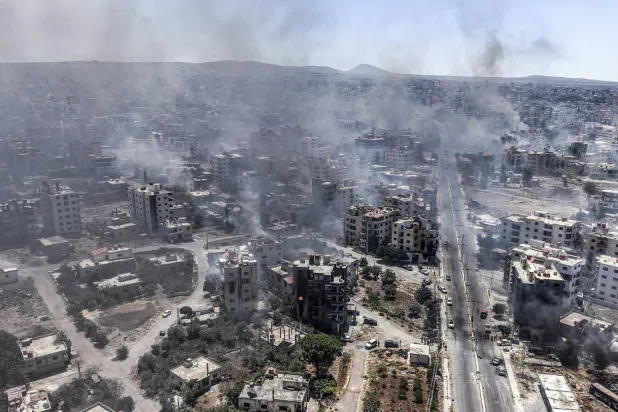
Accountability will reach those who ignited sedition and those who incited, and we stress that there will be no tolerance for anyone who committed a violation, and we are keen to ensure a fair trial for victims and defendants.
The decision by Sadrist leader Muqtada al-Sadr to move from silence to open support for the anti-corruption campaign led by Prime Minister Ali al-Zaidi appears to mark a turning point in Iraqi political balances; it opens the door to a direct confrontation with the forces of the "Coordination Framework," whereas competition between the two sides in recent years had been conducted through political and electoral tools rather than open confrontation.
The first notable reaction came from the leader of the "State of Law" coalition and former Prime Minister Nouri al-Maliki, who defended the "Coordination Framework" as a political project that has proven its success, in a move widely seen as an attempt to contain the growing pressures facing the ruling Shiite alliance.
These developments come at a time when signs of divergence have begun within the forces of the "Coordination Framework," which was formed after the 2021 elections as an alternative to the traditional Shiite alliances that have succeeded each other since the 2005 elections, starting with the "United Iraqi Alliance" which was said to have had the support of the religious authority at the time, passing through the "National Alliance," and culminating in the current formula that emerged after the Sadrist movement left the governing equation.
An archive photo of Sadrist movement leader Muqtada al-Sadr (Reuters)
Sadr's Silence
After the 2021 elections, al-Sadr had attempted to form a "national majority" government that included the "Kurdistan Democratic Party" led by Masoud Barzani and a Sunni alliance led by former Parliament Speaker Mohammed al-Halbousi, but the project stalled due to what became known as the "obstructive third," which prevented the election of the president of the republic by the constitutionally required majority, leading to a continued state of political deadlock.
In the summer of 2022, al-Sadr decided to withdraw his deputies from parliament, announcing his withdrawal from the political process. Addressing members of his parliamentary bloc at the time, he said: "I have decided to withdraw from the political process so as not to participate with the corrupt in any way." He added that he would not participate in any elections in the "presence of the corrupt," calling on his supporters to maintain their political and popular organization in preparation for any future stage if conditions change.
Since then, al-Sadr has boycotted subsequent elections, including the latest ones, despite repeated calls for him to return to the political process, including from his opponents within the "Coordination Framework."
Anti-Corruption Campaign Changes the Equation
The most notable development came with the anti-corruption campaign launched by Ali al-Zaidi's government, which reached its peak with the arrest of 21 political and parliamentary figures in what was known as the "Dawn Raid" operation.
The campaign gained momentum after Judge Diaa Jaafar, who is handling the investigation, announced that part of the stolen funds was used to finance electoral campaigns, a statement that raised widespread questions about the integrity of the recent electoral process and the extent of the influence of political money on its results.
Observers believe that these developments have provided al-Sadr with a political ground that intersects with his positions announced since his withdrawal from parliament, based on his refusal to participate in a system he considers tainted by corruption.
Iraqi Prime Minister Ali Faleh al-Zaidi (Government Media)
Settlement Option or Restructuring?
The selection of Ali al-Zaidi for prime minister came after the forces of the "Coordination Framework" failed to agree on a candidate from within their ranks. After ruling out granting former Prime Minister Mohammed Shia al-Sudani a second term, and the stumbling of Nouri al-Maliki's candidacy amid internal and external objections, political forces turned to choosing a figure from outside the traditional political class.
Al-Zaidi, a businessman in his forties, is seen as an acceptable choice for Washington, in contrast to an Iranian position characterized by caution and a lack of the usual enthusiasm, amid declining Iranian influence in Iraq compared to previous years.
Al-Zaidi's positions also drew attention from the first days of his tenure, whether by not participating in the funeral ceremony of the late Iranian Supreme Leader Ali Khamenei, which was attended by a number of "Coordination Framework" leaders and the official Iraqi delegation headed by President Nizar Amidi, or by announcing his intention to strengthen relations with the United States, with expectations of a visit to Washington within weeks.
Domestically, al-Zaidi announced his intention to proceed with disarming armed factions, giving those factions a deadline ending in September, a file that successive Iraqi governments have failed to resolve due to its political and security complexities.
Supporters of Muqtada al-Sadr wave the Iraqi flag during a demonstration in support of the Iraqi government's anti-corruption measures in Najaf (AP)
Sadr Breaks His Silence
The turning point came when al-Sadr announced his full adoption of the anti-corruption campaign, describing al-Zaidi as a "soldier of reform," in a step that went beyond political support to granting the government broad popular cover.
This was followed by demonstrations in support of the campaign, as Sadrist leaders began to engage in supporting it after months of maintaining silence awaiting al-Sadr's directives.
Observers see this development as the first broad political and popular alignment against the forces dominating power since 2003, especially as the anti-corruption campaign has targeted figures affiliated with influential forces within the "Coordination Framework."
Adding to the sensitivity of the scene is the fact that the priorities of al-Zaidi's government, foremost among them fighting corruption and monopolizing weapons in the hands of the state, intersect with the priorities of US President Donald Trump's administration toward Iraq, which, according to analysts, creates an intersection of interests between Washington and the Sadrist movement, despite fundamental differences between them on other files.
Pressures on the 'Coordination Framework'
This intersection does not mean there is a direct political alliance between al-Sadr and the US administration, but it gives the government support from two sides that were traditionally seen as standing at opposite ends of the Iraqi scene, which multiplies the pressures on the "Coordination Framework."
In the face of these developments, Nouri al-Maliki rushed to defend the "Coordination Framework," stressing in a post on the "X" platform that the alliance "formed an incubator for the national political process," and that its success was embodied in forming three successive governments.
He added that "there is no reason to abandon a project that has proven its success," stressing that "the (Framework) will remain a framework as it was established, preserving its constants, identity, and founders," considering that any development should be limited to working mechanisms and performance, not touch the essence of the project.
Original source: Asharq Al-Awsat


Comments (0)
Be the first to comment.