NATO and Gulf Discuss Security Conditions and Encourage Enhanced Cooperation
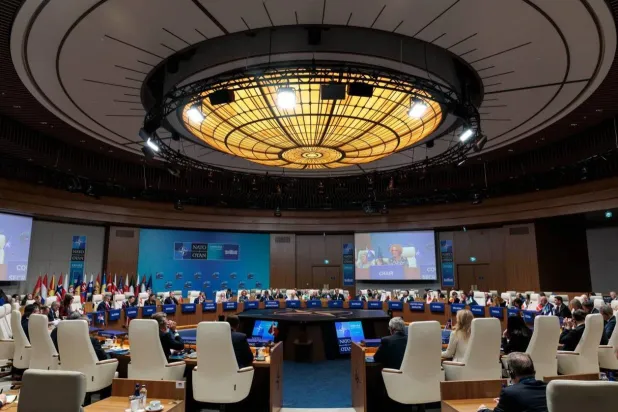
Foreign ministers of NATO countries discussed with their counterparts from the Gulf states participating in the Alliance's Istanbul Cooperation Initiative the repercussions of the Iran war on the region and the world.
Foreign ministers of NATO countries agreed with their counterparts from Gulf states participating in the Alliance's Istanbul Cooperation Initiative (ICI) to enhance cooperation in light of the challenges highlighted by the 'Iran War'.
The meeting, held on Tuesday-Wednesday night on the sidelines of the 36th NATO summit in Ankara, focused on security updates in the region, the issue of maritime security, and strengthening the partnership between the Initiative's member states and NATO.
Turkish Foreign Minister during the meeting of NATO and Gulf states ministers from the Istanbul Cooperation Initiative (Turkish Foreign Ministry)
The meeting was held as part of Turkey's effort, as the host country of the 36th NATO summit, to discuss the Iran war and its repercussions on the region and the world.
The meeting came weeks after tensions in the Strait of Hormuz, despite the United States and Iran reaching a temporary peace agreement.
Enhancing Cooperation
Before the meeting, Belgian Foreign Minister Maxime Prévot said the stability of the Gulf states, which have suffered Iranian attacks during the war with the United States and Israel, is closely linked to Europe's stability, noting that the issue goes beyond the Strait of Hormuz, despite its critical importance for European energy security.
Representatives of Gulf states at the meeting stressed the importance of strengthening cooperation with NATO.
A part of the meeting between Fidan and Kuwaiti Foreign Minister Sheikh Jarrah bin Jaber Al-Ahmad Al-Sabah at the Turkish Foreign Ministry in Ankara (Turkish Foreign Ministry)
Kuwait, which hosts the headquarters of the Istanbul Cooperation Initiative, was represented at the meeting by its Foreign Minister Sheikh Jarrah bin Jaber Al-Ahmad, who held talks with Turkish Foreign Minister Hakan Fidan at the Turkish Foreign Ministry on Monday, on the eve of the NATO summit, focusing on bilateral relations and regional issues.
Bahrain's delegation was headed by the Director General of Bilateral Relations at the Ministry of Foreign Affairs, Sheikh Abdullah bin Ali Al Khalifa.
The head of the Qatari delegation, Minister of State for Foreign Affairs Dr. Mohammed Al-Khulaifi, announced during the meeting that his country and NATO had reached an agreement on a partnership program, details of which were not disclosed, noting that the program will form the comprehensive strategic framework for organizing and guiding areas of civilian and military cooperation between the two sides.
Gulf delegations at the Istanbul Cooperation Initiative meeting on the sidelines of the NATO summit in Ankara (Turkish Foreign Ministry)
He said his country attaches great importance to strengthening its cooperation with the Alliance within the framework of the Istanbul Cooperation Initiative, revealing that they are approaching the final stage of establishing a regional center for peace support operations in Qatar under the Alliance's auspices, noting that the meeting in Ankara came at a critical stage where security and political challenges have become more interconnected and intertwined, and international interests have become more overlapping.
He stated that this makes it necessary to unify efforts and enhance coordination to face challenges affecting the security of Middle Eastern countries and threatening the foundations of regional and international stability.
Istanbul Initiative and the 'Iran War'
The Istanbul Initiative, which had remained a suspended framework during successive crises in the region, regained its importance in light of recent developments and the war between America, Israel, and Iran. Turkey sees the importance of turning it into an effective tool in cooperation with countries bearing the brunt of regional instability.
NATO leaders launched the Istanbul Initiative during their summit held in Istanbul on June 28, 2004, as a partnership framework aimed at enhancing practical cooperation in counterterrorism, energy security, air defense, and joint military exercises, following the September 11, 2001 attacks on the United States. NATO activated Article 5 of its founding treaty for the first time in its history, which increased the importance of regional partnerships and cooperation mechanisms, as threats like terrorism—which transcend borders and require a collective response—demonstrated the need for NATO to engage in closer political and practical cooperation with its regional partners.
Turkish Foreign Minister during the meeting of NATO and Gulf states ministers from the Istanbul Cooperation Initiative (Turkish Foreign Ministry)
The initiative came after a previous step to deepen the partnership between NATO and North African countries through the Mediterranean Dialogue in 1994.
Kuwait, Qatar, Bahrain, and the United Arab Emirates joined the Istanbul Cooperation Initiative, which was launched as a broad framework for cooperation in the Middle East and North Africa after the Mediterranean Dialogue, starting with the Gulf region in 2005. Saudi Arabia and Oman refrained from joining and only participate in some selected activities within its framework.
Objectives of the Initiative
The initiative aims to enhance regional and international security and stability by building practical bilateral partnerships with Middle Eastern countries, focusing primarily on interested states, especially in the Arabian Gulf region.
The Istanbul Cooperation Initiative Group was established, comprising political advisors from NATO member states, to manage relations between the Alliance and partner countries. It was later replaced by the Political Partnerships Committee, responsible for managing all partnership relations within NATO.
Rutte and representatives of the four Gulf states at the Istanbul Cooperation Initiative meeting in Ankara (NATO website)
The regional center for the initiative was established in January 2017 in Kuwait, serving as a key hub for training, education, and enhancing operational partnership between the Alliance and the initiative's member states in the Gulf region. Former NATO Secretary General Jens Stoltenberg participated in meetings held in Kuwait in 2024 to mark the 20th anniversary of the launch of the Istanbul Initiative.
The Secretary General was appointed as Special Representative for the Southern Neighborhood to lead NATO's engagement and cooperation with partners in the Middle East, North Africa, and the Sahel region, including the Istanbul Cooperation Initiative partners, to work on enhancing partnership and cooperation on issues such as defense planning, defense budgeting and development, civil-military relations, taking into account the specific conditions of each country, and establishing cooperation to enable coordinated operations between NATO armed forces and partner countries, allowing them to participate in NATO exercises.
He also coordinates specific exercise programs, cooperation in counterterrorism through intelligence sharing, preventing the proliferation of weapons of mass destruction and their delivery systems, and border security, with a primary focus on terrorism, uncontrolled proliferation of small arms, and smuggling, and developing a civil emergency action plan for responding to natural disasters.
Original source: Asharq Al-Awsat



Comments (0)
Be the first to comment.