North Africa in the Crosshairs of the Open War in the Sahel
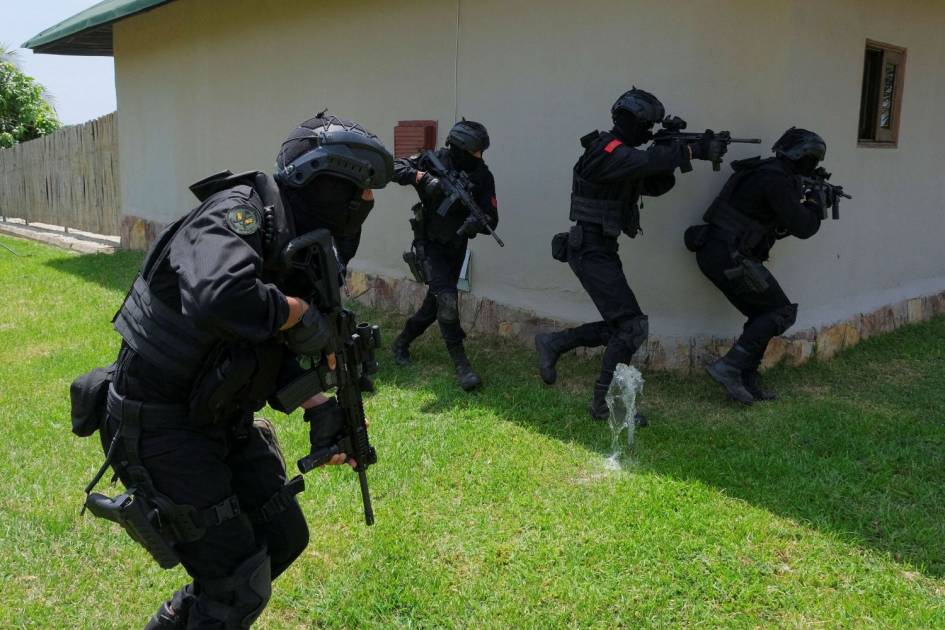
In recent years, the Sahel region has become classified as a real hotspot for terrorist organizations, as Al-Qaeda regroups through the Group for Supporting Islam and Muslims (JNIM) led by Iyad Ag Ghaly, while ISIS continues to gather its ranks there.
The Moroccan authorities' announcement of dismantling a cell linked to ISIS's Sahel province has highlighted the security challenges facing North Africa amid rapid transformations to the west, where Mali, Burkina Faso, and Niger are experiencing major upheavals led by rebel and militant groups that have displayed an unusual audacity in recent days in launching their attacks.
Locally, the announcement was not seen as just an isolated security incident but as a strong indicator of militant groups seeking to expand their activities beyond their traditional strongholds in Niger, Mali, and Burkina Faso, even though Moroccan authorities revealed that they had carried out raids in seven cities, arresting 10 extremist elements.
But this development has awakened concerns in countries such as Egypt, Tunisia, Algeria, Libya, and Mauritania about paying the price of the chaos in the Sahel, especially since armed groups have achieved gains, most notably reaching prominent leaders in the Malian government such as Defense Minister General Sadio Camara, who was killed by militants of the JNIM group affiliated with Al-Qaeda.
Fragile Region
The Maghreb's concerns stem from the region's geography, as North Africa is linked to the Sahel by thousands of kilometers of desert borders extending with Mali, Niger, and Chad—areas that are difficult to fully monitor due to rugged terrain and vastness.
Despite their success in enhancing military capabilities in recent years, concerns remain in North African countries about the spread of chaos to them. Algeria and Morocco have significantly increased their military budgets, and Tunisia has concluded deals to acquire military equipment from the United States and elsewhere.
The expansion of Al-Qaeda and ISIS in the Sahel raises growing apprehension in the north of the continent (Reuters)
Mohamed Akdid, a security researcher specializing in Maghreb affairs, considered that 'Morocco's announcement is indeed striking, as the country has extensive experience in fighting terrorism and extremist groups, but the entire region is fragile to terrorist groups.'
In an interview with Independent Arabia, Akdid said, 'Mali's situation in fighting terrorism is difficult, fluctuating between certain political and military forces and currents, making terrorist groups try to sweep some external spaces to impose their position. Thus, the threat of terrorism and militant groups always threatens the region's countries.'
He stressed that 'the solution lies in sincere joint cooperation among the Maghreb region countries and harnessing unified political and security visions to confront these terrorist groups in order to avoid any slippages.'
Very Likely Possibility
In recent years, the Sahel region has become classified as a real hotspot for terrorist organizations, as Al-Qaeda regroups through the JNIM group led by Iyad Ag Ghaly, while ISIS continues to gather its ranks there.
Following the devastating blows in Syria, Iraq, and elsewhere, the weight of terrorist organizations has shifted to West Africa, which is experiencing chronic political and security turmoil.
African affairs researcher Heba El-Beshbeshi believes that the crisis in West Africa has intensified significantly, especially amid Russian confrontations with armed groups in countries such as Niger, Mali, and Burkina Faso, despite the crisis being concentrated in Bamako with the killing of the defense minister and the escalation of attacks. Therefore, it has become necessary to confront these groups that have started striking at the heart of the regime.
The recent development awakened concerns in Egypt, Tunisia, Algeria, Libya, and Mauritania about paying the price of the Sahel chaos (Reuters)
In a special statement, El-Beshbeshi stressed that 'when West African countries experienced military coups, they did not undertake a political settlement of the situation. There is cooperation between rebels and militant organizations such as ISIS and Al-Qaeda with the Azawad rebels, which has increased the burden on government forces in Mali and their Russian allies,' noting that 'uncertainty surrounds the possibility of tensions spilling over into neighboring countries.'
She added, 'But it is clear that there is regional and international support for armed groups in the Sahel, and there are legitimate concerns in Egypt and some countries in the north of the continent about the spread of chaos and the possibility of militant fighters moving to neighboring countries, especially Libya, which is the dividing line with West Africa and whose borders are very fragile.'
El-Beshbeshi explained that 'the options for neighboring countries lie in holding an international conference under the auspices of the African Union, because no country can face alone the threats posed by armed groups active in the Sahel. In my view, a security cooperation should be established under joint institutional and collective sponsorship to make decisions under an African umbrella.'
Read more
Why did Al-Qaeda shift its attacks from the peripheries to the capitals of the Sahel?
Is France redrawing Sahel security through southern Libya?
Arms flow to the Sahel redraws the maps of chaos
Motorcycles in the Sahel: 'Terrorist' sound and impact
She warned that 'the possibility of armed organizations transferring their operations to North Africa is very likely, and they are already working on that, possessing extensive military capabilities that enable them to do so through lone wolves.'
Worrying Situation
North Africa's concerns are not limited to the possibility of extremists infiltrating the region from West Africa but also to the repercussions of the war. Algeria announced in April 2025 that it shot down a drone belonging to the Malian army after it 'violated Algerian airspace,' amid tensions with the ruling military council in Bamako over its choices in confronting armed groups.
Despite seeking support from countries like Russia and Turkey, the Sahel states today find themselves unable to stop the advance of armed groups that have taken control of vast areas in Burkina Faso and Mali.
Nigerien political and security researcher Mohamed Oual warned that the situation in the Sahel is worrying and that Maghreb countries must be 'on alert' for any development, explaining that 'the incident of the downing of the Malian drone in Algeria and Morocco's dismantling of a cell affiliated with ISIS in the Sahel ring alarm bells about the future of the region, especially since the Sahel is linked to Maghreb countries by vast borders that are difficult to fully control, which over the past years has led to the influx of thousands of irregular migrants to the region, and the possibility of infiltration of militant and wanted elements among them remains likely.'
He concluded that 'the solution lies in fruitful coordination between Sahel and North African countries to avoid any dire consequences of the ongoing conflicts in West Africa.'
Original source: Independent Arabia

Comments (0)
Be the first to comment.