Iran Tightens Security Grip Despite War Conditions
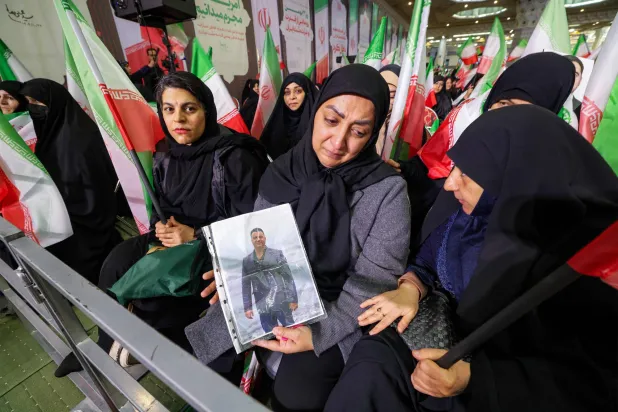
Despite the war conditions Iran is experiencing, its security authorities have tightened following the recent wave of unrest that shook a number of cities.
Despite the war conditions Iran is going through, its security forces have tightened their grip following the recent wave of unrest that shook several cities; human rights and media reports indicate that the authorities have expanded their campaign from chasing protesters in the streets to targeting anyone suspected of providing direct or indirect support to them, a shift that, according to observers, reflects a move from crisis management to reshaping the public sphere under a stricter security umbrella.
According to data cited in a report by the American newspaper The New York Times, the campaign is no longer limited to political activists or participants in protests, but has extended to include doctors, lawyers, academics, business owners, and ordinary citizens, within a security approach that considers any form of support for protesters as part of opposition activity.
From the Street to 'Support Networks'
Recent developments, according to the report, show that Iranian security agencies have moved to a broader stage in dealing with the repercussions of protests; the goal is no longer just to disperse gatherings or arrest participants, but to dismantle what the authorities call 'support networks' that helped the wounded or provided them with medical, legal, media, and financial support.
The data indicate that this approach has led to investigations of people who did not directly participate in demonstrations but provided humanitarian or professional services to the wounded, reflecting an expansion of the concept of participation in protests from the perspective of security agencies.
One of the most sensitive aspects of the campaign, according to the report, is targeting health sector workers, as a number of doctors have been held accountable for treating wounded individuals outside official channels or for not reporting other cases.
This has led to anxiety within the medical community, amid growing fear among doctors of practicing their humanitarian duties normally, especially after some wounded individuals turned to private clinics or doctors working anonymously to avoid arrest.
Observers warn that this climate could create a gap between patients and official health institutions, and push towards more unorganized work in the medical sector.
Economic Tools for Pressure
An Iranian woman shopping at a local market in Tehran, April 28 (Reuters)
The measures, according to the report, are not limited to the security side alone, but also include economic tools; cases of closure, confiscation, or restriction of activity have been recorded against commercial institutions whose owners are suspected of supporting protesters or participating in strikes.
It appears that the aim of these measures is to expand the deterrence circle to include the livelihood and economic dimension, so that the cost of any protest or support activity extends to the livelihoods of individuals and companies.
In parallel, the data indicate an increasing reliance by the authorities on advanced technical tools to track protest participants, including analyzing videos circulated online, using surveillance cameras, and monitoring digital activity on social media platforms.
Individual reports also play an additional role in enhancing the security agencies' ability to identify participants or supporters, even after waves of protests have ended.
A General Climate of Fear
Anti-government protests in the city of Mashhad, January 10 (Reuters)
These policies, according to the report, are reflected in Iranian society more broadly, with a growing sense of caution and fear of any past or indirect connection to protests, even at the level of personal expression or political discussion within families and society.
Observers point out that this climate could lead to a decline in public spaces for political discussion, and reinforce a state of self-retreat within society, amid fear of being summoned or prosecuted.
In contrast, Iranian authorities assert that the measures taken target what they describe as 'disruptive elements' and 'entities linked to abroad,' considering that the protests included attempts to destabilize the country. The official narrative emphasizes that security intervention was necessary to maintain public order and prevent slipping into chaos, at a time when the country faces economic challenges and increasing external pressures.
In contrast, human rights organizations express concern that the scope of arrests has expanded to include groups not directly involved in acts of violence, arguing that the campaign now extends to those who provided humanitarian or logistical support to the wounded.
These organizations warn that the continuation of this approach could lead to the entrenchment of a state of comprehensive deterrence, aimed not only at stopping protests but also at preventing the emergence of any similar movement in the future.
The report concludes that Iran is undergoing a broad recalibration of its internal dynamics after the recent unrest, based on a mix of security, economic, and technical measures, aiming to tighten control over the public sphere and prevent the recurrence of protest waves.
But on the other hand, analysts believe that this approach, despite its effectiveness in the short term, may exacerbate latent tensions within society, especially if the economic and social factors that fueled the unrest remain unaddressed.
While the authorities rely on security deterrence to stabilize the situation, the question remains open about the ability of this approach to contain the roots of political and social discontent, or whether it simply postpones its explosion to an unknown future.
); googletag.cmd.push(function() { onDvtagReady(function () { googletag.display('div-gpt-ad-3341368-4'); }); }); }
Original source: Asharq Al-Awsat

Comments (0)
Be the first to comment.