Seven killed, 22 wounded in bomb blast at Damascus cafe

At least seven people were killed and 22 wounded when a bomb exploded inside a cafe in central Damascus on Thursday, in the deadliest such attack in the Syrian capital in a year.
At least seven people were killed Thursday when a bomb planted inside a cafe in central Damascus exploded, in a new test for Syrian authorities who have worked hard in recent months to establish security and assert control across the country.
The Syrian Health Ministry said the death toll from the Damascus blast had risen to seven killed and 22 wounded.
No group claimed responsibility for the blast, the deadliest in Damascus since a suicide bombing targeting a church in the Duwayliqa district a year ago killed 25 people. Syrian authorities have vowed that the perpetrators will be punished.
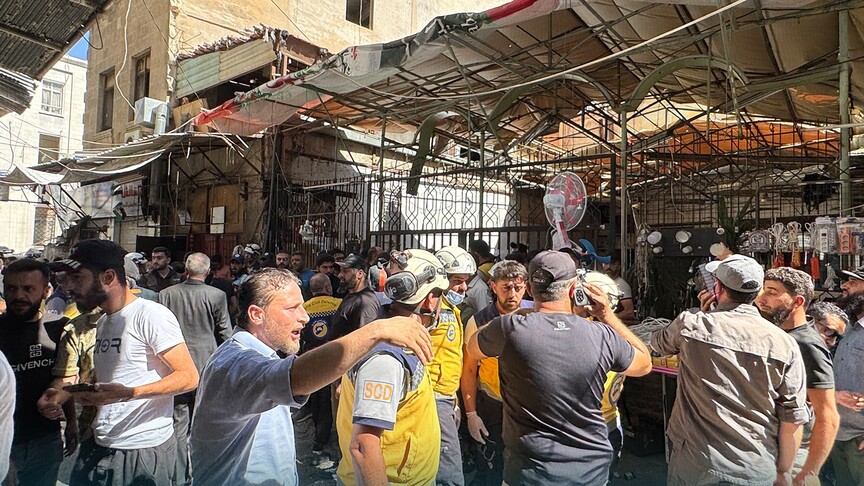
An AFP correspondent saw ambulances rushing to the site, which was cordoned off by security forces amid panic and chaos following the blast in a crowded area.
Brigadier General Mohammad Khayt of the Damascus Internal Security Forces told state television that the explosion was caused by a bomb planted inside the cafe.
According to the Health Ministry, the blast initially killed five people and wounded 20 others.
A security source had earlier told AFP that the explosion occurred inside the cafe during peak hours.
The cafe is located on a busy commercial and residential street in the heart of Damascus, often frequented by lawyers and visitors to the nearby Palace of Justice.
Mohammad al-Dhahabi, owner of an eyeglass shop adjacent to the cafe, told AFP while trembling on a chair, 'After the blast, I felt a strong pressure, then the place shook around us.'
He continued, 'I ran to the spot and saw people lying on the ground with blood everywhere,' a scene he said brought back memories of 'the explosions Damascus witnessed' during the years of conflict.
Ambulances struggled to make their way through the congested street, according to an AFP correspondent.
Nawar Khayyat (40), owner of a solar battery shop opposite the Palace of Justice, told AFP, 'Around 3:00 pm (12:00 GMT), I heard a loud blast and the shop front shook, while people rushed to the cafe and started calling for ambulances.'
'Tampering with stability' -
Authorities vowed to hold those responsible for the blast accountable.
Damascus Governor Maher Marwan Edelbi confirmed to reporters near the Palace of Justice that preliminary investigations had begun. He said, 'This case will not be filed against unknown persons... God willing, those who tampered with these lives will be punished.'
He said that whenever the country experiences 'a state of stability, there are tampering hands that want to remove this stability.'
The blast poses a challenge to authorities who have worked over the past months to rebuild security and military institutions, and to assert their authority and largely maintain security across the country, after facing major challenges in their first year in power, most notably sectarian violence in the Alawite stronghold in the west and then in the Druze area in the south, which killed hundreds.
This is the deadliest blast in Damascus since the suicide bombing inside a church in the Duwayliqa district in June 2025, which killed 25 people, claimed by an extremist Sunni group, while authorities attributed it to the Islamic State group.
The group periodically claims attacks targeting especially Syrian security forces. After the new authorities ousted the rule of ousted President Bashar al-Assad in December 2024, the extremist group, whose members hide in the vast Syrian desert, urged its fighters to battle the new authorities.
The Syrian government officially joined the international coalition to fight the extremist group late last year.
Since the new authority came to power, Damascus has witnessed occasional limited security incidents.
Authorities reported a soldier killed on May 19 when a car bomb exploded in Damascus near a building belonging to the Ministry of Defense, which at the time said the blast coincided with an army team working to defuse a bomb.
Original source: Al-Riyadh



Comments (0)
Be the first to comment.