Syria Prepares Strategy to Combat Money Laundering and Terrorist Financing
With the participation of 5 ministers and a UN program, as part of efforts to strengthen the financial system and exit the 'gray list'
ISTANBUL / Leith Al-Junaidi / Anadolu
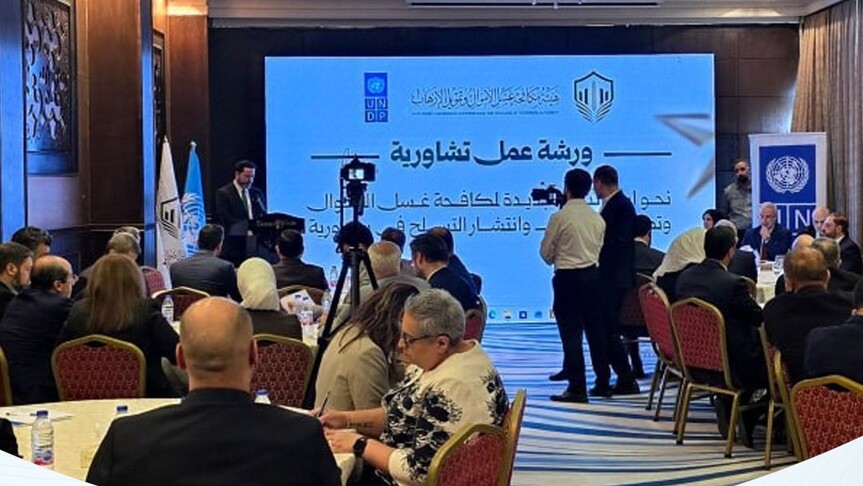
A Syrian authority launched on Tuesday a workshop to prepare a new national strategy to combat money laundering, terrorist financing, and the proliferation of weapons.
The workshop is being held in the capital Damascus, in cooperation with the United Nations Development Programme (UNDP), and with the participation of 5 ministers and representatives of international organizations, according to the Syrian Arab News Agency (SANA).
Participating in the workshop at the Dama Rose Hotel were Interior Minister Anas Khattab, Justice Minister Mazhar al-Wais, Finance Minister Mohammed Yusr Barnia, Economy and Industry Minister Mohammed Nidal al-Shaar, and Communications Minister Abdul Salam Haykal.
The head of the Anti-Money Laundering and Combating the Financing of Terrorism Authority, Safwat Ruslan, said during the opening of the workshop that preparing the strategy represents an opportunity to establish a unified national vision, and to raise the efficiency of the financial system and develop it in line with international standards.
He added that these standards are led by the recommendations of the Financial Action Task Force (FATF).
Ruslan explained that work is ongoing to complete legislative and technical reforms to enhance the effectiveness of the system, supporting the country's efforts to meet international requirements and accelerate its exit from the 'gray list'.
The 'gray list' includes countries subject to enhanced monitoring by the Financial Action Task Force due to deficiencies and shortcomings in their domestic systems for combating money laundering, terrorist financing, and the proliferation of weapons.
Ruslan stressed that combating financial crimes has become a fundamental pillar for protecting the national economy and attracting developmental investments.
For his part, the acting resident representative of the United Nations Development Programme in Syria, Rouhi al-Afghani, said that the strategy comes within the country's new priorities, after more than a decade of financial isolation.
He added that Syria is witnessing a gradual lifting of most international sanctions, alongside early signs of economic recovery.
Al-Afghani explained that the strategy constitutes a framework for redirecting financial flows towards official channels, and building a transparent financial system that enjoys national and international confidence, thereby strengthening the path to exiting the 'gray list'.
In turn, Justice Minister Mazhar al-Wais affirmed that this file is of particular importance, as it is part of establishing the rule of law and protecting society.
He added that combating financial crimes is an international responsibility that requires effective partnership and exchange of expertise.
For his part, Interior Minister Anas Khattab pointed to the direct effects of these crimes on security and stability.
He referred to the ministry's role in pursuing criminal networks and developing investigation and search units, as well as coordination with the judiciary and the public prosecution.
Meanwhile, Finance Minister Mohammed Yusr Barnia said that this file is no longer just a banking or regulatory matter, but has become linked to the soundness of the financial system and investor confidence.
Economy and Industry Minister Mohammed Nidal al-Shaar explained that developing the system provides an integrated legal basis that includes preventive measures, in addition to empowering the Financial Intelligence Unit and linking it electronically with regulatory, judicial, and law enforcement authorities.
According to SANA, the strategy aims to strengthen the rule of law, combat money laundering, curb the financing of terrorism and the proliferation of illicit weapons, and close loopholes that threaten national security and hinder the recovery path.
It also targets supporting confidence in the Syrian financial system, affirming the country's commitment to international standards, and providing a safe and attractive environment for investment, contributing to exiting the 'gray list'.
On December 8, 2024, Syrian factions overthrew the regime of Bashar al-Assad, who had ruled the country since 2000, after inheriting power from his father Hafez al-Assad.
Original source: Anadolu Agency


Comments (0)
Be the first to comment.