The Most Dangerous Scenarios: Is a War Between Turkey and Israel Looming on the Horizon?

So far, only a few researchers and observers have discussed the possibility of a war between Turkey and Israel, even though the leaders of both countries have gone far in exchanging accusations about the potential outbreak of such a conflict, prompting observers and analysts to examine this possibility and anticipate its early repercussions if it indeed erupts.
However, there is a fundamental difference between threatening war and the outbreak of actual military confrontation, and both countries are well aware of this difference. Yet the continuous escalation of tension between these two middle powers carries dangers that make it a direct threat to regional security and stability, requiring serious analysis not only to inform public opinion about its dimensions but also to urge international powers, especially Western countries, to work to prevent it before it is too late.
Voices in both countries are rising, warning of an approaching military confrontation on more than one front at a time when the region is witnessing rapid shifts in its regional axes, including changes in the stance of the US administration. However, the deterioration in Turkish-Israeli relations did not begin today but goes back many years; indeed, the roots of the current dispute extend back decades.
Benjamin Netanyahu was elected Prime Minister of Israel in 1996 at the head of a government led by the Likud party, carrying a program based on two parallel goals: confronting the rise of the Hamas movement and simultaneously working to expand the circle of peace agreements with Arab countries.
Then came the attacks of September 11, which launched the United States on a broad global campaign against terrorism, redrawing the features of the international order.
Just one year later, the Islamist Justice and Development Party (AKP) under Recep Tayyip Erdogan won the Turkish elections, remaining in power for subsequent decades.
Since then, both Israel, as the Jewish state, and Turkey, now governed by a party with an Islamic reference within a secular state, began to formulate long-term strategies that were ostensibly independent but carried within them the seeds of ideological and strategic collision and a struggle for regional leadership.
However, both sides initially had to focus on their immediate challenges.
Turkey, a NATO member, gradually began to shift from the strict secular Kemalist approach to policies with an Islamic character, not only domestically but also in its foreign policy. At the same time, its economy continued to provide significant advantages to both the United States and Israel.
As for Israel, it continued over the years to strengthen its strategic partnership with Washington, both militarily and politically, while Turkey was in turn building a special relationship with the United States, but along a different path.
Over time, Ankara began its project of regional expansion, establishing a military presence in western Libya, strengthening its influence in the Horn of Africa, and then supporting armed Islamist factions in northern Syria.
In response, Israel moved after the October 7 attack towards the Gaza Strip, maintaining control over the eastern part of the strip, and also carried out several military operations inside southern Lebanon to confront Hezbollah.
But the arena that put Turkey and Israel on a direct collision course was Syria. Ankara spent years preparing for a regime change operation in Damascus, and it appears that this happened, to some extent, with tacit Western acceptance or tolerance.
Through Idlib province, the Turkish government supported and brought together two main Islamist factions: the first was Jabhat al-Nusra, and the second consisted of factions spread along the northern border with Syria, which were directly under the supervision of Turkish security agencies.
In December 2025, these two forces moved towards the city of Aleppo before continuing their advance towards Damascus, where the Assad regime was overthrown, taking advantage of a political window that emerged in Washington during the transition between the departure of the Biden administration and the arrival of the Trump administration.
With the inauguration of President Ahmed al-Sharaa as President of Syria, Turkey was overnight transformed into one of the leading regional powers. Thanks to its NATO membership and possession of US weapons systems, President Recep Tayyip Erdogan's regional influence multiplied after the fall of the Assad regime.
Ankara's military allies now stand on the outskirts of the Golan Heights, on the Jordanian border, and facing southern Lebanon.
This rapid expansion southward gave Turkey greater ability to influence energy equations in the eastern Mediterranean. Through its allies in Damascus, it gained access to the Syrian coast and an exclusive economic zone containing gas reserves estimated at hundreds of billions of dollars.
But more importantly, the Turkish expansion, led by the AKP, redrew military geopolitical equations not seen in the Arab Mashreq since 1914, with the outbreak of World War I.
The Syrian Arab Army effectively operates under the umbrella of Turkish military intelligence, while al-Sharaa's rule, his forces, and allied factions receive strategic guidance from Ankara.
In practical terms, Turkey now directly controls northern Syria and its coast, and has expanded its military presence within what could be described as the new "Islamic Republic," from the Iraqi border to Lebanon, through advanced weapons systems, including air defense systems deployed in various parts of the country.
Among all the transformations in the Syrian arena, three developments particularly concern Israel.
First, the Turkish advance towards the Iraqi and Jordanian borders, which could, in the long run, form a base for Ankara's influence to extend towards the Arabian Peninsula.
Second, the potential extension of Turkish influence into northern Lebanon, especially to the largely Sunni city of Tripoli, north of Mount Lebanon.
Thus, the entire Fertile Crescent seems to be gradually falling under the umbrella of post-Ottoman influence, in direct contact with Israeli airspace. Therefore, the Israeli Defense Ministry has since last year moved to draw a red line south of Damascus, aiming to prevent the new Syrian leadership from approaching or deploying near the Golan Heights.
After attacks targeting members of the Druze community in July 2026, attributed to extremist militias, Prime Minister Benjamin Netanyahu ordered the bombing of the Defense Ministry building and the Presidential Palace in central Damascus, in a clear message warning against any southward advance towards Israeli lines.
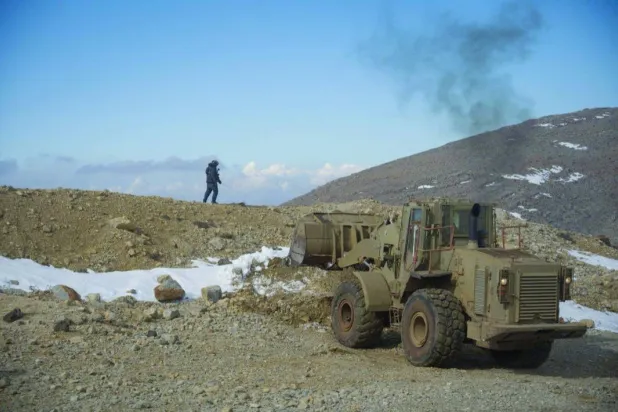
On the ground, Israel has established a security zone in southern Syria extending from Mount Hermon to Suwayda, an area almost the size of Lebanon, forming a defensive belt inside Syrian territory aimed at preventing any Turkish expansion towards the capital Damascus.
Practically, the undeclared lines of influence between Turkey and Israel in Syria now consist of two clear zones: north and south of Damascus, in addition to another line extending north of the city of Tripoli in Lebanon, facing the Israeli line south of the Litani River.
However, the area under Turkish influence in Syria and Lebanon combined far exceeds the area controlled by Israel in southern Syria.
Original source: Al Arabiya




Comments (0)
Be the first to comment.