Escalation with Iran: Targeting Jordan and Bahrain, and Two Ships Hit in Hormuz
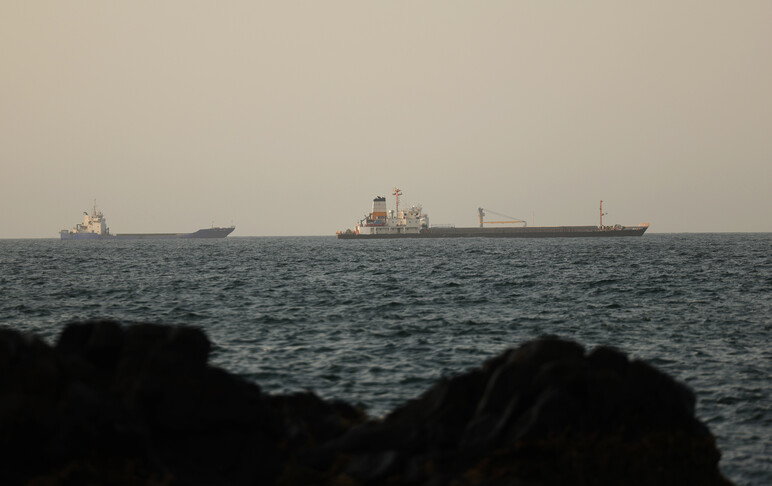
Istanbul / Anadolu
- Amman announced that air defense systems shot down 5 drones and 3 ballistic missiles since last night
- Manama announced the sounding of sirens, indicating a possible attack, after announcing the repulsion of Iranian attacks
- The British Maritime Operations Authority reported that two commercial vessels were attacked off the coast of the UAE and the Sultanate of Oman
- The Revolutionary Guard said the two ships attempted to pass through a "dangerous" route south of Hormuz
- The US Central Command "CENTCOM" announced the completion of a tenth wave of attacks on Iran
Jordan announced on Tuesday the downing of five drones and three missiles, while Bahrain reported repelling Iranian attacks, and two ships were hit off the coast of the UAE and the Sultanate of Oman, according to a British authority.
A responsible Jordanian military source said in a statement that "the armed forces dealt with 5 drones launched from Iran last night and Tuesday morning," according to the official Petra news agency.
He added that "the drones were neutralized with efficiency and precision," and that "the operation did not result in any human casualties or material damage."
In a second statement, the army announced that air defense systems shot down three Iranian missiles targeting Jordanian territory at noon on Tuesday, with no human casualties or material damage.
On Monday evening, the Jordanian army announced the downing of 3 missiles.
The US Central Command "CENTCOM" announced on Saturday the death of two American soldiers and the loss of a third while repelling Iranian attacks with missiles and drones in Jordan on Friday.
In an update on Sunday, CENTCOM said it found unidentified remains at the attack site, and that procedures for examining and verifying them are still ongoing.
For more than a week, Tehran has been launching attacks on "American military facilities and equipment" in Arab countries, including Jordan, Bahrain and Kuwait, in response to the daily US shelling that Iran is subjected to.
** Bahrain
In Bahrain, the Ministry of Interior announced, via the American company platform "X", the sounding of the siren, and called on citizens and residents to "stay calm and head to the nearest safe place."
In a previous wave of attacks on Tuesday, the General Command of the Bahrain Defense Force (army) said in a statement that air defense systems "confronted, intercepted and destroyed a number of treacherous Iranian aerial attacks," without specifying their nature.
It added that "Iran continues its systematic hostile approach through its criminal attacks targeting civilians in the kingdom."
It called on citizens and residents to exercise caution and not approach "any foreign or suspicious objects resulting from the remnants of the brutal Iranian attack, and to report them immediately."
It stressed that "deliberate use of missiles and drones to target civilians and private property is a blatant violation of international humanitarian law."
On July 8 of this month, US President Donald Trump announced the end of the ceasefire stipulated in the memorandum of understanding signed with Iran on June 18 last month.
Trump's announcement came after Iran targeted 3 commercial ships in the Strait of Hormuz, as Tehran insists on imposing a mechanism to regulate the passage of ships through the strategic corridor, while Washington demands what it says is ensuring freedom of navigation and its security in the strait.
** Iran and "CENTCOM"
On the Iranian side, no statement was immediately issued regarding Tuesday's attacks on Jordan and Bahrain, as the Revolutionary Guard spoke of attacks launched on Monday evening.
The Revolutionary Guard said in a statement that it carried out attacks on Monday evening with missiles and drones against "American military sites" in Bahrain and Kuwait.
It added that it targeted and "destroyed" an American radar and an air defense system in Bahrain's Muharraq area, and a "Patriot" air defense system in the Riffa area.
It reported that the attacks in Kuwait targeted an American long-range radar site, a communications center, and satellite communications systems.
It added that it also targeted a hangar for MQ-9 drones at Kuwait's Ali Al Salem base, claiming to have destroyed drones or caused severe damage to them.
It also spoke of targeting the early warning radar, missile defense radar, FPS-117 radar, Patriot system, and satellite communications systems at Kuwait's Ahmed Al Jaber base.
On Tuesday morning, CENTCOM announced via the American platform "X" the completion of the tenth wave of attacks on Iran, which lasted five hours.
CENTCOM said the strikes included Iranian military command centers, naval capabilities, missile and drone launch sites, and air defense systems.
It considered that the goal of the attacks is to "undermine Iran's ability to continue attacking commercial ships transiting the Strait of Hormuz."
** Two Ships Hit
On Tuesday, the British Maritime Operations Authority announced in two statements that two ships were hit, one off the coast of the UAE and the other off the coast of the Sultanate of Oman.
The authority said the ship's captain (not identified) reported a direct hit by a projectile of unknown origin, causing damage to the steering gear (rudder).
It reported that a ship was hit by an unknown projectile 17 nautical miles east of the UAE's city of Dibba, and all crew members are "fine," with no environmental spill or impact on the marine environment.
Eight nautical miles northeast of the city of Lima in the Sultanate of Oman, an oil tanker was hit by an "unknown object" in the Strait of Hormuz.
As of 10:45 GMT, no party has claimed responsibility for the two attacks.
Meanwhile, the Iranian Revolutionary Guard reported in a statement that a fire broke out in the two tankers following two explosions while they were attempting to pass through a route it described as "dangerous and unsafe" south of the Strait of Hormuz, according to Iran's Tasnim news agency.
It stated that the United States "forced" the two tankers to take that route, without providing details on the circumstances of the two explosions.
The current US-Iranian escalation has disrupted navigation through the Strait of Hormuz and threatened air traffic and energy supplies, amid intermittent closures of airspace and warnings of targeting American facilities and interests outside the Middle East.
Original source: Anadolu Agency



Comments (0)
Be the first to comment.