Why Did Hamas Return to Raising Flags and Threatening a 'New October 7'?
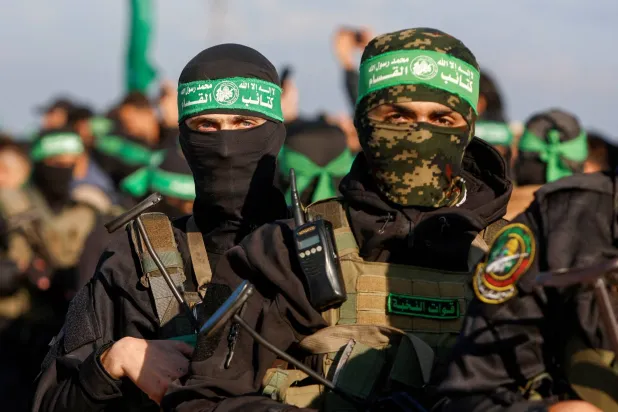
Recently, the raising of al-Qassam flags and the appearance of armed Hamas members at funerals have been observed, along with chants including 'Khaybar Khaybar, O Jews... October 7 will return.'
The moment of raising Hamas and its military wing, al-Qassam Brigades, flags at the funeral of a field commander killed by Israel after being targeted while walking was not coincidental, but rather part of a coordinated effort that may have surprised many observers after a long period during which the movement refrained from such actions.
That funeral for al-Qassam field commander Walid Haniyeh, a relative of former movement leader Ismail Haniyeh who was assassinated by Israel in Tehran in July 2024, coincided with June 26, the day activists called for popular protests against Hamas due to the deteriorating humanitarian conditions in the Strip. This prompted significant concern from the movement, which worked hard to deflect it, believing that 'suspicious' parties were behind it, before the protests fizzled out on their own.
Members of Hamas police in a street in Gaza City (Archive - Reuters)
After that funeral, Hamas continued to raise its flags at all funerals of its activists killed by Israel, and al-Qassam flags were also seen, along with armed men appearing at funerals and chanting slogans including 'Khaybar Khaybar, O Jews... October 7 will return.' This drew the attention of Israeli media, which launched a campaign of incitement against the movement and the Gaza Strip.
The last time Hamas flags and armed elements appeared was during the handover of Israeli captives in the second prisoner exchange deal, which began in January 2025, before Israel later resumed its war in March of the same year. Israeli forces exploited these events to track down movement leaders and members, later killing them in a series of assassinations and operations.
With the scene repeating recently, especially as the Israeli war continues on a smaller scale despite the ceasefire declared in October 2025, Asharq Al-Awsat asked four Hamas sources in the Gaza Strip about the reasons for the return of flag-raising and the appearance of armed men, and the wrapping of victims' bodies in Hamas and al-Qassam flags. All confirmed that a decision was taken by the movement's leadership in Gaza and disseminated to all areas to resume raising flags and chanting 'jihadist' slogans at funerals of activists killed by Israel.
Hamas faces a severe financial crisis... but its financial situation is considered better than other factions (Archive - Reuters)
According to the four sources, each speaking separately, the decision was made to affirm that Hamas leadership remains present and strong, and cannot be defeated through military action or any plans, whether Israeli or American, that bypass an agreement with the movement on the future of the Gaza Strip and the entire Palestinian cause.
One source said that one of the reasons was the call for what was termed the popular mobilization or 'June 26 revolution,' noting that Hamas leadership was convinced there were attempts to create widespread chaos inside the Strip. The movement wanted, starting with Haniyeh's funeral, which was held that afternoon hours before the protest time, to show that it was still strong and cohesive. The other three sources neither confirmed nor denied this account.
The four sources confirmed that all the armed men appearing at recent funerals are relatives and friends of the victims, some of whom are affiliated with the movement and appear without coordination or official status.
Regarding the threat and hinting at a repeat of October 7, and other so-called 'jihadist' slogans, the sources confirmed that these slogans are improvised in content, but the internal directive distributed to those responsible for events in the areas, including organizing funerals, was to chant slogans recalling the role of 'resistance' and that it is still present and active, just as it was before the war.
Members of al-Qassam Brigades, the military wing of Hamas, in Rafah, southern Gaza, February 2025 (Reuters)
Some saw that this step could provoke Israel and give it justification to escalate its aggression inside the Gaza Strip. Activists affiliated with Hamas from inside and outside the Strip called for stopping the raising of flags and chanting of those slogans, pointing out that Hebrew media exploited this to incite against Gaza again, very much like at the beginning of the war, and that Israeli intelligence used it to monitor participants in those funerals, who were later assassinated as happened previously in prisoner exchange operations and elsewhere.
Two Hamas sources said these calls might be realistic, but Israel does not need pretexts; the aggression has not stopped since the declared ceasefire, and assassinations and crimes continue at varying but still significant levels. We have lost more than 1,060 Palestinians so far as a result of this ongoing aggression.
A third source said: 'Certainly, the reality has changed, and what was acceptable before the war is no longer suitable for the current circumstances, but that does not mean complete surrender. Assassinations have proven each time that they do not weaken the movement but rather strengthen it to continue its path.'
Concurrently, Hebrew media reports from various channels and newspapers, based on official intelligence reports submitted to the Israeli General Staff and political echelon, spoke of Hamas's recovery in Gaza, claiming it is manufacturing weapons of various types, repairing some tunnels, and possibly preparing to attack forces, as it refuses to disarm, controls humanitarian aid, continues to transfer money from abroad to Gaza to pay its activists, and funnels funds to the military wing to reorganize and recruit new members.
Fighters from al-Qassam Brigades affiliated with Hamas in the Gaza Strip (Archive)
According to the Hebrew newspaper Israel Hayom, the Israeli army is stepping up the pace of assassinations in Gaza to hinder Hamas's efforts to consolidate its presence as it continues to renew its military capabilities. The newspaper quoted a political source as saying: 'We are accelerating the pace of assassinations, but we remain below the threshold of international criticism, and this situation will continue as long as Hamas is unwilling to disarm.'
Meanwhile, the Hebrew newspaper Yedioth Ahronoth reported that the commander of the Israeli army's Southern Command, Yaniv Asor, has been trying for some time to convince the General Staff to resume large-scale fighting in Gaza, but has not succeeded so far, given the political echelon's desire not to resume fighting now due to restrictions imposed by the United States.
The four Hamas sources told Asharq Al-Awsat that Israeli threats and what Hebrew media publish are part of the ongoing incitement campaign that existed before and during the war and continues to this day, and are not new.
Two sources confirmed that the movement is exploiting some available capabilities to prepare to defend Palestinians if Israel decides to resume the war, but it will not initiate any attack as happened on October 7, 2023, or otherwise. Its goal is to reach an agreement that guarantees Palestinian rights, completely stops the war, provides relief to Gaza Strip residents, secures the necessities of life, and rebuilds their homes.
"); googletag.cmd.push(function() { onDvtagReady(function () { googletag.display('div-gpt-ad-3341368-4'); }); }); }
Original source: Asharq Al-Awsat

Comments (0)
Be the first to comment.