Yemeni Information Minister to Asharq Al-Awsat: We Prevented Imposing Sanaa Airport as an Iranian Platform
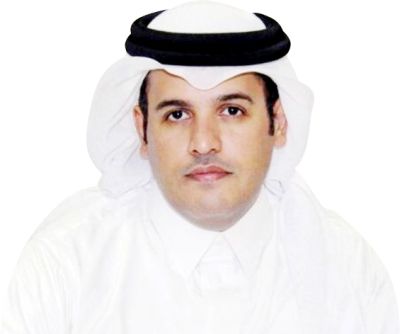
The Yemeni Information Minister affirmed that the state will not stand idly by in the face of any violations and will take all political, diplomatic, legal, and military measures to prevent infringement on sovereignty.
Yemeni Information Minister Moammar al-Eryani affirmed that the state will not stand idly by in the face of any new violations and will take all political, diplomatic, legal, and military measures guaranteed by the constitution and international law, to prevent any attempt to infringe on Yemen's sovereignty or impose facts on the ground by force.
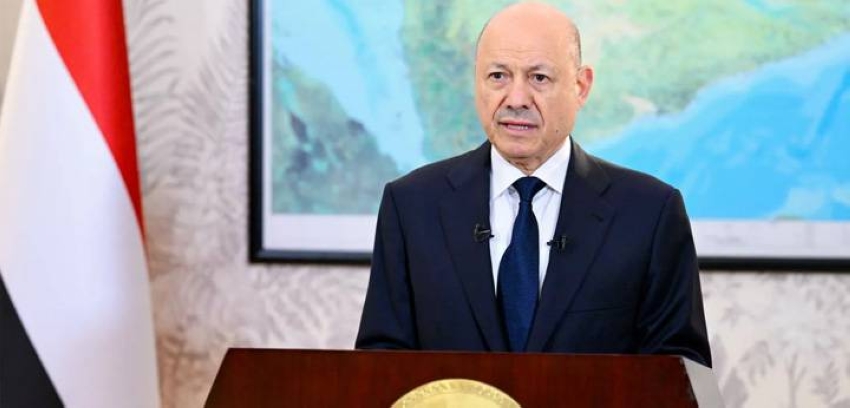
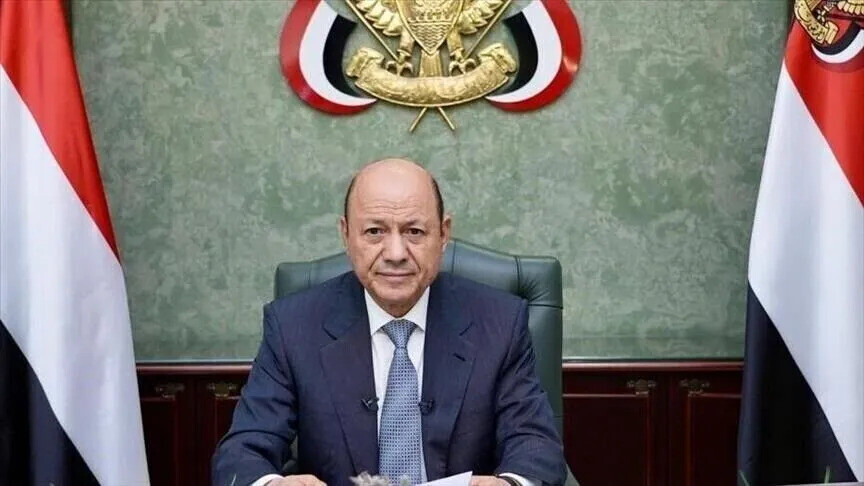
Video| Speech by His Excellency President Dr. Rashad Mohammed al-Alimi, President of the Presidential Leadership Council, Supreme Commander of the Armed Forces, at the joint emergency meeting of the Presidential Leadership Council with the National Defense Council pic.twitter.com/jvH6eZrasS
— Moammar al-Eryani (@ERYANIM) July 14, 2026
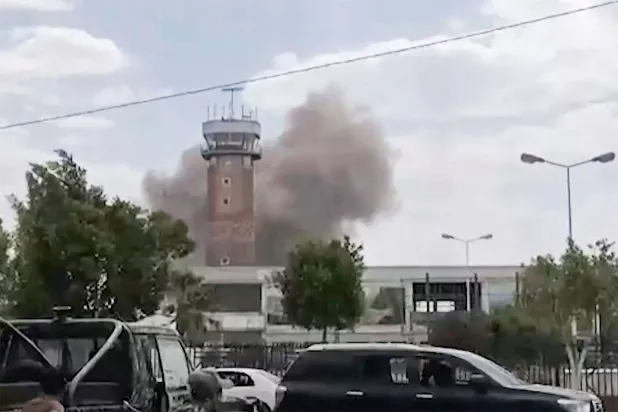
In an interview with Asharq Al-Awsat following developments that saw the Yemeni Ministry of Defense announce on Monday the targeting of Sanaa International Airport's runway to prevent the landing of an Iranian plane that attempted to reach the capital outside legal and sovereign procedures, al-Eryani considered the position of the Yemeni state clear since the beginning of the crisis, as the government had exhausted all political, diplomatic, and legal tracks, and presented practical initiatives aimed at continuing civilian flights via Yemenia (Yemen Airways), preserving the interests of citizens and respecting the sovereignty of the Yemeni Republic.
New escalation between the Yemeni government and the Houthis after targeting Sanaa airport runway to prevent an Iranian plane from landing, with military readiness raised and presidential warnings against violation of sovereignty. https://t.co/Ym401pFlUB
— Asharq Al-Awsat Newspaper (@aawsat_News) July 13, 2026
Al-Eryani said that 'the terrorist Houthi militia, with direct support from the Iranian regime, rejected those initiatives and insisted on imposing a fait accompli outside state institutions. His Excellency the President of the Presidential Leadership Council, the Supreme Defense Council, the Cabinet, and the Ministry of Defense have affirmed that protecting the sovereignty of the Yemeni Republic, its airspace, and its ports is a constitutional duty that allows no negligence.'
The Yemeni minister sent a message to reassure the Yemeni people, saying that the armed forces and security agencies are today at the highest levels of readiness and preparedness, implementing the directives of the President of the Presidential Leadership Council, the National Defense Council, the decisions of the Cabinet, and what the Ministry of Defense announced, revealing that they are capable of performing their constitutional duty to protect the sovereignty of the Yemeni Republic and defend its airspace and land, sea, and air ports.
Crisis Management Room
When asked about his country's options if the Houthis choose escalation, al-Eryani highlighted a crisis management room, revealing that state institutions work in full coordination within it, monitor developments around the clock, and take necessary measures according to military, security, and political assessments, ensuring the protection of citizens and the preservation of national interests, affirming that the state holds the initiative and the ability to deal with any developments responsibly and firmly.
National Defense Council holds Houthi militias and the Iranian regime responsible for the escalation and adopts comprehensive measures to protect sovereignty https://t.co/X37UlAf4Jt
— Dr. Rashad Mohammed al-Alimi (@PresidentRashad) July 13, 2026
Al-Eryani also placed full responsibility for any escalation or its repercussions 'on the shoulders of the Houthi militia and the Iranian regime, who chose to reject all peaceful initiatives and continue violating international law and undermining peace opportunities.'
Houthi Rejection of Yemeni State Initiatives
Regarding the plane's landing at Hodeidah airport, Asharq Al-Awsat asked about the government's position on that step. The Yemeni Information Minister stressed that the state's success in this crisis is not measured by where the plane landed, but by preventing the goal that Iran and the Houthi militia sought, namely imposing Sanaa airport as a permanent platform for Iranian flights outside state authority. He added that his government dealt with the crisis from the beginning with responsibility and firmness, exhausted all political, diplomatic, and legal tracks, and presented practical initiatives to spare Yemen and the region further escalation, including operating civilian flights via Yemenia (Yemen Airways) and its readiness to facilitate the transfer of the Houthi delegation via the national carrier. However, the 'militia,' with direct support from the 'Iranian regime,' rejected all those initiatives.
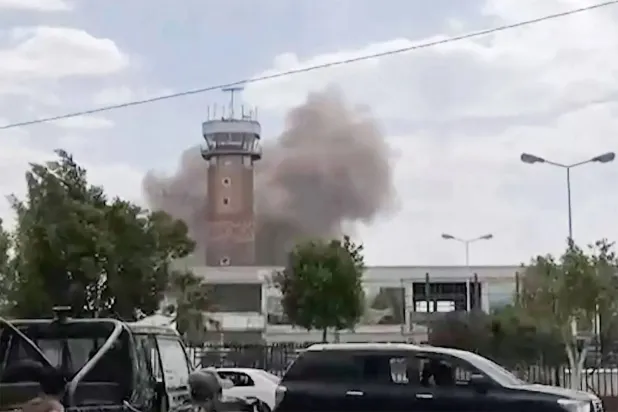
Yemeni army bombed Sanaa airport runway to prevent an Iranian plane from landing (Reuters)
Al-Eryani was more detailed on this point, saying: 'When the militia insisted on imposing a fait accompli, the state implemented what it had previously announced, and prevented the Iranian plane from landing at Sanaa airport, affirming that its warnings were not for media consumption, but rather an expression of a sovereign position based on the state's responsibilities to protect its airspace and ports.'
He continued: 'Preventing the plane from landing at Sanaa airport constituted the most important turning point in the crisis because it thwarted the attempt to consolidate the airport as a platform for regular Iranian flights and affirmed that the Yemeni government will not allow any diminution of its sovereignty or grant the Houthi militia sovereign powers it does not possess.'
Allowing Landing at Hodeidah Airport
Al-Eryani pointed out that 'the decision to allow the plane to land at Hodeidah airport was taken from a position of strength, after the state proved its readiness and ability to impose its will, and it does not, in any way, change the legal and sovereign position of the Yemeni Republic rejecting any Iranian flights outside official frameworks.' He considered that this crisis 'established a new equation: any future Iranian air movement towards Yemeni territory will not be viewed as a civilian flight, but as an attempt to violate the sovereignty of the Yemeni Republic and impose a new fait accompli.' He affirmed, in the same context, that the (Yemeni) state will deal with any similar attempt according to what the constitution and international law guarantee, to protect Yemen's sovereignty and security, and prevent the use of its lands and airports to serve the Iranian project.
A circulated image of the Iranian plane after its arrival at Hodeidah airport (X)
Al-Eryani had announced on Monday that the Houthis detained an International Committee of the Red Cross (ICRC) plane at Sanaa airport and prevented it from leaving, and also detained the pilot and co-pilot as hostages. During his speech, he described this as 'not an emergency behavior, but part of a systematic pattern that the militia has followed in violating international law and international humanitarian law.'
He added: 'The militia has previously kidnapped dozens of UN employees and workers in international agencies and humanitarian organizations from their workplaces and homes, arbitrarily detained them, targeted humanitarian institutions, confiscated their property, and used humanitarian workers as a political bargaining chip, in a flagrant violation of all international customs and conventions.'
Houthi Seizure of National Carrier Aircraft
This did not stop there, as al-Eryani revealed that the Houthis' record includes 'the seizure of four aircraft belonging to Yemenia (Yemen Airways) and disruption of the national carrier's operations, causing severe damage to citizens and the civil aviation sector.'
He expressed surprise at the continued operation of flights by some international organizations to Sanaa airport, in the absence of security and legal guarantees, and amid the militia's continued detention of aircraft, abduction of individuals, and threats to civil aviation safety.
A UN plane at Sanaa airport transporting a humanitarian shipment (United Nations)
Original source: Asharq Al-Awsat

Comments (0)
Be the first to comment.