A 64-team World Cup 'will destroy football'... Tebas calls on Infantino to resign

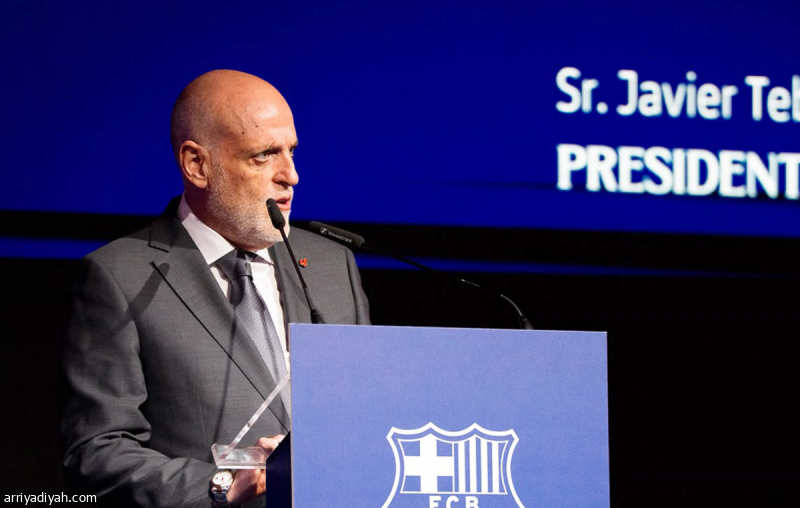
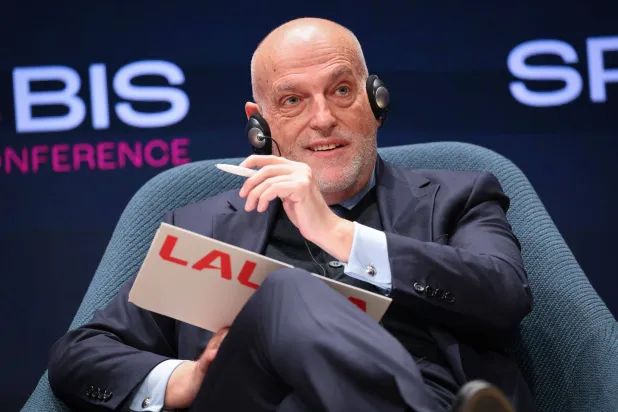
Javier Tebas, president of La Liga, launched a scathing attack on FIFA, considering that expanding the World Cup to 64 teams would "destroy the football industry," and called on FIFA President Gianni Infantino to step down.
Tebas's remarks came on the heels of the conclusion of the 2026 World Cup, amid proposals to raise the number of participating teams in the 2030 tournament from 48 to 64.
In an interview with the Italian newspaper La Gazzetta dello Sport, Tebas said that increasing the number of participating teams "makes no sense," stressing that football is not limited to the World Cup, despite it being the most important tournament, and that domestic competitions are what sustain the game and ensure its continuity.
He added: "They are destroying the football industry, an industry that provides tens of thousands of jobs, for an event that lasts 40 days and in which only a limited number of players participate."
He continued: "We need fewer national teams and greater protection for domestic football at all levels. Officials do not realize the extent of the damage, and they make their decisions in an irresponsible manner."
When asked if Infantino should leave his post, Tebas replied: "In my opinion, yes, I think his time is up, but he has the support of the system and the federations, and there is not much more to add."
He added: "There is no opposition candidate, and no one wants to run for election knowing they will lose. This is the system, and it is a system that is sick to its core."
The La Liga president pointed out that during his time in the United States, he heard many people oppose Infantino and disagree with his decisions, but they do not take any actual steps against him.
He said: "I don't know whether silence is worse or complicity; because those who remain silent are well aware of the damage being inflicted on football."
Infantino has served as FIFA president for ten years and is expected to run for a fourth term during the international body's congress next March.
However, Tebas believes that the case of US forward Folarin Balogun could have ousted Infantino from his position.
FIFA's Disciplinary Committee had suspended a one-match ban imposed on Balogun, allowing him to participate with the US national team against Belgium in the World Cup Round of 16, following a call made by US President Donald Trump to Infantino.
Tebas said: "Suspending the American player's ban is extremely serious."
He added: "They were lucky that Belgium eliminated the United States, otherwise the issue could have turned into a crisis that might have cost Infantino his position."
He continued: "After Belgium's victory, they managed to bury the issue, but these matters are merely the tip of the iceberg."
Tebas accused FIFA of making decisions according to its own interests rather than the interests of football, and also criticized the extension of the half-time break to 27 minutes, arguing that water breaks were unjustified in some stadiums.
He said: "FIFA changes things as it pleases and to serve its interests. If it needs a 27-minute break, it does so."
He added: "The water breaks were a lie. We apply them in La Liga when temperatures are genuinely high, but the stadiums in Dallas, Los Angeles, and Atlanta were air-conditioned, and I had to wear a jacket in the stands."
He continued: "It was a break dedicated to commercials."
Infantino confirmed last week that the proposal for a 64-team World Cup will be studied and discussed.
However, Alejandro Domínguez, president of the South American Football Confederation (CONMEBOL) and FIFA vice-president, spoke about the matter as if it had already been decided.
Domínguez wrote on the X platform: "The next edition will be on our home soil. In 2030, the World Cup is coming to Uruguay, Argentina, and Paraguay. It will be a wonderful opportunity for football to celebrate the World Cup centenary with a tournament featuring 64 teams."
CONMEBOL appears to be one of the most prominent parties lobbying behind the scenes to raise the number of participants to 64, which is double the number of teams that used to participate in the tournament before the 2026 edition.
A 32-team format had been in place for the World Cup from the 1998 edition until the 2022 edition, before the number was raised to 48 teams in the 2026 World Cup.
Domínguez's remarks came just one day after the end of the first 48-team edition, hosted by North America.
The majority of the 2030 World Cup matches are scheduled to take place in Morocco, Portugal, and Spain, while Uruguay, Argentina, and Paraguay will host the opening matches to celebrate the centenary of the tournament's inception.
Infantino said in an interview with the Swiss website Blick: "Holding a tournament with the participation of 64 teams is definitely a matter that will be studied and discussed within the competent committees after the World Cup."
Infantino and Trump talk with Spain coach Luis de la Fuente during the 2026 World Cup presentation ceremony (Reuters)
He emphasized that the tournament "is dedicated to the entire world, not just Europe and South America."
He added: "Every country must be allowed to dream of participating in the World Cup. One can notice that the quality of the national teams is very high and continues to improve around the world."
Infantino had described the expansion of the World Cup to 48 teams as "a 100 percent success," despite criticism directed at the new system by fans and coaches.
Among the critics was Carlos Queiroz, coach of the Ghana national team, who described the expansion as making the tournament "banal and ordinary."
Original source: Asharq Al-Awsat




Comments (0)
Be the first to comment.