How La Liga Club Academies Contributed to Shaping Spain's World Cup Triumph

The success of the Spanish national team in the 21st century, especially during the last two years after winning the European Championship (Euro 2024) and then the 2026 World Cup, is more than just an achievement achieved by an exceptional generation; it is the fruit of an integrated model for talent development and player preparation, which has made Spanish football a global reference in this field.
Spain's superiority and dominance over the world's elite teams is based on the true engine of local football: the youth academies of La Liga clubs. It is no coincidence that 25 out of 26 players who won the World Cup in New Jersey, USA, were formed in La Liga academies. David Raya is the only exception, after moving to England at the age of 16. Behind this success are decades of systematic work in talent development, within a system that combines scientific methodology, competitive strength, and comprehensive player development, not just an exceptional generation or a temporary formula.
In this context, La Liga took a decisive step in 2022 by launching the national plan for the development and improvement of academies. Although La Liga had been working for years on implementing initiatives to enhance talent development within clubs, this plan established an integrated strategy aimed at raising the level of professional football academies in Spain. The goal was clear: to enhance sporting excellence, increase the professionalism of academy structures, and support the economic sustainability of clubs. This model is also based on a competitive environment that encourages players to engage in competitions from an early age; a young player in Spain can reach adulthood having played about 500 official matches during his formation stages, a wealth of competitive experience that is difficult to find in many other countries.
Added to this is a training methodology that focuses on understanding the flow of play, decision-making, and developing tactical intelligence, elements that have contributed to preparing generations of players capable of reading different match scenarios and adapting to various playing styles. This is why the Spanish technical and tactical methodology has become one of the most appreciated and widespread models worldwide.
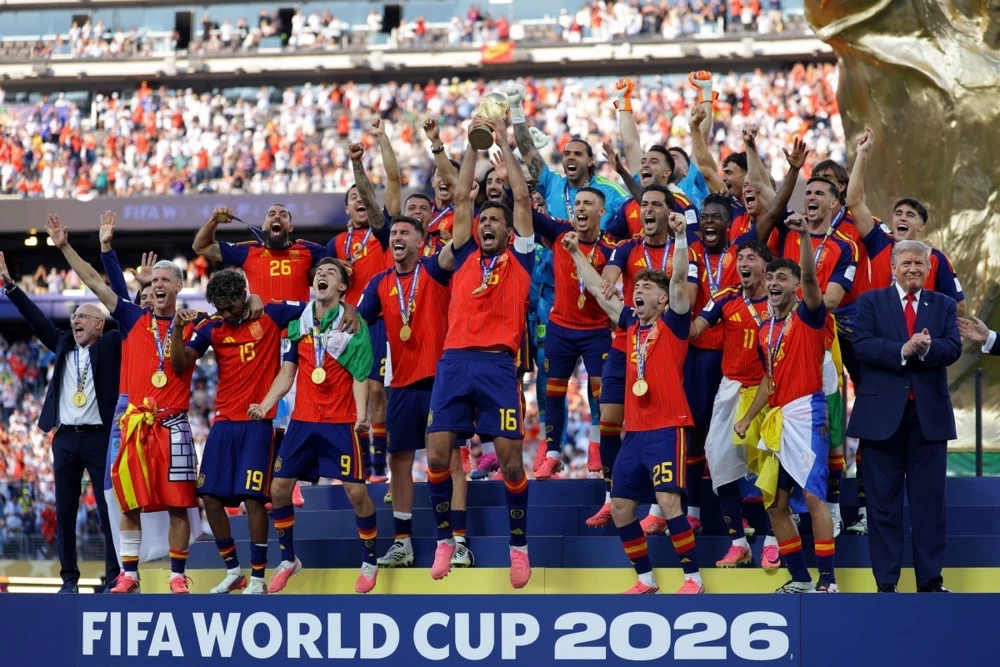
Spain captain Rodri lifts the World Cup celebrating the triumph (EPA)
In addition, the competition model in Spanish football is characterized by the fact that the reserve teams of La Liga clubs participate within the official competition pyramid in semi-professional tiers, which accelerates the maturation of players at the competitive level. In some cases, these teams succeed in reaching professional football competitions, as will happen in the 2026-2027 season with the participation of Real Sociedad B and Celta Fortuna in La Liga Hypermotion (the second division of Spanish football). This integrated model contributes to preparing more complete players, better able to adapt and succeed in various playing styles, and this is one of the main reasons why the Spanish technical and tactical methodology today is one of the most demanded and exported models around the world.
Original source: Asharq Al-Awsat



Comments (0)
Be the first to comment.