By the Numbers… Why Spain Deserved the World Cup Title?
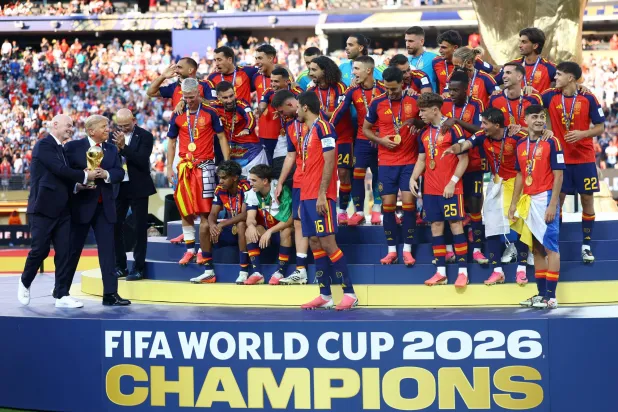
Spain's second world title, 16 years after their first in South Africa, was no fluke; behind it are numbers and statistics that showcase the brilliance of their players.
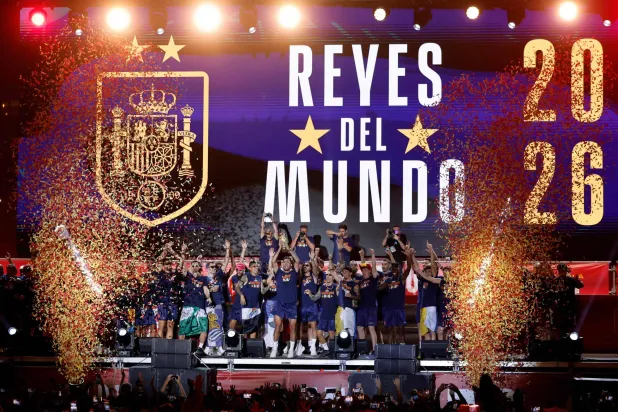
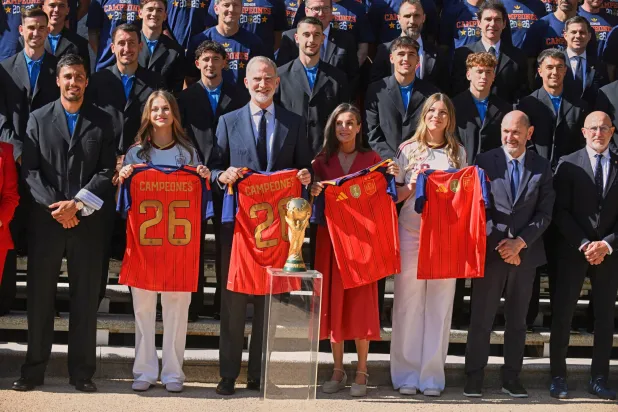
Spain's second world title, 16 years after their first in South Africa, was no fluke; behind it are numbers and statistics that showcase the brilliance of their players, who deservedly beat Argentina 1-0 after extra time on Sunday in New Jersey, near New York.
FIFA published these impressive numbers across all positions, from goalkeeping to defense, midfield, and attack, as well as collective performance.
Midfielder Rodri deservedly earned the title of Best Player of the tournament. The Spanish captain completed 790 successful passes, breaking his own personal record as the player with the most passes in World Cup history.
The midfielder had made 638 successful passes in the 2022 Qatar tournament, breaking the previous record set by Xavi in South Africa 2010 (599 passes).
His closest chasers in North America were his compatriots Pau Cubarsí (668 passes) and Aymeric Laporte (618 passes).
Spain's defenders Marc Cucurella and Pau Cubarsí each played 750 minutes, tying for the most playing time with Argentina midfielder Alexis Mac Allister.
Mikel Oyarzabal recovered the ball 58 times, more than any other player in the tournament. The 29-year-old forward was followed by his Spain teammate Pedri and Morocco's Nael El Aynaoui (51 each), while his teammate Dani Olmo applied defensive pressure the most (305 times).
With Spain's victory at New York New Jersey Stadium, the team went unbeaten in 38 consecutive matches, a new world record. Since a 1-0 loss to Colombia in March 2024, Luis de la Fuente's squad have won 29 and drawn nine. The previous record was held by Italy with 37 matches unbeaten between 2018 and 2021.
Lamine Yamal completed the most successful dribbles in this tournament (35). He was followed by France's Kylian Mbappé (28), Argentina's Lionel Messi (25), Brazil's Vinícius Júnior (23), and Belgium's Jérémy Doku (21).
The late Argentine Diego Maradona holds the record for the most successful dribbles in a single edition (53 in Mexico 1986), while his compatriot Lionel Messi has the best record in the 21st century (46 dribbles in the 2014 Brazil finals).
Lamine Yamal (19 years, 6 days) became the fourth youngest player to win the World Cup (jointly). He is preceded only by Italian defender Giuseppe Bergomi (18) and Brazilians Pelé and Ronaldo (17).
Bergomi was nicknamed 'The Uncle' because, despite his young age, he sported a thick mustache. Pau Cubarsí (19 years, 178 days) ranked seventh on the list, one place ahead of France's Kylian Mbappé.
Spain scored 14 goals in these finals, two more than their previous best in a tournament set by Emilio Butragueño in 1986, and four more than they scored in their 2010 title-winning campaign.
Spain carved their path to the title with seven consecutive wins. Only Brazil, with 11 straight wins spanning the 2002 and 2006 editions, has a longer winning streak than La Roja in the finals.
Unai Simón kept a clean sheet in seven of eight matches, the highest number in a single edition of the tournament.
The previous record was five matches, held by Netherlands' Jan Jongbloed (1974), Italy's Walter Zenga (1990), Brazil's Taffarel (1994), France's Fabien Barthez (1998), Germany's Oliver Kahn (2002), Italy's Gianluigi Buffon (2006), and Spain's Iker Casillas (2010).
Simón also set a new record for consecutive minutes without conceding a goal in the World Cup: 650 minutes, stretching from the 2022 Qatar finals (where Spain exited on penalties to Morocco in the round of 16) until he finally conceded a goal from a shot by Belgium's Charles De Ketelaere in the quarterfinal.
The previous record was held by Zenga (517 minutes).
Mikel Oyarzabal scored five goals in this tournament, equaling the Spanish record for most goals in a single World Cup. Butragueño also scored five in Mexico 1986, and David Villa matched that in South Africa 2010.
Ferran Torres became the second substitute to score the winning goal in a World Cup final, after Mario Götze for Germany against Argentina in 2014. Overall, the Valencia native became the fifth player to come off the bench and score in a final, after Netherlands' Dick Nanninga, Italy's Alessandro Altobelli, and Germany's Rudi Völler. Remarkably, four of them scored against Argentina.
Spain conceded just one goal, the fewest conceded by a champion during a World Cup campaign, surpassing France in 1998, Italy in 2006, and Spain themselves in 2010 (two goals each).
Original source: Asharq Al-Awsat


Comments (0)
Be the first to comment.