Collina settles debate over refereeing in Egypt-Argentina clash
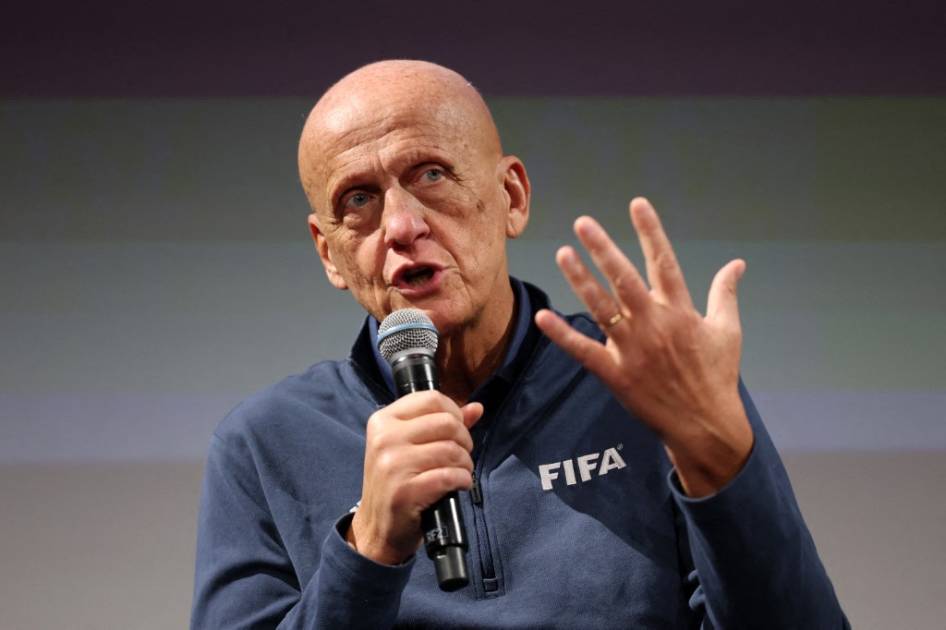
Summary: The former Italian referee and FIFA Referees Committee Chairman Pierluigi Collina responded to the Egyptian national team's accusations against the referee of the Argentina match, and defended the independence of World Cup referees.
The head of the FIFA Referees Committee, Pierluigi Collina, defended the refereeing in the round of 16 World Cup match that ended with Argentina's 3-2 win over Egypt, rejecting allegations of bias and emphasizing that match referees work with complete independence.
In an interview published on FIFA's website on Thursday, Collina said that criticizing referees is part of football, but he condemned questioning the integrity of referees after Egypt complained about the officiating following the defeat.
Collina said: 'Constructive discussion about decisions will always remain part of football, but baseless allegations have no place in our sport.'
He added: 'No one can question the integrity of World Cup match referees... and no one can claim that refereeing in FIFA can be influenced by any person, not even the FIFA President (Gianni Infantino).'
Collina explained that such allegations could lead to threats against referees and their families.
Egypt's objections to refereeing decisions: Egypt exited the tournament, but considered that they were wronged by refereeing after Argentina turned a two-goal deficit into an exciting victory, sealing the match with a last-gasp goal scored by Enzo Fernandez in stoppage time.
Coach Hossam Hassan claimed after the match that there might have been pressure on the referee to keep Argentina in the tournament, while the Egyptian Football Association expressed 'its deep dissatisfaction with the performance of the refereeing team that officiated the Egypt-Argentina match and with some decisions related to the Video Assistant Referee (VAR) technology, which raised many question marks... The association affirms its commitment to the rights of the national team and its keenness to take all measures permitted by the regulations to preserve the fairness and integrity of the competition.'
Egypt said that Mostafa Abdel Raouf 'Ziko's goal in the second half was wrongly disallowed due to an alleged foul in the build-up, stressing that the supposed foul did not occur at all. Also, it was angered by the failure to award a foul in favor of Mohamed Salah after a challenge moments before the move that led to Argentina's winning goal.
Collina's explanation of the video technology and controversial decisions: Collina said that the Video Assistant Referee correctly recommended disallowing Ziko's goal after spotting a foul by Marwan Attia against Argentina defender Lisandro Martinez during the build-up.
Collina said: 'We see that a foul remains a foul. Regardless of whether the foul seems 'clear', if the referee on the field did not see it, the VAR can intervene.'
Collina also defended the decision not to award a penalty to Egypt before Argentina's winning goal, saying that both the on-field referee and the VAR deemed the contact between Salah and Julian Alvarez as 'a normal football challenge.'
He added: 'Stepping on an opponent's foot is an offense, while a defender who touches the ball first and then makes normal football contact has not committed an offense.'
Despite acknowledging that some refereeing situations are inherently subject to interpretation and judgment, Collina emphasized that FIFA is satisfied with the application of VAR principles throughout the tournament.
Original source: Independent Arabia



Comments (0)
Be the first to comment.