Julián Álvarez... from recovery race to hero of 'Swiss night'
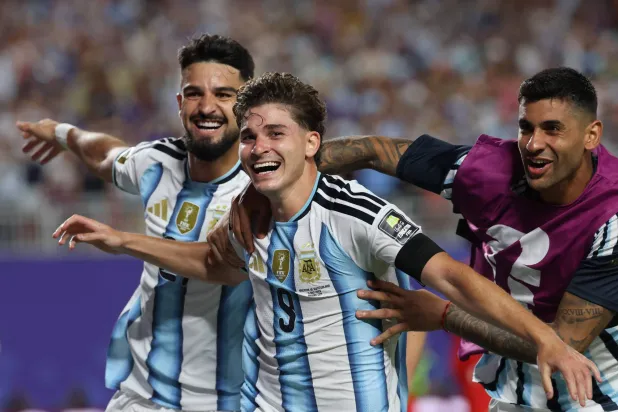
Julián Álvarez appeared at the moment everyone was waiting for.
Dani Olmo started the 2026 World Cup from the bench in the opening match against Cape Verde, but soon became a key pillar in Luis de la Fuente's plans, and is expected to lead the team's attack in the semi-final against France on Tuesday.
Olmo is considered one of the fundamental pillars in the possession-based playing style adopted by the Spanish national team.
With the style based on ball control, Olmo becomes an indispensable element due to his ability to connect between midfield and attack.
De la Fuente said at the start of the tournament: 'He is a master at playing between the lines.'
The 28-year-old Barcelona player is living his best period. Throughout his career, few have doubted his talent and playmaking ability, but he has rarely enjoyed continuity due to injuries, which has probably deprived him of a greater international presence.
Olmo said before the match against Belgium: 'My life and career have been like this, I always have to prove who I am, but that's not a problem, it's a challenge I set for myself, to prove it again, as I have always done,' adding that, unlike his teammates, he had to emigrate outside Spain as a teenager to build his football future.
Olmo... formed in 'La Masia', Barcelona's training center, but in 2014, at age 16, he decided to leave for a different experience (Reuters)
Emigration for success
Olmo grew up in 'La Masia', Barcelona's academy, but in 2014 when he turned 16, he preferred to leave due to the difficulty of reaching the first team, which was brimming with names like Iniesta and Xavi.
But instead of moving to another big club in Europe, he chose with his family to go to Dinamo Zagreb, a club with a good reputation for developing young talents (Luka Modrić, for example, graduated there), but far from the spotlight of the major leagues.
Olmo said previously: 'In Croatia, the culture was different, and I learned a lot physically.'
He added: 'In Spain, the focus was more on the ball, especially at Barcelona (...) but Croatia benefited me a lot. I was 16 years old, and I was training with national team players who played in the World Cup. It was a big step for me. It made me develop physically and mentally because the game was faster.'
In Zagreb, his name began to shine, before moving to Leipzig where he honed his talent in the German league, until he returned to Barcelona exactly two years ago.
He is considered a key element in German coach Hansi Flick's team thanks to his ability to play between the lines and open spaces for his teammates, as well as his goal contributions: 20 goals and 17 assists in 88 matches wearing the Catalan club's shirt.
Olmo returned to Barcelona after writing his name as a prominent star (AFP)
With De la Fuente in the age groups
De la Fuente didn't need to see him at Barcelona to call him up to the national team. As is the case with a number of 2026 World Cup players (Unai Simón, Mikel Merino, Mikel Oyarzabal, and Fabián Ruiz), Olmo was crowned European Under-19 champion in 2019 under his leadership.
Two years later, he called him up again for the Tokyo Olympics, where Spain won the silver medal, even though he had already made his international debut with the senior team and scored a goal just 3 minutes after entering the pitch in the Euro 2020 qualifier against Malta in 2019.
He participated in the European Championship in summer 2021 and the World Cup in Qatar 2022, but his most notable achievements with the 'La Roja' shirt came with De la Fuente, as he won the UEFA Nations League in 2023, and was runner-up in 2025, as well as winning the European Championship in 2024, and now he reaches the semi-final of the North American World Cup.
De la Fuente values Olmo's dynamism in attacking play, his ability to make a difference, and his pressing effort.
The number 10 holder of the red national team said before the quarter-final against Belgium: 'We are a team that attacks together and defends together. The coach says the first defender is the striker, and the rest follow him.'
Olmo's early career shows that he had to leave Spain as a teenager to build his football future, which gave him different physical and mental experiences. However, he suffered from lack of continuity due to injuries, a challenge he seeks to overcome in this tournament. The semi-final against France remains a decisive test for his attacking leadership and ability to translate his efforts into results.
Original source: Asharq Al-Awsat

.jpg)

Comments (0)
Be the first to comment.