Why has Haaland transformed from a football star into a cultural phenomenon?
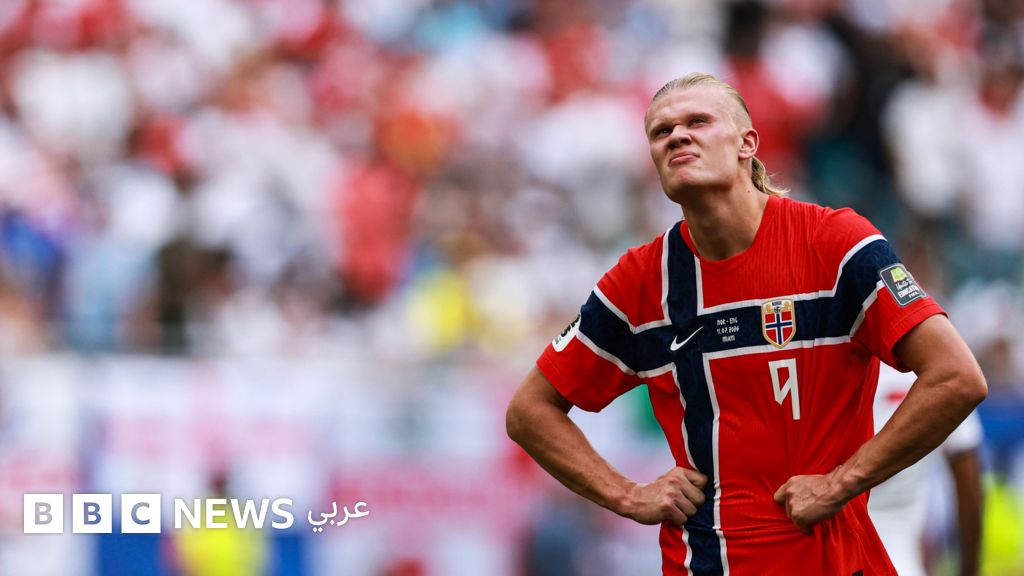
Why has the Norwegian star Erling Haaland transformed from a dazzling player on the pitch into a digital phenomenon? And why is he seen as a different model of masculinity?
Why has Haaland transformed from a football star into a cultural phenomenon?
Published 6 minutes ago
Reading time: 5 minutes
Even if the Norwegian national team exited the World Cup qualifiers, it can be said that its brightest star, Erling Haaland, has achieved victory... online.
Within a few weeks, the Norwegian striker's name became one of the most talked-about on social media platforms, transforming into something of a cultural phenomenon that transcended the boundaries of football.
For example, searches for Haaland's name on TikTok in the UK rose by more than 300 percent in one week, making him the most searched player during that period of the tournament.
Searches for the phrase 'Haaland best moments' also jumped by more than 1,300 percent, while thousands of posts bearing his name tag spread.
But notably, many of the searches were not only related to his goals or stats, but to his daily life: What is his morning routine? Does he really drink ultra-pure water? And what is his connection to the Chinese herbal drink 'Wong Lo Kat'? Indeed, some users even searched for people who look like him.
So what made the 25-year-old player one of the most prominent faces of this edition of the FIFA World Cup? And what is the reason for the growing public interest in him?
Who will win the 2026 World Cup? This is how artificial intelligence predicts.
World Cup: Argentina and England's hard-fought passage to the semi-finals and completion of the golden square
Skip most read and continue reading
Houthis target Abha airport and warn against flying in Saudi airspace
Iran expands attacks to Bahrain, targets two tankers in Hormuz, and Washington continues its third night of strikes
Why do mosquitoes bite some people more than others?
United Kingdom: 12 people arrested for threatening an Islamic event in Suffolk
An unmanufactured image
Skip podcast and continue reading
Worth attention
In-depth explanation of key events and topics to help you understand the most important changes around you and their impact on your life
Episodes
Podcast end
It seems that a large part of the answer lies in the way Haaland presents himself to the public.
Unlike many athletes whose accounts are filled with carefully designed promotional posts, Haaland shares spontaneous clips from his daily life, showing himself eating at local restaurants, trying American accents in a funny way, or simply acting like a 25-year-old enjoying his trip to the United States.
This spontaneity has made many feel that fame hasn't changed him, and that he doesn't try to fabricate a certain image of himself, and that his online presence is closer to an ordinary person than to a global star whose every appearance is subject to PR calculations.
Perhaps what helped spread his popularity even more is that he doesn't take a spectator stance towards the memes that spread about him, but rather participates in them himself.
For example, when a video seen by tens of millions compared his hairstyle to a green onion, he didn't get angry or ask for it to be removed, but responded with a famous meme of a dog looking sideways in a sarcastic comment.
Even when Google added a Viking-inspired animation to search results for his name, he jokingly invited his followers to try searching for themselves.
On another occasion, he revealed that he ignored a message he received on Instagram from actor Tom Holland, simply because he didn't know who he was.
This kind of self-mockery made his digital presence seem closer to the language of 'Generation Z' to which he belongs, who prefer self-deprecation and interaction with jokes rather than trying to control a rigid public image.
'Babygirl' and different masculinity
Image caption: Some compared Haaland to the image of masculinity promoted by 'manosphere' communities online
Alongside his goals, another discussion emerged on social media regarding Haaland's personal image.
While on the pitch he appears as a strong, unstoppable striker, off it he shows a cheerful personality, not hesitating to laugh at himself or interact lightly with the audience.
A number of users and content creators believe that this contrast between athletic strength and spontaneity in daily life makes him represent a different model from the traditional image of masculinity associated with football, which is often linked to aggression or displays of dominance.
Therefore, in some digital communities, the term 'babygirl' has spread as a description for Haaland; it is a sarcastic expression used by internet audiences to describe men who are strong and successful but also appear kind, sensitive, or far from traditional displays of masculinity.
Some even compared him to the image of masculinity promoted by 'manosphere' communities online, where control, dominance, and showing superiority over others are often celebrated.
In contrast, these observers see that Haaland combines physical strength with humor and humility, without seeming preoccupied with proving his 'manliness'.
Special popularity among women
For this very reason, this aspect of his personality has become the focus of thousands of posts written by women on TikTok, Instagram, and X, in which they talked about how Haaland was the reason for their interest in following World Cup matches, even though some of them had not followed football before.
Some commentators believe that his presence through memes and daily stories made football seem more open to an audience that has long felt excluded from traditional fan culture.
Also striking many was his decision to add his mother's maiden name 'Braut' to his shirt in the World Cup, a move followers considered a rare gesture of appreciation to his mother.
Image caption: Many were struck by his decision to add his mother's maiden name 'Braut' to his shirt in the World Cup
Between the Golden Boot and trend-making
Part of Haaland's popularity lies in the way his personality has intertwined with internet culture, alongside his brilliance on the pitch.
While his goals created important football moments, his sarcastic comments, spontaneous photos, and related memes also formed a broad digital presence that extended beyond football.
In a time when fame is measured by the ability to create trends and feed content and digital discussions, it seems that Haaland has managed to combine competing for the Golden Boot (the award given to the player who scores the most goals during the tournament) and turning, in many eyes, into one of the most prominent internet stars during this World Cup edition.
Skip short clips and continue reading
Short clips
Short clips end
Bono cries and reveals reasons for defeat against France July 10, 2026
World Cup: How Arabs told their story in the group stage (by numbers) June 28, 2026
Morocco's World Cup dreams collide with France's strength and Mbappé's brilliance July 9, 2026
Original source: BBC Arabic



Comments (0)
Be the first to comment.