Spells, Prayers, and Talismans: How World Cup Fans Turn to the Supernatural to Support Their Teams?
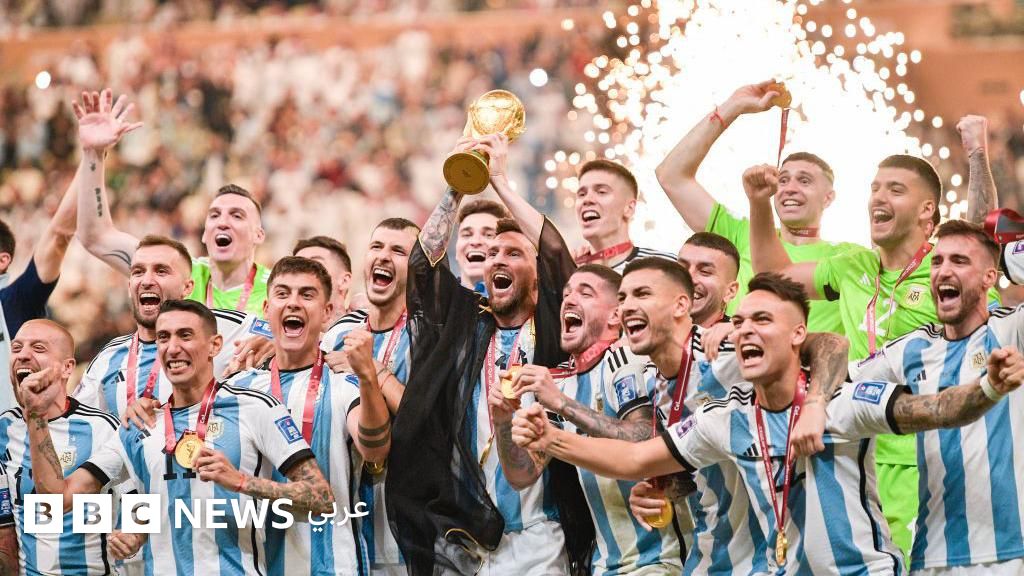
From candles and prayers to mysterious rituals: How faith and superstition merge in football and the World Cup?
Spells, prayers, and talismans: How World Cup fans turn to the supernatural to support their teams?
Image caption: Argentina won the FIFA World Cup in 2022.
Article Information
Author, Libby DesiatoRole, Global Religion CorrespondentReporting from, London
Published 29 June 2026
Reading time: 5 minutes
Dalia Walker believes something supernatural was behind her country's victory in the last World Cup.
Dalia, a 41-year-old from Buenos Aires, says, "I think magic helped Argentina win."
Dalia was one of a large group of women who describe themselves as witches, casting spells and performing various rituals to support Lionel Messi and the rest of the Argentine team.
These women called themselves 'La Brujineta', a name combining 'bruja' (witch in Spanish) and 'La Scalonneta', the nickname for the Argentine team under current coach Lionel Scaloni.
Mohamed Salah: Can Egypt's icon lead the 'Pharaohs' to a historic feat at the 2026 World Cup?
Football betting in the Arab world: Heavy turnout and a thriving market despite the ban
Dalia says members of 'La Brujineta' used modern witchcraft, candles, prayers, and talismans in their rituals.
The women communicated via WhatsApp groups and social media, sharing ideas about which aspects of the team's performance needed the most support.
One of the most common rituals aimed to 'freeze' the abilities of specific opposing players, something Dalia says she did not support.
Instead, she preferred rituals she considered more positive, such as lighting candles and sending 'positive energy'.
Skip Most Read and Continue Reading
Do you really need to avoid gluten?
'A meal I ate on holiday ended up giving me 38 parasites in my brain'
Ukraine strikes a major oil facility in the Russian city of Saint Petersburg
Funeral music and 'selected verses': How social media covered Khamenei's farewell ceremony
Image caption: Dalia Walker says she will light candles on her altar for Argentina.
When Argentina won in Qatar in 2022, the 'La Brujineta' group saw it as a culmination of their efforts.
Dalia says, 'For me, that was truly the witches' World Cup.'
She plans to perform the same rituals this time, lighting blue and white candles, the national team colors, on her altar.
She adds, 'In Argentina, if something works, superstition says you have to repeat it exactly the same way next time.'
It's not just 'La Scalonneta' fans who turn to supernatural powers. In Peru, a group of shamans performed rituals in Lima to help their team qualify for the 2022 tournament, but they lost 5-4 on penalties to Australia. Across Africa, spirituality deeply intertwines with daily life, including football.
Rituals and Spells
For some, this means turning to local belief systems and traditional healers. In 2002, the Confederation of African Football (CAF) banned so-called 'team consultants'—a euphemism for traditional spiritual healers—from any role with teams participating in the Africa Cup of Nations.
Sports journalist Maher Mezahi says that even now, some passionate fans rely on traditional practices while dancing and cheering in stadiums, wearing talismans, reciting spells, and in some cases even 'breathing fire'.
In November last year, when Nigeria was eliminated from World Cup qualifiers, their coach Eric Chelle accused the Democratic Republic of Congo team of using 'voodoo' magic, but former DR Congo coach Florent Ibenge dismissed the claims as 'nonsense'.
Image caption: Nigeria coach Eric Chelle accused the Democratic Republic of Congo team of using voodoo magic.
The hint of magic and sorcery may make many reluctant to openly admit to practicing traditional rituals.
Mezahi says, 'The football world tends to be Eurocentric. The biggest clubs are there, the best players play there, so anything foreign to Europe may be viewed or treated with suspicion.'
But he believes 'this is not something Africans should be ashamed of; it's something we practice in our daily lives.'
He affirms that accepting the idea that 'traditional African spiritual practices are backward, primitive, or third-world' reinforces the belief that everything from the West is best.
But some argue there is a big difference between performing rituals aimed at influencing the opposing team's performance or the match outcome, and generally praying for God's blessing.
At the World Cup, I only support Captain Majid
'God is the center of everything we do'
Mezahi says African football fans and teams are more open to embracing Abrahamic religions, such as Christianity and Islam.
He points to a common chant among Algerian fans that includes a prayer to God to protect and help their team. He adds, 'If you listen to West African countries in particular, like Ghana or Nigeria, they play gospel music at every match.'
Ghana's Sports Minister, Kofi Iddie Adams, recently asked a church gathering to pray for the national team, known as the 'Black Stars'.
The Ghana Football Association also sought prayers from the country's two largest religious groups, Christians and Muslims. A national prayer service was held in Accra to pray for the team before their participation in what the association described as 'the biggest stage in football', referring to the World Cup.
Image caption: Ghana fans attend a friendly match against Wales in June.
The Ghana Football Association shared the country's Imam in Friday prayers before the tournament, where the Imam prayed for God to grant the team success and blessings, according to an FA statement.
Accra-based journalist Nathan Larya says, 'We believe that God is the center of everything we do,' explaining the importance of faith in Ghanaian culture.
He adds, 'Yes, human effort is important, but this prayer is a special and blessed culmination of our efforts, and it is necessary for victory.'
He continues, 'So prayer and seeking God's protection and guidance are important.'
Image caption: Brazilian player Kaká boldly revealed his faith.
Maher Mezahi says, 'Perhaps there is no place where faith and football intertwine as much as in Africa.'
He adds, 'One of the clearest expressions of faith I saw as a boy was after Brazil won the World Cup in 2002.'
He continues, 'There was a player named Kaká who took off his jersey, and underneath he wore another shirt that said: 'I belong to Jesus.' I said to myself: 'This is interesting; I had never thought of someone wearing a shirt like that under his jersey.'''
Mezahi says that was 'a message to the world.'
Original source: BBC Arabic


Comments (0)
Be the first to comment.