Souls That Refuse Amputation: The Story of the First Women's Amputee Football Team in the Gaza Strip
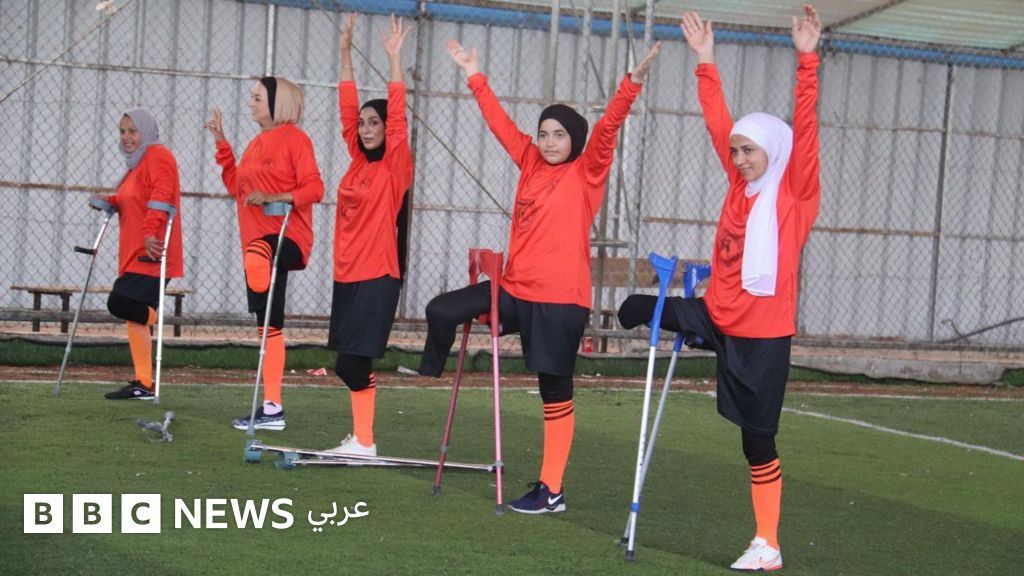
In the Gaza Strip, the first players of the women's amputee football team are engaged in an epic of willpower, challenging injury and war conditions to prove that disability does not prevent dreaming or winning. What is their story?
Souls That Refuse Amputation: The Story of the First Women's Amputee Football Team in the Gaza Strip
Article Information
Author, Marwa JamalRole, BBC News Arabic
Published 2 hours ago
Reading time: 6 minutes
"What I remember is that I woke up, tried to get up from the bed, but couldn't stand on my legs, so I started hopping on one leg until I reached the living room. After I arrived, I discovered that my leg was missing."
At dawn on November 19, 2023, Razan Imad Kheira, a 24-year-old young woman and a famous runner in the Gaza Strip, was sleeping in her home in the al-Daraj neighborhood in the heart of Gaza. She did not know that this night would split her life into two halves: before amputation and after. The aircraft targeted the house opposite hers, and everything changed.
She says of that moment: "I kept bleeding for an hour and a half while my family tried to call an ambulance amid the fire and constant shelling, until the car finally arrived to take me to the al-Daraj clinic. There, doctors faced a complex medical situation; the bullets and shrapnel had left my second leg hanging by a thin piece of skin."
Razan continues: "They gave me first aid there, and they amputated the leg that was still there, the one hanging by a single piece of skin. The doctor held my leg and placed it next to me."
Learn about the secret history of women's football
This terrifying scene was even harsher for Razan because she was not an ordinary girl; she was a runner.
Sports run in her family's blood since childhood: "Before the war, I was a runner. My father is a football player and coach in the stadiums, and my uncle is a football player and coach. Since we were children, they taught us this. In the stadiums, we were always there—me, my sisters, the boys, my cousins—all of us as a sports family."
Comment on video, Gaza football player: I lost my foot in the war but I did not lose my dream
When the "Palestine Amputee Association" contacted her to offer the idea of joining a women's football team, Razan felt the offer was strange; she is a long-distance runner, not a football player. But the will to live inside her made her overcome hesitation: "It's not my specialty, football, but I said to myself, why not? Why don't we try? Why don't we give this team a try?"
Today, Razan looks at her crutches not as tools of disability, but as alternative wings. She is well aware that her current crisis lies in the lack of prosthetic limbs she seeks to obtain in order to stand again, but at the same time she does not put her life on hold.
Skip most read and continue reading
Mowaffaq Salti Air Base: What do we know about the Jordanian air base targeted by Iran?
"Trump, not Iran, is the greatest threat to the world; he is a weapon of mass destruction by himself" – article in The Guardian
World Cup 2026: Who will win the biggest World Cup in history, Argentina or Spain?
With orange lips and a roar-like call... a new monkey discovered in the Congo forests
"Injury is not the end of life and not the end of the road. On the contrary, maybe because of my injury I can achieve bigger things than this. I am the one who chooses the path ahead, not the injury. I have not lost hope, and all that hinders me now is getting a prosthetic limb. If there is an alternative like crutches or playing with one leg, why not? With the very little we have and the limited opportunities available, we try and strive. Injury is not the end of the road."
Image caption, the runner Razan
"My foot left me, but depression did not leave me"
Dalia, one of the team members, experienced a similar ordeal to Razan. The shell that fell on her house did not pass by; it left behind an amputated body and a soul burdened with trauma. Dalia introduces herself today with a phrase that sums up a reality forced by war: "My name is Dalia al-Sakouri, a war casualty."
Dalia recalls those long days when the boundaries between night and day faded within the hospital walls: "Five months was my treatment period after my house was bombed. My foot left me during that time, but depression did not leave me. Five full months of successive surgeries, enduring pain, and facing the psychological paralysis that follows the loss of limbs."
Euro 2022: England wins the Women's European Championship for the first time
In that black-clad period, when depression was devouring every thought that crept into her head, Dalia began a journey to find any straw to cling to so she wouldn't fall completely. She would stare at the ceiling of the room and talk to herself: "Thank God, I still have my mind. Yes, I have an amputated foot, but thank God I am better than others, and others are better than me."
The biggest challenge lay in her profession; Dalia is primarily a photographer, a profession that depends entirely on movement, on chasing, and on standing for long periods to capture the frame. In a moment of honesty with herself, she realized that her previous professional life had changed forever: "I was a photographer, but I can't do what I used to do before. Before is different from today."
This forced transition led her to spend long hours in front of internet screens, browsing aimlessly, until a different spark appeared before her eyes: videos of a team of amputees playing football.
She asked herself in secret: "Why don't I benefit from this game and that?" She felt an overwhelming joy that revived her desire to take initiative. She immediately moved and spoke to the head of the association, explained her desire and her situation, and the reply came welcoming: "I would like you to be with us and be on this team."
Skip the podcast and continue reading
Worth paying attention to
In-depth explanation of the most prominent events and topics, to help you understand the most important changes around you and their impact on your life
Episodes
End of podcast
Dalia stepped onto the field, and when her remaining foot touched its bright green grass, she felt her soul breathing again, as she says: "Thank God... the game of football made me happy... and I try to get closer to it more, and God willing, I will be happier and happier."
When we asked Dalia about the impact of her injury and how she managed to overcome this obstacle and join the team, she answered: "My injury today is an amputation, may God help. Whether it's me or others, anyone injured, may God help them. Today I challenged my injury; I challenged it because I want to play football, because one day I will benefit. We Palestinian girls, nothing stops us, thank God. Even though the war is still going on, even though the injuries keep happening, despite everything, thank God we are up to it."
Women who loved football and ascended to its throne
Dalia does not deny the daily suffering; leaving the house has become a battle in itself. She says about it: "Today I suffer a lot from my errands, but then I say, I am up to it... I go out and come down and go and come back."
This daily stubbornness has turned into a source of inspiration for those who watch her on the street; people surround her with words of support: "Most people keep telling me, 'Masha'Allah, you have willpower.' That makes me happier, and I love it when people come and tell me, 'Masha'Allah, you have willpower' and so on."
For Dalia, the field redefined the impossible; the body that was unable to run normally found in the presence of the ball an exceptional driver to run with one foot after the round ball.
One-handed goalkeeper
Original source: BBC Arabic




Comments (0)
Be the first to comment.