Tebas opens fire on FIFA after Balogun decision
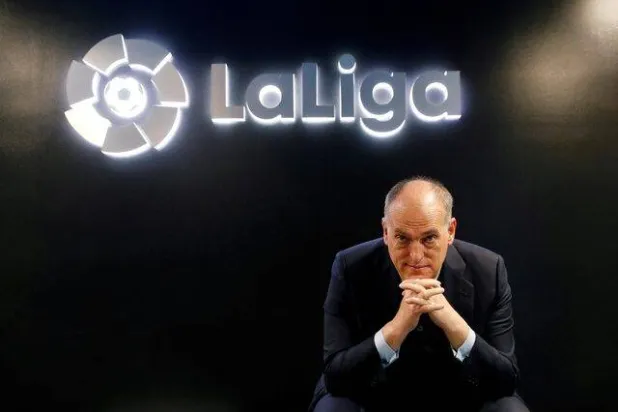
Javier Tebas, president of the Spanish Football League (LaLiga), launched a violent attack on what he described as the complicit silence surrounding the International Federation of Association Football (FIFA).
English referees Michael Oliver and Anthony Taylor will not be able to officiate any match played by the Argentine national team in the 2026 World Cup, despite being among the tournament's top referees, due to political and geopolitical considerations related to the legacy of the Falklands War.
According to The Athletic, Oliver will officiate the match between Spain and Belgium in the quarter-finals, making it his seventh match of the tournament, the most matches an English referee has officiated in a single World Cup. However, his chances of leading the final match appear very slim.
This is because FIFA regulations prevent referees from officiating matches of their national teams to maintain neutrality and avoid conflicts of interest. However, for English referees, the ban extends to Argentina's matches due to the historical dispute between the two countries over the Falkland Islands.
Legacy of the Falklands War
The Falklands War broke out in 1982 and lasted 74 days between the United Kingdom and Argentina, ending with the surrender of Argentine forces and the return of the islands to British control.
The war resulted in the deaths of 649 Argentine soldiers and 255 British soldiers, in addition to three islanders. The issue remains a sensitive file in Argentina, where President Javier Milei constantly reaffirms his country's sovereignty over the islands.
How does FIFA select referees?
FIFA appoints referees for each match separately, taking into account a set of factors, including geopolitical considerations.
Under this policy, a referee from a country that has political or historical disputes with another country is not assigned to officiate a match involving that national team, to avoid any suspicion of bias or conflict of interest.
This is not limited to England and Argentina; the same rule can apply to other disputes, such as not assigning matches involving Iran to referees from the United States, or vice versa.
Not just national team matches
These criteria also extend to matches that may directly affect the path of the referee's national team in the tournament.
For this reason, English referees were not candidates to officiate any match in England's group during the group stage, nor will they be candidates to officiate the Switzerland-Argentina quarter-final showdown, because the winner could face England in the semi-finals if England beats Norway.
Principle also applied in club tournaments
The same idea is adopted in club competitions. In the English Premier League, referees are prohibited from officiating matches of clubs from their regions or those with which they have ties that could raise suspicions.
That is why Michael Oliver does not officiate matches for Newcastle United or Sunderland, because he is from northeastern England.
The final decision
The appointment of referees is overseen by a team led by Pierluigi Collina, who has the final say in selecting officiating crews for each match, taking into account technical, geographical, and political aspects to ensure the highest levels of integrity and neutrality in the tournament.
Original source: Asharq Al-Awsat



Comments (0)
Be the first to comment.