The Italian Sculptor Who Turned Gold into a Dream: The Complete Story Behind the World Cup Design

Behind the World Cup, one of the most famous sports symbols in history, stands an Italian sculptor who turned a piece of gold into an icon that encapsulates the dreams of teams and fans, and embodies the most important moment of victory in every player's career.
Competition to choose a new trophy: The story of the design began in the early 1970s, after Brazil kept the Jules Rimet trophy following their third tournament win in 1970; prompting FIFA to search for a new design that expresses the universality of the game and the value of the tournament.
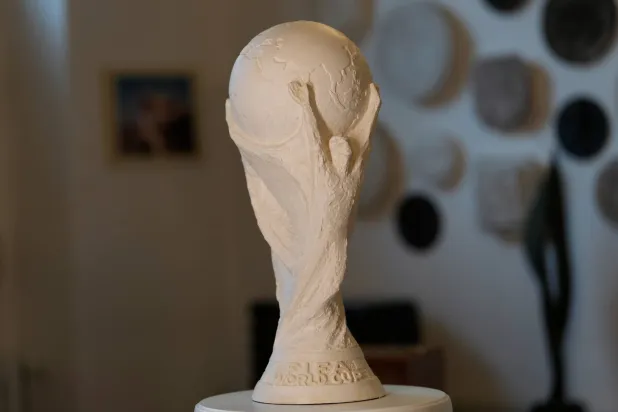
Dozens of artists and designers submitted their proposals, before selecting the design of Italian sculptor Silvio Gazzaniga, who offered a different concept based on two human figures holding the Earth, in a scene that combines power, movement, and joy.
The trophy is made of 18-carat gold, stands about 37 centimeters tall and weighs more than six kilograms, while its base is adorned with two bands of green malachite.
Gazzaniga did not design the trophy as a static object, but gave it an upward motion starting from the base, then rising in spiraling lines to the Earth; so that the two figures appear to be celebrating lifting the world to the sky.
The trophy first appeared in the 1974 World Cup finals, and West Germany was the first team to lift it after winning the final against the Netherlands.
Since then, the moment of lifting the trophy has become the most anticipated final scene of the tournament, encapsulating tears of joy and the long journey that players and teams undertake to reach the podium.
For more than five decades, the trophy's value has transcended that of precious metal, transforming into a global cultural icon known to millions, even those who do not regularly follow football.
The winning team is not given the original trophy to keep permanently; it remains the property of FIFA, and the champion later receives a commemorative replica, while the names of the winning teams are engraved on the base of the trophy.
Original source: Sabq

Comments (0)
Be the first to comment.