Unprecedented Final in World Cup History
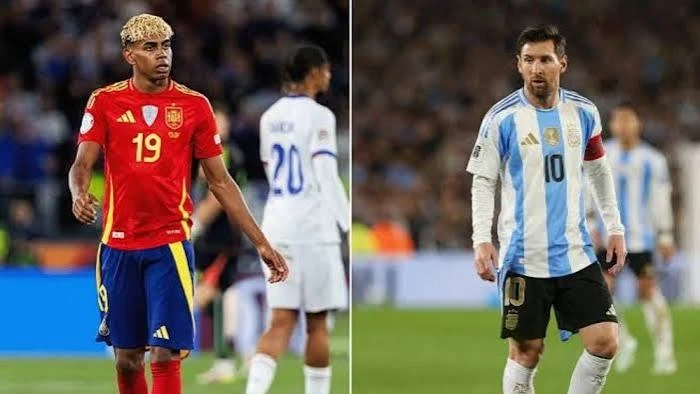
The 23rd FIFA World Cup concludes on Sunday at MetLife Stadium in East Rutherford, New Jersey, near New York, with a match between Spain and defending champion Argentina. It is the first time in history that the European champion meets the Copa América champion in the final.
Spain is aiming for its second title in its second final appearance after winning in South Africa in 2010, while Argentina seeks to equal the joint runners-up to record-holder Brazil (5 titles) – two European teams, Germany and Italy (4 each).
Argentina plays its seventh final, having lost in 1930, 1990, and 2014 to Uruguay, West Germany, and Germany respectively, and won in 1978, 1986, and 2022 against the Netherlands, West Germany, and France.
Argentina relies on its star Lionel Messi, while Spain hopes its talented 19-year-old player Lamine Yamal will have a good day to decide the match without extra time or penalties.
Europe leads in the number of titles in World Cup history: its representatives have won 12 times – Germany and Italy 4 each, France 2, Spain and England 1 each – compared to 10 for Latin America, represented by only three countries: Brazil (5 titles), Argentina (3), and Uruguay (2).
Defensive strength and offensive efficiency for Spain
Spain has conceded only one goal and has never trailed in this tournament, becoming the first team to keep clean sheets in six matches in a single World Cup.
Defensive solidity and attacking efficiency have marked the team's path to the final, clearly demonstrated in the 2-0 win over France, the 2018 champion and 2022 runner-up, in Tuesday's semifinal in Dallas.
The surprising goalless draw against Cape Verde in the opening match raised doubts about Spain's abilities in this tournament, but six consecutive wins have dispelled all question marks.
After eliminating the European quartet of Austria, Portugal, Belgium, and France in the last four knockout rounds, Spain is one step away from making history. The team has not lost in 37 matches (27 wins, 10 draws, in regular time only). Victory would give it not only the longest unbeaten streak for a European team ever, but also a sixth major title from seven finals played.
For its part, Argentina staged another comeback in the semifinal, overcoming a deficit against England to win 2-1 on Wednesday in Atlanta, reaching the final for the seventh time (3 titles, 3 runner-ups). Only Germany, with eight finals, has more.
The South American nation was forced into extra time or a comeback after the 75th minute in each of its four knockout matches, but that should not worry an Argentine team that has won 14 consecutive matches, a shared record among South American teams.
With this strong momentum, it is not surprising that Argentina reaches the final for the third time in the last four World Cups, seeking to become only the third nation to successfully defend the title after Italy (1934 and 1938) and Brazil (1958 and 1962).
But to achieve that, it must break the curse that haunts defending champions: the last three world champions who reached the final of the following edition all lost.
The two teams are tied in head-to-head record with six wins each and two draws, but Argentina won their only World Cup meeting 2-1 in 1966.
Their last meeting saw a crushing 6-1 win for Spain in a friendly in 2018, one of three Spanish victories in the last four encounters between the two sides in the 21st century (against one defeat).
Forward Mikel Oyarzabal, captain of Real Sociedad, opened the scoring for Spain against France, taking his tally to five goals in this tournament. Four of these goals came between the 20th and 40th minutes, but his late goal had given Spain victory in the 2024 European Championship final.
As for Lautaro Martínez, striker and captain of Inter Milan, he came off the bench and made a decisive impact in Argentina's last three matches, also scoring the winning goal in the 2024 Copa América final against Colombia.
No player in World Cup history has scored or assisted in four consecutive appearances coming off the bench.
Original source: Akhbaar24




Comments (0)
Be the first to comment.