What do you know about the official ball of the 'Yellow' League?
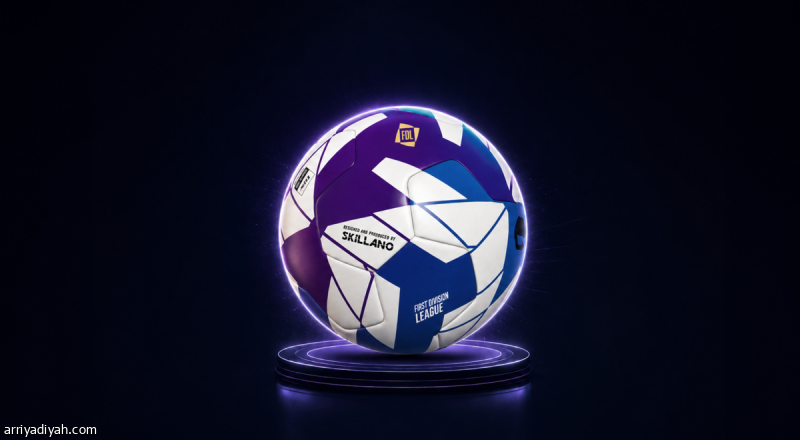
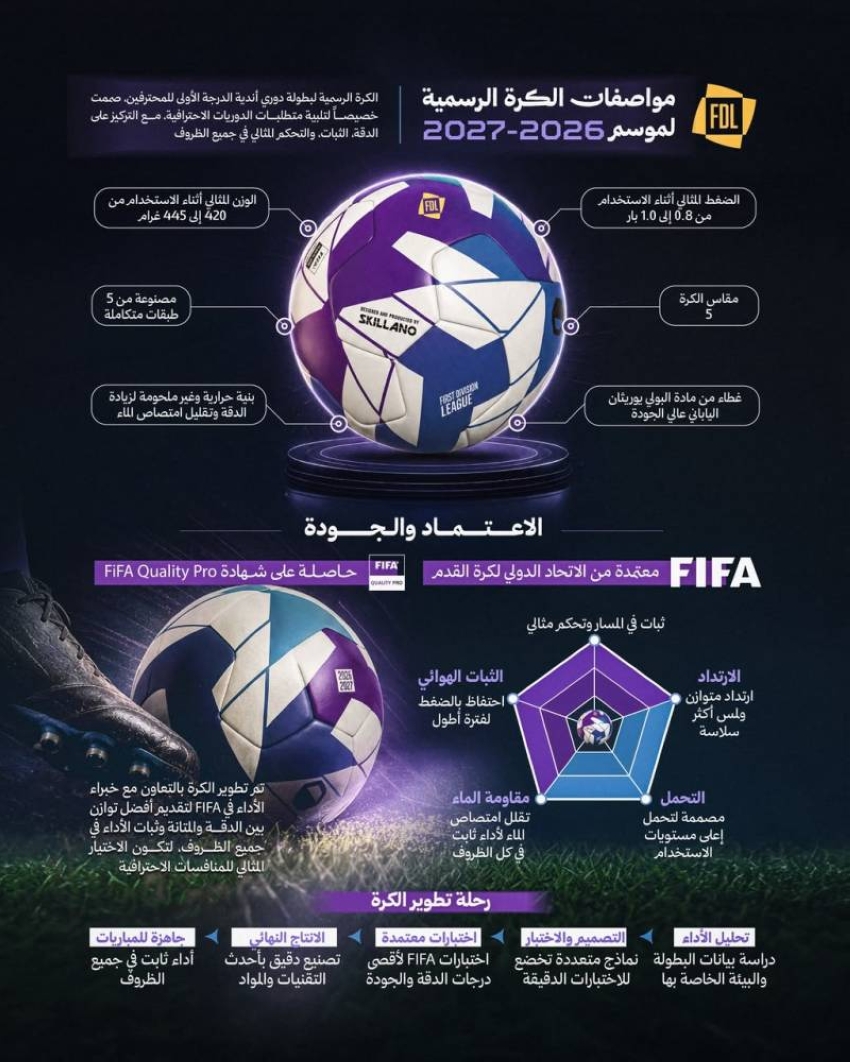
The First Division League Clubs Association launched the official ball for the Yellow League competitions for the 2026-2027 sports season, as part of its partnership with the Saudi brand 'SKILLANO', specialized in manufacturing sports clothing and equipment. The new ball carries the approval of the International Football Federation 'FIFA', after obtaining the 'FIFA Quality Pro' certificate, which confirms its compliance with the highest technical standards approved for use in official competitions. The new ball has been named as the 'official ball of the First Division Professional Clubs Championship', and its design and production were undertaken by SKILLANO Company, the manufacturer of sports supplies, a Saudi brand that relies on imported manufacturing materials including an outer cover 100 percent from Japanese polyurethane, with the championship logo FDL along with the phrase First Division League on its outer parts, and is adorned with a visual identity that blends purple, blue and white colors. The use of this ball is primarily and officially focused on the matches of the First Division Professional Clubs League 'Yellow', in addition to the adoption of products and equipment of the manufacturing brand in other local competitions affiliated with Saudi federations and clubs, such as the Saudi Handball Federation, and a number of clubs of various grades. The ball obtained the FIFA Quality Pro certificate, which represents the highest quality rating granted by the International Football Federation for sports equipment used in official championships, after undergoing a series of laboratory and field tests approved by the central laboratories of FIFA to ensure compliance with all engineering and physical conditions. The ball weighs between 420 and 445 grams, and the internal pressure levels are adjusted to range between 0.8 and 1.0 bar, with the adoption of the standard size number five used in professional competitions, and its structure consists of five integrated layers, and a modern structure consisting of eight external panels. The manufacturing process relied on the seamless thermal bonding technique without the use of traditional sewing, which helped raise the levels of mechanical precision of the ball, and reduce water absorption rates during play in rainy and humid conditions, thus maintaining its weight and stability during running and passing. The results of technical tests showed the ball's superiority in five main performance axes, including stability of the air trajectory, increasing players' ability to control it, in addition to its high ability to maintain internal pressure for long periods, and providing balanced rebound that increases the ball's speed and reduces the energy loss caused by friction with the ground. The development journey went through five successive stages, starting with analyzing data related to the championship and the climatic environment of the stadiums, then moving to the design stage and preparing initial models, followed by FIFA-approved laboratory tests, leading to the final production stage, and field readiness testing in various weather conditions.
Original source: Arriyadiyah


Comments (0)
Be the first to comment.