"Artemis 2" Diary between Earth and Moon: Pancakes, Coffee, and Isolation in the Bathroom
"); googletag.cmd.push(function() { onDvtagReady(function () { googletag.display('div-gpt-ad-3341368-3'); }); }); }
Summary
The last crewed mission to lunar orbit was the Apollo program more than half a century ago.
Astronauts floating in lunar orbit as part of the Artemis 2 mission are not leading a very different life from what usually happens on Earth. For example, they eat pancakes and couscous, take pictures with their mobile phones, encounter email problems, and fix a broken toilet.
The journey of the four crew members of Artemis 2 lasts about 10 days in lunar orbit aboard the Orion capsule, which has the space of a small truck.
Preparing for this mission led by NASA was like getting ready for camping, according to Christina Koch.
The box contains 58 pancakes, 43 cups of coffee, broccoli, grilled chicken breasts with five types of hot sauces, as well as maple syrup famous in Canada because one of the astronauts is Canadian.
But the toilet had a problem.
Unlike the Apollo mission, where astronauts only had bags for their needs, some of which were left on the lunar surface, the Artemis crews have actual toilets.
Christina Koch took on repairing the toilet in the first 24 hours of the flight.
She said Thursday evening, 'I am proud to be the space plumber,' adding, 'Let me remind you that it is the most important part of the vehicle. We all breathed a sigh of relief when it was resolved.'
Using the toilet causes a lot of noise in the vehicle to the point that headphones must be worn to avoid the noise when using it.
Jeremy Hansen said it is 'the only place where we can feel isolated for a brief moment.'
After the toilet, the crew faced IT problems. During a live NASA broadcast, mission commander Reid Wiseman was heard complaining about email issues. The matter was handled from the Houston center in Texas.
In zero gravity, it is also necessary to think about how to sleep during a 10-day journey. The solution was to place sleeping bags hung on the walls to avoid floating in the middle of the vehicle.
Reid Wiseman joked, 'Christina sleeps with her head down in the middle of the vehicle, like a hanging bat,' noting that 'the position is more comfortable than you think.'
Like a child
Zero gravity affects physical fitness, so it is necessary to exercise half an hour a day. The vehicle is equipped with equipment similar to that available in gyms.
NASA has recently allowed the use of smartphones aboard its spacecraft.
Agency director Jared Isaacman said in February, 'We give our crews the opportunity to keep private moments for their families and share inspiring pictures and recordings with the world.'
In the midst of a mission costing billions of dollars amid a geopolitical confrontation with China, human admiration for outer space remains overwhelming.
Jeremy Hansen did not hide his joy while answering journalists' questions, saying, 'I feel like a child.'
When the rocket launched, Victor Glover, the first black person to travel to the moon, said, 'You try to maintain a sense of professionalism, but the child inside me wants to shout with joy.'
Midway
The four astronauts on the Artemis 2 mission have reached the halfway point between Earth and the Moon, and they continue to approach it in preparation for orbiting it in the coming days, in the first mission of this kind since 1972.
NASA wrote on its social media accounts Friday evening (Saturday morning Middle East time), 'We are halfway there.'
Tracking data provided by the agency on the Internet showed that the Orion spacecraft carrying the four astronauts is now 219,000 kilometers from Earth, and a similar distance must be covered to reach the vicinity of the Moon.
Orion on this flight carries Americans Christina Koch, Victor Glover, Reid Wiseman, and Canadian Jeremy Hansen. The last crewed mission to lunar orbit was the Apollo program more than half a century ago.
The astronauts document their time in space themselves using their smartphones and cameras, and NASA broadcasts live footage of them.
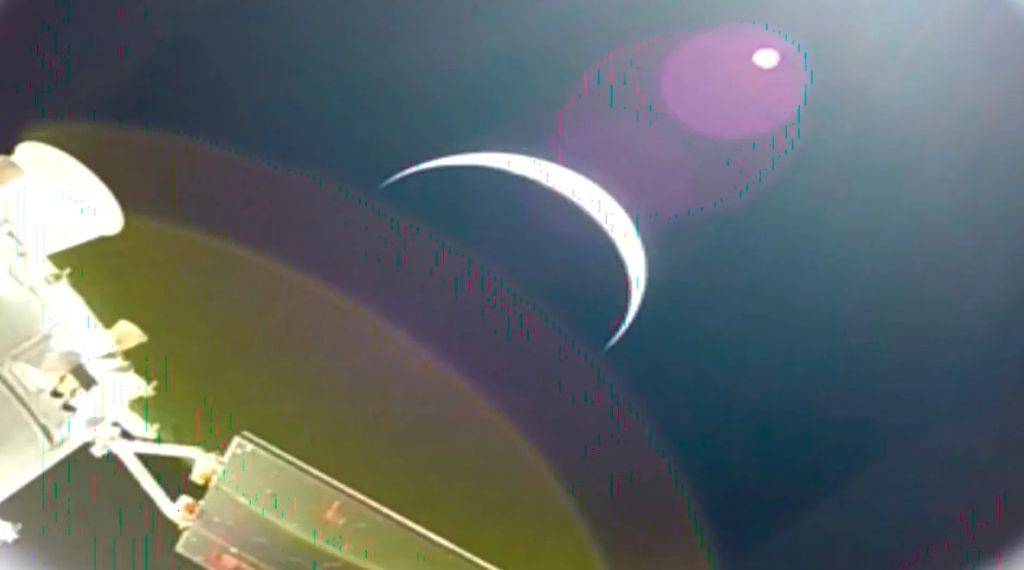
On Friday, the agency published the first pictures taken by the astronauts of Earth, including images of it passing in front of the Sun.
A NASA official said, 'We see Earth as a small blue ball through the crew's eyes; we feel we are suddenly with them.'
Glued to the windows
The flight lifted off from Florida on Wednesday, and the spacecraft performed the major burn needed to exit Earth's orbit on Thursday, then headed toward lunar orbit.
Jeremy Hansen said, 'We are all glued to the windows here.' Christina Koch said, 'Nothing can prepare you for the feelings that overwhelm you at this moment.'
No human has seen Earth from this distance in half a century. After the Apollo program ended in 1972, crewed flights were confined to low Earth orbit, especially to the International Space Station at an altitude of 400 kilometers.
The Moon is a thousand times farther away, and it takes several days to reach it. On this flight, the astronauts will not land on its surface; they will orbit it and see its far side before returning to Earth on April 10.
The far side of the Moon is the side that is not visible from Earth, as only one side always faces Earth during its orbit.
A big adventure
This flight relies on a physical mechanism known as 'free return,' meaning the Moon's gravity will pull the spacecraft to orbit it and then fling it back toward Earth.
This means that changing the flight path is impossible; the spacecraft cannot return to Earth until after orbiting the Moon.
In the event of a major problem, the astronauts must wear their spacesuits to survive for six days.
Read more
This section contains related articles, placed in (Related Nodes field)
Despite preparing for all possible contingencies, unpleasant surprises cannot be ruled out, especially since this flight is the first for the Orion spacecraft.
Clayton Swope of the Center for Strategic and International Studies says, 'If the surprises are limited to email or toilet problems, that would be a victory.'
The goal of the Artemis 2 mission is to ensure complete preparations before Americans return to the lunar surface, this time with the aim of establishing a lunar base in preparation for planned missions to Mars.
The US space agency aims to carry out a crewed landing on the lunar surface in 2028, before the end of Donald Trump's term, and before the date set by the Chinese for their moon landing.
But experts say this date is very ambitious and may face delays, as the vehicle that will be used to land astronauts from the main spacecraft to the lunar surface is still under design.
"); googletag.cmd.push(function() { onDvtagReady(function () { googletag.display('div-gpt-ad-3341368-4'); }); }); }
More about: Spaceflight, Moon, Artemis 2, NASA
Original source: Independent Arabia



Comments (0)
Be the first to comment.