Egypt inaugurates advanced phase at Dabaa nuclear plant with Russian and international presence
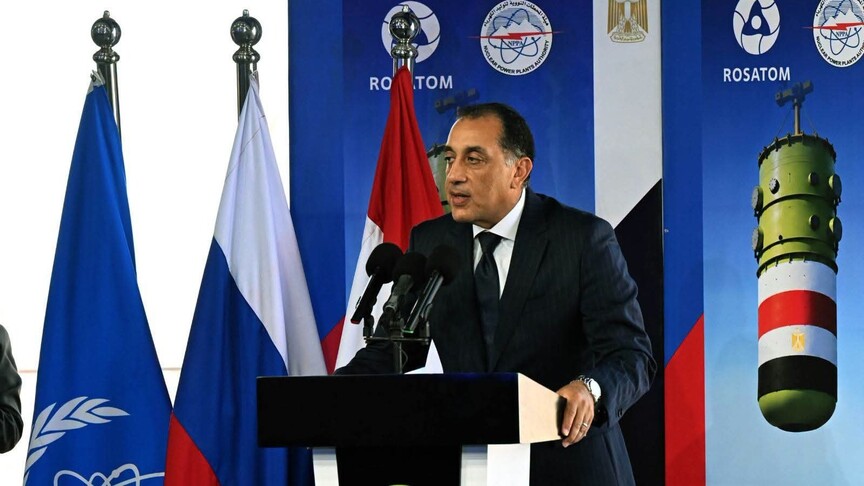
IAEA Director General Rafael Grossi attended the installation ceremony of the reactor pressure vessel for the second nuclear unit at the Dabaa nuclear plant, and discussed with Egyptian Foreign Minister the Washington-Tehran negotiations
Cairo / Anadolu
Egypt inaugurated an advanced phase at the Dabaa nuclear plant (west) on Thursday, with the presence of Russian and international officials, including IAEA Director General Rafael Grossi.
The Egyptian Cabinet stated in a press release that Prime Minister Mostafa Madbouly witnessed the installation ceremony of the reactor pressure vessel for the second nuclear unit at Dabaa, which Egypt is implementing in cooperation with Russia.
According to the statement, Grossi and Russian officials, including Alexey Likhachev, Director General of the Russian state atomic energy corporation Rosatom, attended the installation ceremony.
Likhachev said in a speech on the sidelines of the event that 'the project to build the Dabaa nuclear plant is witnessing accelerated progress according to the approved timeline,' according to the Egyptian statement.
He noted that 'the installation of the reactor pressure vessel for the second nuclear unit comes only seven months after the same process was completed for the first nuclear unit (November 2025), reflecting the accelerated pace of the project.'
Likhachev added that 'this achievement represents a key step paving the way for the next phase of work, which involves starting the welding of the main cooling circuit pipeline of the reactor.'
He affirmed that 'the project continues its progress in accordance with the highest quality and nuclear safety standards.'
Meanwhile, Grossi expressed in his speech his appreciation for the progress witnessed in the Dabaa nuclear plant project.
He noted that the IAEA continues to support member states in developing their peaceful nuclear programs according to the highest nuclear safety and security standards.
The Dabaa nuclear plant is the first nuclear power plant in Egypt, and is being built in the city of Dabaa in Matrouh Governorate (west).
The plant consists of four nuclear units with a capacity of 1,200 megawatts each, totaling 4,800 megawatts, and uses Russian VVER-1200 pressurized water reactors (generation III+), which are among the most advanced and safest nuclear reactor technologies in the world, according to the Egyptian statement.
Egypt is implementing the plant project in cooperation with Russia, as Cairo and Moscow signed a cooperation agreement on November 19, 2015, to build the plant at a cost of $25 billion, provided by Russia as a soft government loan to Egypt. In December 2017, the two countries signed final agreements for the construction of the plant.
The first nuclear reactor is scheduled to start operations in 2028, followed by the other reactors successively in 2030, according to estimates by the Egyptian Ministry of Electricity.
According to what was reported by Russia Today network on Thursday, the reactor pressure vessel is classified as one of the most critical and sensitive components in any nuclear facility. It is a giant steel tank made of special high-strength alloys, housing the reactor core where controlled chain nuclear fission reactions take place.
This giant structure, weighing hundreds of tons, has been designed to meet the highest international nuclear safety standards, enabling it to withstand extreme temperatures, enormous pressures, and continuous radiation exposure throughout its intended operational life exceeding 75 years, extending safely until 2100, according to the same source.
*Grossi meets Abdelatty
On the sidelines of his participation in the installation ceremony of the reactor pressure vessel for the second nuclear unit at the Dabaa nuclear plant project, Grossi met with Egyptian Foreign Minister Badr Abdelatty in the city of El Alamein (northwest), according to a statement by the Egyptian Foreign Ministry.
Abdelatty welcomed Grossi's participation in the installation ceremony, emphasizing that it 'reflects the depth of partnership between the two sides in implementing Egypt's peaceful nuclear program.'
The meeting also addressed regional developments, and the Egyptian minister stressed the importance of building on the opportunities provided by the recent memorandum of understanding between the United States and Iran, to support the resumption of a serious negotiation track and contribute to containing escalation.
On June 18 last, Washington and Tehran signed a memorandum of understanding to stop the US-Israeli war that broke out at the end of last February against Iran, and they are continuing difficult negotiations to reach a final agreement, mediated by Pakistan and Qatar.
Original source: Anadolu Agency



Comments (0)
Be the first to comment.