Kimmy Kai 3: Chinese AI Model Rattles Competitors in America
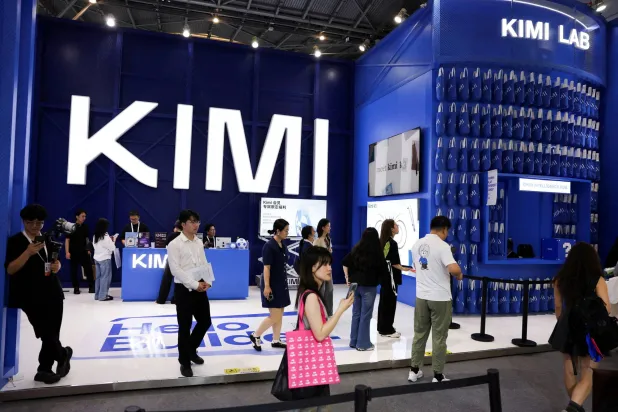
The new AI model 'Kimmy Kai 3' has sparked widespread admiration thanks to its capabilities, which are close to the performance of the most advanced American AI systems.
The new AI model 'Kimmy Kai 3', launched by Chinese startup Moonshot AI on Friday, has sparked widespread admiration for its capabilities, which are close to the performance of the most advanced American AI systems, prompting calls in the United States to move quickly to keep pace with this development.
Since the launch of the 'V1' tool from Chinese company DeepSeek in December 2024, Chinese AI companies have been continuously reshaping the industry landscape with open-source models that can be downloaded and modified, offered for free.
These models partially reconsider the economic foundations of AI established by major Western companies, which are based on paid and closed models, according to Agence France-Presse.
With the Kimmy Kai 3 model, a new level has been reached, particularly in terms of scale; it was created using 2.8 trillion parameters (adjustable criteria), about twice the size of DeepSeek V4 Pro, launched in April with 1.6 trillion parameters.
Moonshot AI boasts that its new model represents 'the upper limit in terms of open-source model size' in the field of AI.
But what caused surprise first and foremost is the performance of Kimmy Kai 3; AI models are now compared according to a wide range of benchmarks and specific tasks.
In this race, Kimmy Kai 3 approaches advanced AI models such as Fable 5 from Anthropic and GPT 5.6 Sol from OpenAI in many aspects.
In some rankings, Moonshot AI's tool topped the list, especially in the field of application or website programming, according to the benchmark set by the reference platform Arena AI.
At present, code generation is the most prominent use of generative AI, a market currently dominated by Anthropic, while OpenAI continues to solidify its presence there at an accelerated pace.
Alex Finn, head of the platform Henry Intelligent Machines BBC, said in a post on X that this will bring about a radical and permanent transformation in the AI race.
Escalating Geopolitical Tensions
David Sacks, who oversaw the AI file at the White House until March and remains an adviser to US President Donald Trump, said: 'This is a cause for concern.'
Sacks sees this new achievement as a Chinese victory in the conflict between China and the United States.
While China accelerates its progress, Sacks criticized what he described as 'the United States complicating matters,' saying: 'Politicians and bureaucrats ban data centers, impose more laws and restrictions at the state level, and strive to grant new federal agencies the authority to license the latest models.'
Sacks points to the protest movement against building new data centers, as well as the Trump administration's backtracking, which is now seeking to test the latest AI technologies before bringing them to market.
Dean Ball, former White House adviser on AI, believes that the success of the Chinese system is due to turning AI into a 'public good' rather than a product, which will hinder progress and investment, as it will discourage the private sector from engaging.
Hussein Abbas, a computer science professor at the University of New South Wales in Canberra, Australia, says: 'I am not saying Americans should be worried, but they cannot remain idle either.'
Chinese AI models are widely followed and increasingly used in the West, and interest in them has been renewed in recent months thanks to their lower average cost compared to advanced American models, at a time when AI prices are rising sharply.
The emergence of AI agents—programs capable of executing a series of tasks based on simple commands in everyday language, and even evaluating their own performance and correcting errors—has multiplied the need for computing power and increased the cost of any project.
Some, including Gavin Baker of the investment firm Atreides Management, downplayed the significance of Kimmy Kai 3's impact, noting that initial tests showed it consumes a large amount of computing capacity, making it relatively expensive compared to an open-source model.
Anastasios Angelopoulos, CEO of Arena AI, believes that the surge in AI model capabilities will exacerbate geopolitical tensions.
He explained, during an interview on the TITV podcast, that this translates into Chinese restrictions on exporting its domestic models, or into the United States restricting the use of Chinese AI within its borders.
He said: 'The competition between China and the United States is intensifying, posing increasingly significant risks.'
Original source: Asharq Al-Awsat


Comments (0)
Be the first to comment.