Successful first joint test between Turkish 'Kızılelma' and Italian 'M-346'
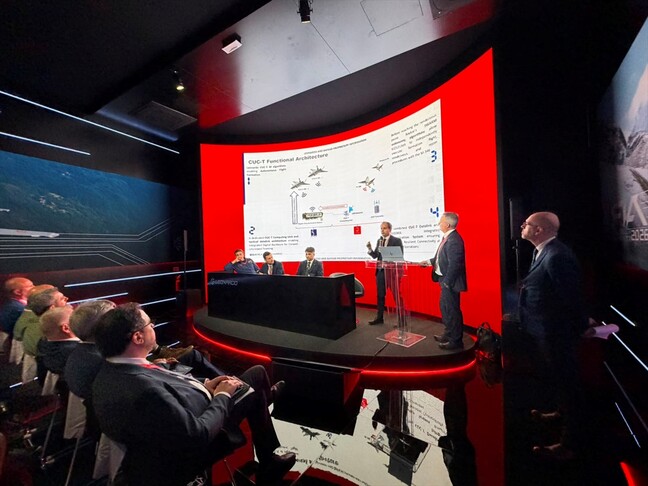
The test was conducted within the 'K-Swarm' program to develop cooperative operations between manned and unmanned aircraft..
London / Anadolu
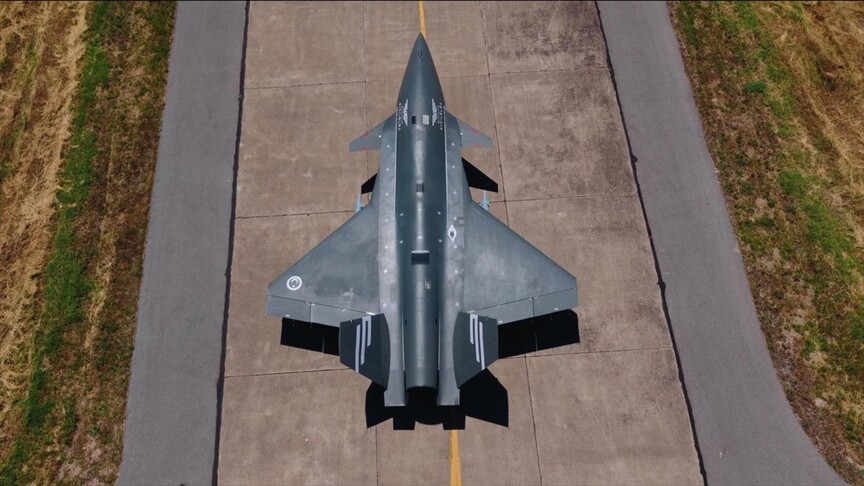
Turkish companies Baykar and Italian Leonardo, global leaders in defense and aviation, announced on Monday the success of the first live joint test between the unmanned aerial vehicle 'Bayraktar Kızılelma' and the Italian manned aircraft 'M-346' within the 'K-Swarm' program.
This was announced during a briefing on the sidelines of the Farnborough International Airshow in Britain, where engineers and test pilots from both companies presented the results of the first joint flight operations.
The two companies said they successfully completed the first phase of live tests of the program, which aims to develop concepts and tactics for cooperative operations between manned and unmanned aircraft.
They added that Leonardo's M-346 and Baykar's Bayraktar Kızılelma carried out a series of autonomous formation flights.
During the flights, the ability of the two platforms to cooperate and coordinate using advanced next-generation algorithms was assessed.
Engineers and test pilots from both companies confirmed that transitioning from simulation environments to actual flight tests represents a major milestone in the program.
They explained that the tests demonstrated the effectiveness of the technologies and solutions developed to support future air combat systems, as well as contributing to the development of existing fighter aircraft capabilities.
According to the statement, the tests were conducted in May at Baykar’s flight and test center in the Çorlu district of Tekirdağ province, northwestern Turkey.
Participating were Leonardo’s M-346 attack combat aircraft, the Italian Air Force’s T-346A aircraft, which handled air monitoring tasks, along with Bayraktar Kızılelma.
The tests aimed to evaluate new algorithms, tactics, and procedures developed by Leonardo’s innovation laboratories for flight and control systems in Turin, Italy.
These technologies were integrated with the full M-346 simulator in Venegono, Italy.
For its part, Baykar integrated intelligent swarm autonomy capabilities, developed using its advanced software and hardware architecture, into CUC-T algorithms.
The advanced autonomous capabilities of the Kızılelma aircraft accelerated the system integration process, according to the companies.
The tests proved the two aircraft's ability to carry out joint missions within a single air formation, achieving advanced levels of coordination between two high-performance aerial platforms.
Joint Command
During the flights, data exchange between the two aircraft was synchronized via an advanced radio frequency-based system.
The tactical Leonardo GCC platform handled communication protection and real-time monitoring, enabling command and control operations during flight.
Bayraktar Kızılelma took off fully autonomously before independently joining the M-346 using intelligent autonomy algorithms developed by Baykar.
After the two aircraft joined the formation, the manned aircraft’s pilots assumed full control of the joint flight path.
Thanks to the integrated avionics system, the M-346 pilots were able to issue commands to execute various formations and maneuvers.
Kızılelma executed the commands fully autonomously via a dedicated system for managing joint missions between manned and unmanned aircraft.
The commands included changing positions, separating from the formation, and rejoining it.
The companies confirmed that the tests were the result of months of joint work by engineering teams and test pilots.
The work included system integration, developing test scenarios, validating algorithms, and ensuring flight operations met safety and efficiency standards.
** Upcoming Phases
The companies said that the data collected during the tests will form the basis for the program's next phases.
They added that the next phases will include more complex scenarios, involving the operation of a larger number of aerial platforms within a single mission, enhancing situational awareness and operational coordination.
Additional tests are planned in the coming months, featuring new operational functions and more advanced scenarios.
Baykar and Leonardo considered the success of the first phase a reflection of the strength of their partnership and a showcase of their technological and industrial capabilities in developing solutions for multi-domain air operations.
Original source: Anadolu Agency




Comments (0)
Be the first to comment.