Science and Technology / KAUST Develops New Technology Enabling Devices to Self-Prove Their Digital Identity
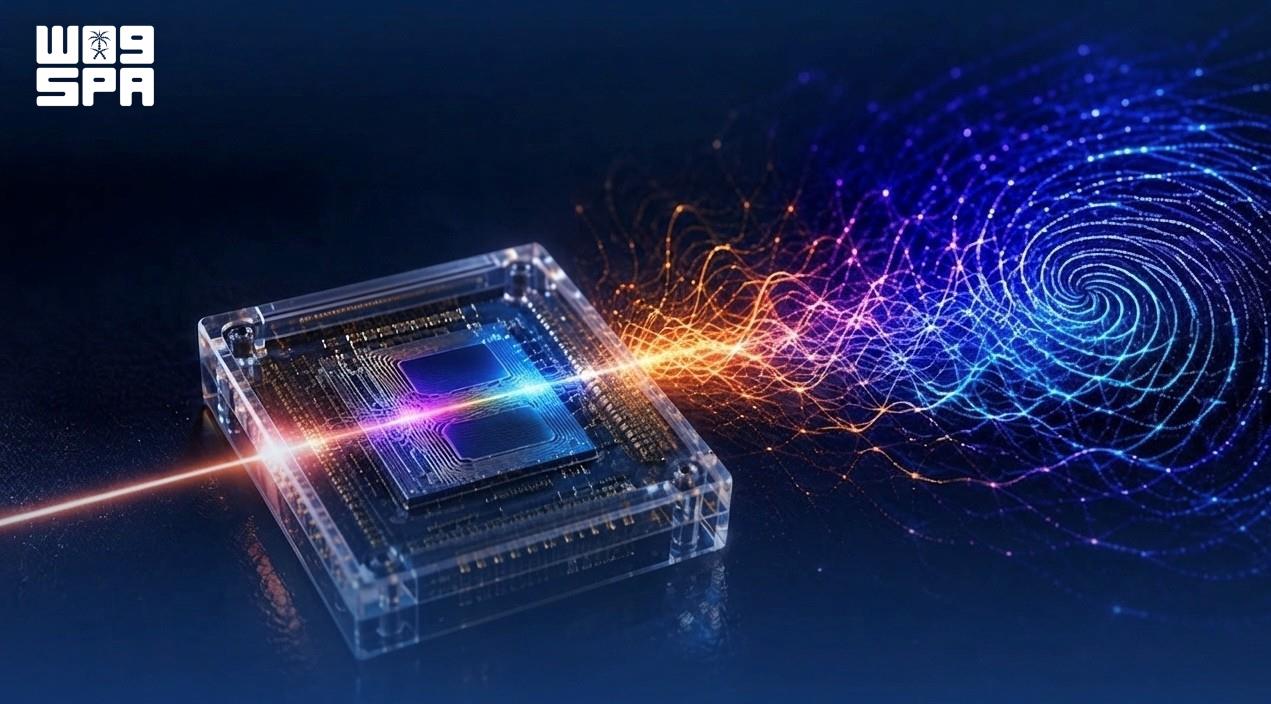
Jeddah, Muharram 23, 1448 H corresponding to July 08, 2026, SPA Researchers at King Abdullah University of Science and Technology (KAUST) have succeeded in developing an innovative technology that enhances the reliability of digital devices by relying on their unique physical characteristics, potentially offering a faster and more secure alternative to traditional passwords and security keys in the future. The study, published in the journal Nature Electronics, highlights one of the growing challenges facing modern digital infrastructure, especially as the number of devices connected to digital networks increases, making the need to verify each device's identity more urgent. Traditional methods rely on passwords or digital security keys that can be stolen or copied, and managing them on a large scale becomes more complex and resource-intensive. Hence, the need emerged for a means that allows a device to prove its identity through a unique and authentic feature in its physical components that is difficult to imitate or steal. KAUST's technology gives each electronic device a unique "digital fingerprint" that describes the subtle differences in the device's own structure. It uses tiny integrated laser chips inside each device that produce laser beams to generate a distinctive optical code, which does not match any other code, just like fingerprints. Then, artificial intelligence is employed to recognize and verify this fingerprint at high speed, making it difficult to forge or copy a device's identity, and reducing reliance on traditional passwords or security keys. Assistant Professor Yating Wan, who led the research at KAUST, said: 'All devices connected to digital networks need a reliable means to prove their identity. Currently, this often relies on passwords or security keys stored within the system. Our approach explores the possibility of devices relying on their inherent physical properties to prove their identity, without the need for traditional credentials.' This technology holds promising potential to enhance the security of large-scale digital networks that rely on communication among millions of devices, servers, and sensors. Potential applications include cloud computing, artificial intelligence infrastructure, the Internet of Things, and digital systems used in industrial and service sectors. Laboratory tests showed that the system can perform identity verification operations at very high speeds with low power consumption, making it suitable for future computing systems that require advanced levels of performance and efficiency. She added: 'With the continuous expansion of artificial intelligence applications and cloud services, the need for new security solutions that can work efficiently on a large scale is increasing. This study highlights how optical and laser technologies and artificial intelligence can be integrated to develop innovative methods to address this challenge.' The KAUST research team is currently studying ways to integrate this technology into future computing and communication systems, contributing to building a more secure and reliable digital infrastructure. // End // 17:15 T M 0175
Jeddah, Muharram 23, 1448 H corresponding to July 08, 2026, SPA Researchers at King Abdullah University of Science and Technology (KAUST) have succeeded in developing an innovative technology that enhances the reliability of digital devices by relying on their unique physical characteristics, potentially offering a faster and more secure alternative to traditional passwords and security keys in the future. The study, published in the journal Nature Electronics, highlights one of the growing challenges facing modern digital infrastructure, especially as the number of devices connected to digital networks increases, making the need to verify each device's identity more urgent. Traditional methods rely on passwords or digital security keys that can be stolen or copied, and managing them on a large scale becomes more complex and resource-intensive. Hence, the need emerged for a means that allows a device to prove its identity through a unique and authentic feature in its physical components that is difficult to imitate or steal. KAUST's technology gives each electronic device a unique "digital fingerprint" that describes the subtle differences in the device's own structure. It uses tiny integrated laser chips inside each device that produce laser beams to generate a distinctive optical code, which does not match any other code, just like fingerprints. Then, artificial intelligence is employed to recognize and verify this fingerprint at high speed, making it difficult to forge or copy a device's identity, and reducing reliance on traditional passwords or security keys. Assistant Professor Yating Wan, who led the research at KAUST, said: 'All devices connected to digital networks need a reliable means to prove their identity. Currently, this often relies on passwords or security keys stored within the system. Our approach explores the possibility of devices relying on their inherent physical properties to prove their identity, without the need for traditional credentials.' This technology holds promising potential to enhance the security of large-scale digital networks that rely on communication among millions of devices, servers, and sensors. Potential applications include cloud computing, artificial intelligence infrastructure, the Internet of Things, and digital systems used in industrial and service sectors. Laboratory tests showed that the system can perform identity verification operations at very high speeds with low power consumption, making it suitable for future computing systems that require advanced levels of performance and efficiency. She added: 'With the continuous expansion of artificial intelligence applications and cloud services, the need for new security solutions that can work efficiently on a large scale is increasing. This study highlights how optical and laser technologies and artificial intelligence can be integrated to develop innovative methods to address this challenge.' The KAUST research team is currently studying ways to integrate this technology into future computing and communication systems, contributing to building a more secure and reliable digital infrastructure. // End // 17:15 T M 0175
Original source: SPA


Comments (0)
Be the first to comment.