Rare total solar eclipse turns daytime into temporary darkness in parts of the Kingdom
Friday/Saturday 17 July 2026
Al Jazeera - SPA:
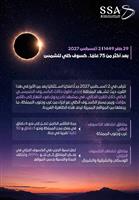
The Earth is anticipating an exceptional and distinctive astronomical event on August 2, 2027, considered one of the most prominent of the 21st century—a rare historic event that Saudi Arabia has not witnessed for over 75 years.
Arabs and the peoples of the Middle East
The Earth will witness one of the longest total solar eclipses of the current century, a rare astronomical phenomenon that temporarily turns daylight into darkness in the regions it passes through.
The path of the total eclipse intersects with large parts of western and southern Saudi Arabia, granting it a distinguished strategic position on the global astronomical observation map to monitor and document this phenomenon, while the maximum duration of the total eclipse is expected to be recorded over neighboring Egyptian territory.
The Saudi Space Agency stated that residents and visitors of western and southern regions of the Kingdom will experience a total eclipse, with the duration of blocking sunlight and complete darkness reaching about 6 minutes in some southern areas such as Abha, while Jeddah and parts of the western coast will record a blocking duration of about 5 minutes and 50 seconds—relatively long periods that offer researchers and astronomy enthusiasts a golden opportunity to study the solar corona.
In this context, experts explained that the rest of the Kingdom's regions (central, eastern, and northern) will not be isolated from this event, as they will experience a partial eclipse of the sun's disk with varying percentages, with the blocking ratio reaching about 80% in some of those areas. The duration, percentage, and timing of the eclipse's start and end differ precisely according to the geographical coordinates and location of each region and governorate.
The Saudi Space Agency emphasizes the utmost importance of following safety guidelines during the observation of the phenomenon, stressing the necessity of avoiding looking directly at the sun without using special filters on glasses and binoculars, to ensure the safety of everyone and guarantee a safe observation experience.
Original source: Al-Jazirah




Comments (0)
Be the first to comment.