A Sculpture Designed to Attract Insects in Britain
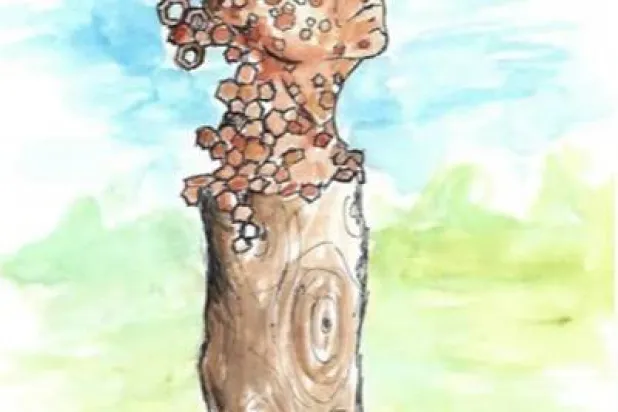
In an initiative combining art and environmental conservation, a new sculpture is being installed in Binley Park in Westbury, Wiltshire, UK...
The issue of 'artistic unemployment' has once again come to the fore in Egypt, and the debate has resumed about some artists turning to other professions, as evidenced by the announcement by artist Rami Nader of his desire to work outside the artistic field, stressing that he is looking for a stable opportunity for an office job, and asked his followers on Facebook to help him find a job opportunity.
Artist Rami Nader topped the trends on Google in Egypt on Friday after writing on his Facebook account that he is looking for an office or home-based job for any number of hours, and he showcased his skills and expertise, especially in computer and technology, and his level of English.
Rami Nader has participated in more than 20 dramatic works and films, in addition to dozens of theatrical works. Among the works he took part in are the films 'Alf Mabrouk', 'Tak Tak Boom', 'Taweezat Two', 'Harj wa Marj', and the series 'Ragel wa Set Setat', 'Hikayat al-Banat', 'Haramt ya Baba', 'Al-Lu'ba', 'Al-Safara', 'Karetha Tabi'eya', and 'Tamer wa Shawqeya'.
The specter of unemployment continues to haunt artists, as seen in many cases and complaints announced by other artists before due to the lack of opportunities offered to them or their absence. Among them are Maha Ahmed, Fadi Khafaga, and Reda Hamed. Artist Tawfiq Abdel Hamid announced his retirement in refusal to play repeated roles, and a controversy arose over rumors that he was forced to turn his car into a taxi, which he denied in televised statements, saying that this incident dates back to the 1990s.
Artist Sherif Khairallah had announced his intention to work as a taxi driver for fear of accumulating debts, as he stayed away from art for several years after being ignored, and no artistic work was offered to him.
Egyptian art critic Tarek El-Shennawy believes that this phenomenon is not new, as many artists in all fields—whether actors, singers, directors, photographers, or editors—have suffered from this in the past, adding to Asharq Al-Awsat: 'But the phenomenon has become more present now due to the spread of social media, and these complaints are followed and topped the interest.'
He continued that the problem stems from the fact that 'some artists distance themselves from the scene for reasons related to themselves or to the artistic situation that does not accommodate them, contain them, or welcome them at a certain moment, while demand increases for existing names that have already achieved popularity and are repeated out of laziness by some production companies or directors, or a kind of bet on what is popular demand in that period.'
El-Shennawy gives examples of artists like Mostafa Gharib and Michel Milad, saying they are in demand these days, and then other names of comedians who achieved remarkable successes fade away just because the artistic state now wants specific names. El-Shennawy rules out that there is intentional exclusion of artists by production companies, given the multiplicity of production entities, and although one entity controls the largest share, diversity still exists.
In this context, previous statements by the head of the Egyptian Actors Syndicate, Ashraf Zaki, confirmed that he has taken many measures to solve the problem of employing actors, even though the syndicate is not obligated to employ its members. The United Media Services Company had earlier announced the signing of a cooperation protocol with the Egyptian Company for Media Production City and the Syndicate of Acting Professions to produce a set of historical and religious works, and to implement a mechanism to benefit from artists who have not had opportunities to participate in works in recent years, and involve them in television and radio dramatic works.
Ashraf Zaki, head of the Actors Syndicate (Instagram)
Egyptian art critic Mohamed Abdel Rahman believes that 'this crisis never ends; it has existed since the beginnings of the artistic movement in Egypt,' adding to Asharq Al-Awsat that 'some artists, when the spotlight fades on them, face financial crises and thus turn to other professions, and some artists do not have other skills to work outside art, and that is where the tragedy begins.' He continued: 'This is a message for young artists to have financial security because roles may decline. The matter is sensitive, but it is a reality in all creative professions, and its solutions are not to look for job opportunities, because supply exceeds demand, and the granting of roles is primarily subject to the vision of direction and production, to the extent that a single actor may be requested for 10 roles, while these roles could be distributed among 10 actors, but that is the decision of the producer and director in the end. Therefore, actors should be prepared for this and the fluctuations of the artistic field.'
The Syndicate of Acting Professions in Egypt includes about 4,000 members and undertakes important service roles, including health care for artists and establishing a home for elderly artists. It is also making vigorous moves to approve actors' right to public performance, claiming that it will ensure a continuous and semi-steady income for actors and directors to face any periods of recession they may experience.
Original source: Asharq Al-Awsat


Comments (0)
Be the first to comment.