A Small Sudanese War in the Nuba Mountains Unlike Its Larger Counterpart
Summary: Kauda in the Nuba Mountains has returned to the forefront as one of the most sensitive flashpoints in the Sudanese war, as the conflict intertwines with historical disputes in South Kordofan, opening the door for the center of military gravity to shift to a new front where considerations of geography, resources, and armed alliances intersect.
South Kordofan State, stretching along the border between the Kordofan and Darfur regions and the border of South Sudan, has not been immune to the cycles of violence that have marked Sudan's modern history. For decades, the region has remained one of the most intractable conflict zones for political settlements, due to historical accumulations, ethnic complexities, and rugged mountainous geography comprising dozens of clustered mountains amid savanna plains, providing armed movements with a favorable environment to sustain fighting and reposition. Whenever one front calms, another ignites.
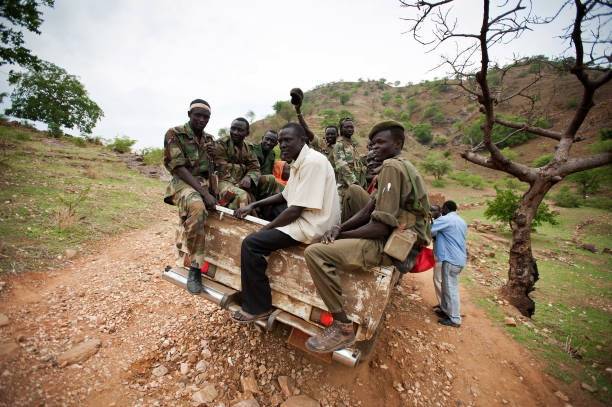
With the outbreak of war between the Sudanese army and the Rapid Support Forces in April 2023, South Kordofan gradually gained a prominent position in the military calculations of both sides, as the scope of confrontations expanded beyond traditional centers and extended to regions that had been theaters of civil wars for decades.
At the heart of this geography lies the mountainous town of Kauda, in the south of the state, which over years of conflict has become the main political and military center of the Sudan People's Liberation Movement-North (SPLM-N) led by Abdelaziz al-Hilu, and one of its most important organizational and logistical bases. Its location, amidst complex terrain and along routes linking South Kordofan to the states of Kordofan and Darfur and to the border with South Sudan, has given it strategic importance, keeping it constantly present in calculations of war and peace. Any escalation affecting it transcends local boundaries to reflect broader shifts in the balance of power within Sudan.
The Nuba Mountains are home to dozens of ethnic and linguistic groups, led by the Atoro, Shuwaya, Moro, Qualib, Ama, Tira, Katla, Nymang, Dajo, and others, alongside Arab tribes, most notably the Messiria and Hawazma. This diversity has contributed to a complex social and cultural identity, and has made the region vulnerable to intersections of local and political conflicts over decades.
Against the backdrop of developments in the region this month, Kauda has returned to the forefront as one of the most sensitive flashpoints in the Sudanese war, as the conflict intertwines with historical disputes in South Kordofan, opening the door for the center of military gravity to shift to a new front where considerations of geography, resources, and armed alliances intersect.
Escalating Tensions
Tensions escalated in the city of Kauda, the stronghold of the SPLM, after a dissident local group, mostly belonging to the Atoro component, tightened its control over large parts of the city, including local administration headquarters, following a border dispute with the Shuwaya component that quickly descended into armed clashes and widespread fires, reflecting a deep rift within the political and military structure of the movement in its most important historical stronghold.
The crisis began with a dispute over the demarcation of administrative boundaries between the two tribes in the Dabi area, after the Atoro rejected an agreement ratified during the 'Hiban Conference' in 2022, and some of its members removed boundary markers. Then officers and fighters from the tribe refused to execute leadership orders, escalating the crisis and sparking clashes last March. The conflict escalated in May into confrontations between the SPLM and the Atoro tribe, after the movement announced it was pursuing those it called 'rebels.' The battles resulted in the deaths of at least 61 people, including women and children, amid accusations of widespread violations against civilians and mass displacement of the population.
With the outbreak of war, South Kordofan gradually gained a prominent position in the military calculations of both sides (Getty)
According to local sources, the group expelled the local government and set fire to the homes of several senior officials, including the SPLM secretary and foreign minister of the civil administration, Ammar Amun Daldum, and the home of the deputy governor of the Nuba Mountains region, Daoud Ishaia. The main government headquarters, churches, and offices of local organizations were vandalized and burned. All mediations, including an initiative led by figures from South Sudan, failed to contain the crisis or reach a settlement over the border dispute.
In response, the mek (chief) of the Atoro tribe, Koko al-Duqayl Danjala, rejected accusations of rebellion, asserting that his tribesmen had not turned against the SPLM but were defending their historical lands. He expressed fear that elements linked to the former regime or groups from outside the Nuba Mountains were behind the killings, burnings, and displacement, considering that what is happening bears the hallmarks of violations the region experienced during the war years. He also accused parties within the movement of responsibility for some security incidents, including the killing of the deputy pastor of the Catholic Church, Reverend Yohanna al-Amin Narum, and two of his companions. Meanwhile, observers believe the crisis has gone beyond a tribal border dispute to become a test of the SPLM's cohesion and its ability to maintain political and military control in Kauda, which has been the center of gravity of its project in the Nuba Mountains for decades.
Historical Accumulations
The Nuba Mountains constitute one of the most complex flashpoints of the Sudanese conflict, not only because of their rugged terrain comprising about 99 mountains, but also due to historical and political accumulations that have made them a permanent arena of competition between the center and the periphery. The roots of the crisis date back to the years before Sudan's independence, when the Torit mutiny erupted in August 1955, which later developed into the 'Anya Nya' movement, before the first civil war ended with the Addis Ababa Agreement in 1972. However, the conflict returned more fiercely in 1983 with the founding of the Sudan People's Liberation Movement by John Garang and his comrades, which adopted the 'revolutionary war' model inspired by Chinese leader Mao Zedong's ideas, based on exhausting the enemy through guerrilla warfare and mobilizing local communities politically and militarily.
Read more
Fled War, Then Return Hindered... The Tragedy of Sudanese Refugees
Historic Decline of the Nile in Sudan and the Prime Suspect: Ethiopia's Grand Renaissance Dam
Investigative Report Reveals Involvement of American Companies in Sudan's War
Lack of Swift Justice Deepens Suffering of Victims in Sudan
The sons of the Nuba Mountains, foremost among them Abdelaziz al-Hilu and Malik Agar, became involved in the movement's project, driven by demands to end political and developmental marginalization, along with the historical legacy linked to campaigns of enslavement and invasion during the Turkish-Egyptian era, and the continued weakness of development despite the region's oil wealth. After the 2005 Comprehensive Peace Agreement (Naivasha Agreement), the region was granted the right of 'popular consultation' instead of a referendum, but the faltering implementation of that, followed by the secession of South Sudan in 2011, left South Kordofan outside the conflict settlement. This led to the emergence of the SPLM-North under Abdelaziz al-Hilu, who established Kauda as the movement's political and military center, from which he rebuilt its institutions and managed its military operations.
Original source: Independent Arabia



Comments (0)
Be the first to comment.