Environmental Creativity: Turkish Man Turns Waste into Ornaments for His Home's Surroundings
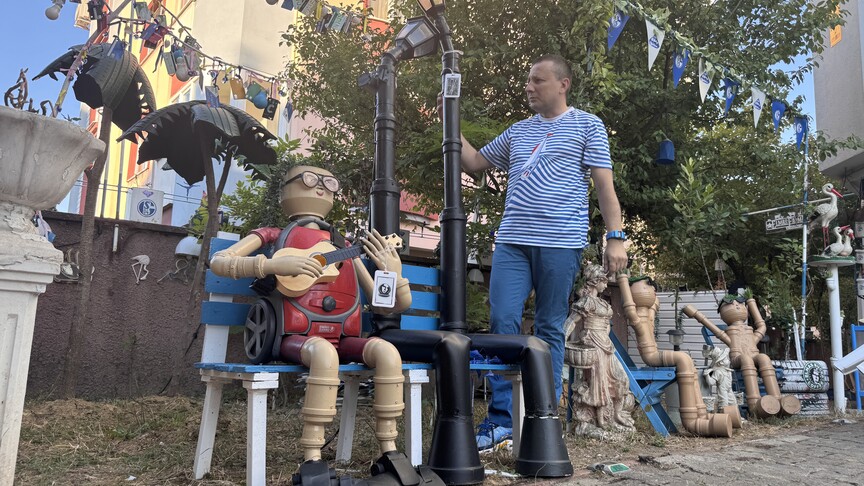
ZONGULDAK / Gökhan Yılmaz / AA
- Retired computer technician Zakaria Alagöz turned the basement of the building where he lives into a workshop that realizes the 'zero waste' concept
- He produced about 70 creative sculptures from waste materials, adding solar-powered lighting to them
- He turns waste materials into decorative products, beautifying the building's surroundings while contributing to environmental protection
In an inspiring model of recycling and environmental creativity, retired computer technician Zakaria Alagöz turns waste and scrap into artworks that adorn the surroundings of his building in the Çaycuma district of Zonguldak province, northwestern Turkey.
Alagöz (45), married and father of two, started his hobby of making sculptures since childhood when he made miniature models from empty cleaning product cans.
During the coronavirus pandemic, he turned this passion into a serious project, converting the basement of the three-story 'Almas' building in the Çay neighborhood into an art workshop operating under the 'zero waste' concept.
40 meters of daily creativity
Alagöz spends a few hours daily in the building's common basement, about 40 square meters, continuing his artistic work.
In this modest workshop, Alagöz collected waste and scrap materials from multiple sources and has so far produced about 70 artistic sculptures.
Among his most prominent works: a tank made from an air conditioner's outdoor unit, a helicopter from a kitchen hood, a palm tree from an old car tire and water pipes.
Also a swan from an old fan, a human figure from a vacuum cleaner, a pen-shaped door from sewage pipes, cactus plants, lighting poles, and a water well from used tires.
He describes some of his creations: 'I made a tank from an air conditioner's outdoor unit, a helicopter from a kitchen hood, a house decorated with tree ornaments, a swan from an old fan, a palm tree from 70 mm diameter water pipes, and figures of people on bicycles.'
'Zero Waste Building'
Alagöz placed his sculptures in the building's garden, which has become locally known as the 'Zero Waste Building,' and equipped each piece with solar-powered LED lights, giving them a special aesthetic at night and attracting the attention of passersby and visitors.
In his interview with Anadolu Agency, Alagöz said: 'Since my childhood, I have been in the habit of making artworks using old materials, and I focused more on this hobby after the coronavirus pandemic.'
He added: 'I obtained approval from the building residents before starting the project, with one goal: to beautify the surroundings we all share.'
Creativity and environmental protection
Alagöz emphasized that his works receive great admiration from visitors who stop daily to view them and ask about how they are made.
He stressed that his project is not for financial profit, but to invest time in a useful way and protect the environment.
He continued: 'I turn waste materials into decorative products, so I beautify the building's surroundings and contribute to environmental protection at the same time.'
He noted that nature abounds with large quantities of materials that can be reused.
He stated that he not only recycles but also hands over the leftover materials from his work to scrap dealers for recycling.
'Zero Waste' promising Turkish project
It is worth noting that Turkey launched the 'Zero Waste' project in 2017, initiated by Emine Erdoğan, wife of the Turkish president, aiming to reduce the impact of waste on the environment, change consumption habits, and manage waste through recycling and benefiting from it after sorting at the source, ultimately achieving a recycling rate of 60 percent by 2030.
In mid-December 2022, the United Nations adopted the 'Zero Waste' project resolution submitted by Ankara within the framework of sustainable development plans and combating climate change, with 105 other countries co-sponsoring it.
The resolution was approved unanimously by the United Nations General Assembly, and accordingly, the UN General Assembly declared March 30 of each year as 'International Day of Zero Waste.'
Original source: Anadolu Agency

Comments (0)
Be the first to comment.