America Strikes Deeper into Iran... Prepares for Broader War
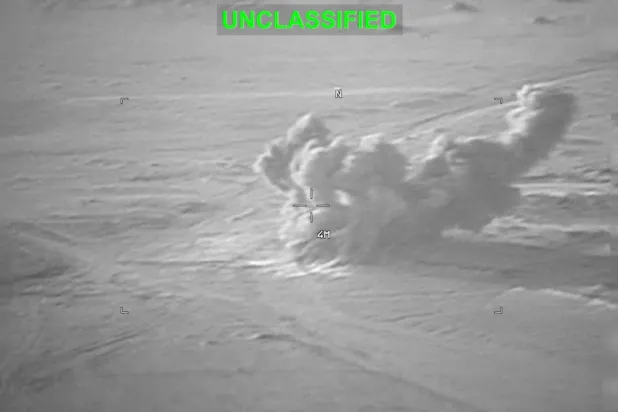
The United States has opened a new bombing front in northwestern Iran, targeting Tabriz for the first time, while continuing its strikes on ports and military bases along the Arabian Gulf and the Sea of Oman, on the ninth night of the campaign, amid American preparations for a possible expansion of the war.
The U.S. Central Command (CENTCOM) announced early Monday the start of a 'new wave of strikes,' which it said aims to undermine Iran's ability to attack commercial vessels and civilian sailors in sea lanes connected to the Strait of Hormuz, after the death of a third U.S. service member since the resumption of fighting.
CENTCOM said the new wave targeted military command centers, air defense and coastal surveillance facilities, naval capabilities, missile and drone launch sites, as well as communications networks.
The strikes came after eight nights during which U.S. forces focused primarily on southern Iran, before the bombing extended north to Tabriz, where the Revolutionary Guard is believed to run fortified underground missile bases.
The official IRNA news agency reported at least one death in the vicinity of Tabriz, located about 520 kilometers northwest of Tehran. It said the strikes also targeted the port of Mahshahr in Khuzestan province, the cities of Sirik and Jask in Hormozgan province opposite the Strait of Hormuz, and Konarak and Chabahar in Balochistan, which border the Gulf of Oman.
The Revolutionary Guard-affiliated Tasnim news agency reported explosions in Tabriz, Chabahar, Konarak, and Bandar Mahshahr during the early hours of Monday, without providing precise details on the targeted sites or the extent of damage.
Iran's Mehr news agency reported that a site near Silvana district in Urmia, West Azerbaijan province, was hit, resulting in injuries to a number of people who were transported to medical centers. The Revolutionary Guard-affiliated Fars news agency also quoted the governor of Bushehr as saying the city was subjected to two attacks on Monday morning, without specifying the targeted sites or the extent of losses.
In Tabriz, the crisis management official of East Azerbaijan province said a strike targeted a 'military area' within the city, killing one person and injuring others, providing additional details on the attack whose initial toll had been announced by IRNA.
Iranian media also reported an explosion heard in Isfahan, but the province's crisis management official later said the sound was caused by the detonation of unexploded ordnance left over from previous rounds of fighting, not a new U.S. strike.
Explosions later on Monday shook the city of Shiraz, the capital of Fars province, with no immediate clarity on the nature of the targeted sites or the extent of damage.
0 seconds of 0 secondsVolume 90%
Press shift question mark to access a list of keyboard shortcuts
00:00
00:00
00:00
The reports of renewed strikes came hours after CENTCOM announced the end of its latest wave of operations against Iran, suggesting that the attacks were spread over stages during the early hours of Monday, or that the U.S. announcement preceded the full appearance of their toll in local reports.
The spread of targets draws a broad military arc extending from Urmia and Tabriz in northwestern Iran to Bushehr and the ports and bases scattered along the Arabian Gulf and the Sea of Oman. In Tabriz, the bombing concentrated on a military area and what is believed to be missile facilities, while Khuzestan and Bushehr contain oil ports, industrial centers, and vital energy lines, and Sirik, Jask, Chabahar, and Konarak are directly linked to Iran's naval capabilities and navigation route monitoring networks.
The previous day's U.S. strikes had hit sites near the port of Abadan on the eastern bank of the Shatt al-Arab, in addition to the Darkhovin nuclear plant under construction near Al-Flaihiyah in Khuzestan.
The International Atomic Energy Agency said the Darkhovin plant was still in the early stages of construction and did not contain nuclear material during the last visit of its inspectors, so targeting it poses no radiological risk. The IAEA Director General, Rafael Grossi, called for military restraint around facilities linked to Iran's nuclear program.
According to the latest toll announced by the Iranian Health Ministry, 50 people have been killed and more than 500 injured since the resumption of fighting in early July, while the overall toll of the war that began on February 28 remains incomplete.
Tehran had accused the United States on Saturday of targeting a water desalination plant inside Iran. Washington did not confirm carrying out an attack on an Iranian plant.
New American Death
The expansion of the campaign coincided with the U.S. military's announcement of the death of a service member in northern Iraq on Saturday during a 'controlled detonation' of unexploded ordnance found on a downed Iranian attack drone.
His death came after CENTCOM announced the deaths of two U.S. service members in Jordan and a third missing following an Iranian attack on Friday. The command later said unidentified remains were found at the attack site, and tests are still ongoing to verify their identity.
The U.S. Department of Defense identified the two killed as First Lieutenant Tyler James Vehan, 25, and Private Isabella Gonzalez, 19. It said they were killed in Jordan while participating in a U.S. mission related to the fight against ISIS, without disclosing additional details about the circumstances of their deaths.
This brought the number of U.S. service members killed since the start of the war on February 28 to 17, along with more than 420 others wounded.
The Washington Post quoted a U.S. official as saying that the deadly attack on Muwaffaq Salti Air Base in Jordan was the second successful targeting of the facility within a week. It was preceded by about a day by another strike that hit nearly 20 U.S. service members, some of whom sustained shrapnel wounds.
0 seconds of 0 secondsVolume 90%
Press shift question mark to access a list of keyboard shortcuts
00:00
00:00
00:00
U.S. President Donald Trump said U.S. forces struck Iran 'very hard' once again, and the attacks were carried out in honor of the fallen service members.
In a brief telephone interview with NewsNation, Trump also said he 'doesn't care at all' about Iran's announcement that it is no longer committed to the bilateral memorandum of understanding reached a month ago, emphasizing the end of the interim agreement.
CENTCOM had said that one of the previous waves of bombing directly targeted Revolutionary Guard forces that participated in the attack on U.S. service members in Jordan on July 17. The announcement marked a shift from previous command statements, which usually focused on the nature and military function of the targeted facilities, without referring to targeting specific individuals in response to specific attacks.
A U.S. official familiar with internal administration discussions told the Washington Post that the strikes targeting bridges and railway lines around Bandar Abbas near the Strait of Hormuz over the past week were considered by Tehran as an escalation in the nature of the U.S. campaign, prompting it to expand its response.
He added that after those strikes, the Iranian side became 'less concerned' about the possibility of inflicting large numbers of casualties on U.S. forces.
Regional Strikes
Original source: Asharq Al-Awsat


Comments (0)
Be the first to comment.