Aoun-Trump Meeting: A Station to Modify the Agreement through Application?
Political sources from various directions and affiliations agree that the Lebanese-Israeli 'Framework Agreement' is now in dire need of an exceptional dose of support from Washington, as a foundation to extricate it from the tensions surrounding it, paving the way for its implementation by obliging Israel to facilitate the deployment of the Lebanese army in the two model areas, with towns under its occupation, some beyond the Blue Line, to be included later.
Political sources positioned midway between supporters and opponents of the 'Framework Agreement' assert that it needs modification of some of its clauses, provided that this comes in the context of its gradual implementation after reaching a final agreement between the two countries with American intervention, considering that what is currently on the negotiating table is tantamount to an agenda.
The sources told Asharq Al-Awsat that the meeting of President Joseph Aoun with his American counterpart Donald Trump in Washington constitutes a station that must be bet on, as it may lead to providing Lebanon with a dose of support that can only be secured through American pressure on Israel, not only to oblige it to de-escalate, but also to facilitate the army's deployment in the two experimental areas.
The sixth round of negotiations
The sources pause at a station preceding the American-Lebanese meeting, related to the resumption of Lebanese-Israeli negotiations in their sixth round on July 15 and 16 in Rome, and confirm Lebanon's attendance, which Aoun informed Lebanese Ambassador to the US Nada Hamadeh Mouawad, in response to her notification from the US State Department of the date in the Italian capital. The sources ask whether the army's deployment in the two experimental areas will be achieved soon, perhaps before the resumption of negotiations and ahead of the Aoun-Trump meeting?
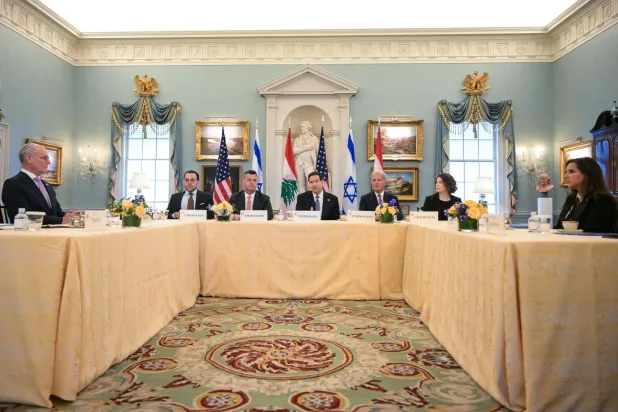
The ambassadors of Lebanon and Israel in Washington sign the 'Framework Agreement' in the presence of US Secretary of State Marco Rubio (AFP)
The sources call on Washington to pressure Tel Aviv to oblige it to put the two experimental areas on the track of implementation as soon as possible to lend credibility to its sponsorship, by demanding that Prime Minister Benjamin Netanyahu withdraw pressures and conditions to facilitate the army's deployment there, especially since the talks conducted by US Central Command (CENTCOM) commander Admiral Brad Cooper in Tel Aviv with senior Israeli officials before his return to Beirut focused on reducing Israeli military escalation and removing obstacles preventing the army's deployment.
The sources note that Cooper was informed by Aoun and Army Commander General Rodolph Haykal, when he met them, that the army is fully ready to deploy in these two areas, and that Lebanon is awaiting the arrival of the head of the 'Mechanism' committee, US General Joseph Cleverfield, to Beirut to inform him of the Lebanese decision in this regard.
Concern over Iran developments
In contrast, the sources express concern over Trump's statement that the 'Memorandum of Understanding' with Iran has ended, and decline to comment on whether he aims through his threat to halt negotiations to pressure it to make the required concessions, and thus there is fear of the two countries returning to square one with the resumption of war between them and its repercussions on the situation in Lebanon.
It believes that separating the Lebanese track from the Iranian one requires Washington to turn to the Lebanese arena with tangible steps to bolster Aoun's position against the campaigns targeting him, and enhance Washington's credibility by pressuring Israel to withdraw from the south, which would allow tightening the political noose on the 'Shiite duo' in their reliance on the Islamabad track.
But on the other hand, it calls for clearing the atmosphere between former Progressive Socialist Party leader Walid Jumblatt, and between Aoun and Prime Minister Nawaf Salam, with no communication with the latter.
Implementing the Framework Agreement
Sources close to the team supporting direct Lebanese-Israeli negotiations point out that the settlement lies in implementing the 'Framework Agreement' after translating it into a final agreement, provided that, with American support, some observations on it are taken into account to make it implementable and not remain contingent on the 'Memorandum of Understanding' signed between the United States and Iran, especially since Trump had already declared its demise, in order to bring the two sides' views closer.
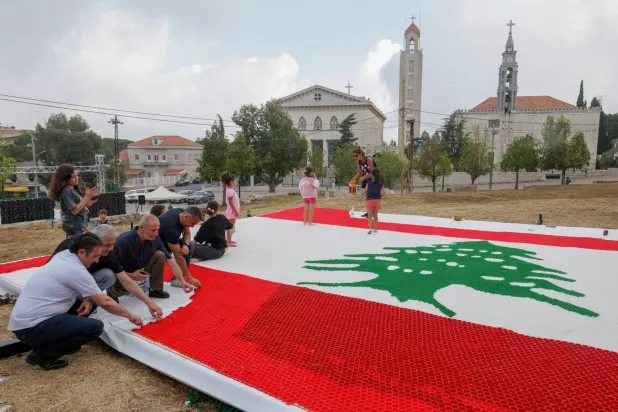
Lebanese artist Caroline Chapitini puts the finishing touches on a Lebanese flag 70 square meters long made from 10,452 plastic bottles in north Beirut (EPA)
The sources believe that American support for Lebanon, as conveyed to Aoun by Trump and his Secretary of State Marco Rubio, must be translated into tangible steps that would embarrass the 'Shiite duo' and open the door for revitalizing communication between Aoun and Speaker of Parliament Nabih Berri, against the backdrop that the 'Memorandum of Understanding' is now in 'clinical death', unless a surprise occurs requiring Iran to make the required concessions. Lebanon still relies on US intervention to curb Israel's performance because its continued military escalation and bulldozing of homes in towns within the Blue Line not only embarrasses Aoun but also targets the American sponsorship of Lebanese-Israeli negotiations. This was supported by Cooper in his meetings in Beirut, expressing understanding of Lebanese explanations, taking into account that it is time to provide the conditions for the success of the army deployment plan in the two experimental areas, which would automatically extend to other towns as soon as Israel withdraws from them up to the international border.
The sources ask: Where is American support for Lebanon spent if it is limited to American media positions that are not translated into tangible steps that would besiege the 'Shiite duo'?
Jumblatt's Observations
The sources confirm that there is nothing preventing the adoption of some observations listed by Jumblatt the elder in his criticism of the 'Framework Agreement' for lacking any reference to the 'Armistice Agreement' signed between the two countries in 1949, and Israel's phased withdrawal from Lebanon within a timeline, in return for absorbing Hezbollah's weapons. They say his convergence with Berri on them does not mean he fully adopts the 'duo's' position. Jumblatt the elder does not support linking the Lebanese track to Iran, supports the collection of Hezbollah's weapons, and had stood by direct negotiations between Lebanon and Israel. Necessity dictates adopting some of his observations, especially since the redeployment of the Israeli army as stated in the 'Framework Agreement' does not mean withdrawal to the international borders; otherwise, why omit any reference in this regard? Because redeployment does not oblige Tel Aviv to withdraw; rather, in the military sense, it allows it to reposition its army in the area following the Blue Line.
Therefore, Lebanon enters over the next two weeks a delicate phase that requires anticipation of the outcome of the sixth round of Lebanese-Israeli negotiations, which comes just days before the Lebanese-American meeting that is supposed to constitute, from Lebanon's perspective, a turning point in the American position, coupled with a question about Hezbollah's reaction to Trump's declaration of the 'Memorandum of Understanding' if it maintains its stance, and how it will act in either case.
Original source: Asharq Al-Awsat
Comments (0)
Be the first to comment.