Washington speaks of implementing agreement... and Tel Aviv insists on staying in southern Lebanon
The discrepancy between Washington and Tel Aviv regarding the implementation of the 'framework agreement' in Lebanon is renewed, with the United States insisting on starting its implementation through gradual Israeli withdrawals and the deployment of the Lebanese army, while Israel insists on keeping its forces in the areas it controls and linking any withdrawal to security considerations. This contradiction has raised questions about whether it reflects a genuine difference in approach to the agreement or merely a formal disagreement, at a time when Lebanon is still waiting for the transition to field implementation amid ongoing Israeli military operations in the south and ambiguity about the timing and scope of the withdrawal.
Real disagreement... but it remains under the alliance ceiling
In this context, Lebanon's former ambassador to the United States, Riyad Tabbarah, believes that the current discrepancy between Washington and Tel Aviv regarding the implementation of the framework agreement in Lebanon is a real difference in priorities, but it does not amount to a rupture or a breakdown of the strategic alliance between them, suggesting that this discrepancy will be reflected in Lebanon as political and field 'tug-of-war' in the coming period.
Tabbarah told Asharq Al-Awsat: The US president 'seeks to achieve a major political achievement in the Middle East, and sees it as the most prominent opportunity to boost his political stock, after his bets in other international files faltered, while the current Israeli government moves according to a different vision driven by ideological and security considerations, making it less willing to make concessions in regional files.'
He added that 'the Israeli government, led by Benjamin Netanyahu and supported by ministers such as Bezalel Smotrich and Itamar Ben-Gvir, is clinging to its political and security project, and therefore the disagreement with Washington will remain over some files, but it will not turn into an open confrontation or rupture.'
He explained that 'Israel cannot dispense with US support, and the United States, due to the nature of internal balances and the influence of the pro-Israel lobby within US institutions, is not inclined to sever its ties with Tel Aviv, which keeps the ceiling of disagreement controlled no matter how high it rises.'
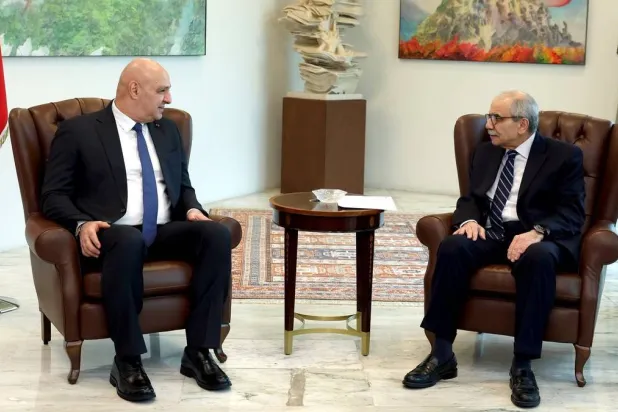
Lebanese President Joseph Aoun in a previous meeting with the head of the Lebanese delegation to the Washington negotiations, Ambassador Simon Karm (Archive - Lebanese Presidency)
Tabbarah believed that 'the reflection of this discrepancy on the Lebanese scene will be limited,' expecting 'a continued phase of tug-of-war between the two sides without a radical shift in US policy towards Israel or in the mechanism of implementing the agreement.'
Regarding the Israeli withdrawal, he considered that Israel may show readiness to implement partial withdrawals from some areas, but it will not retreat, in the foreseeable future, from its main goal of maintaining a wide border strip free of any presence or activity, resembling a 'scorched earth,' to prevent any future infiltration or attacks across the border.
He pointed out that this security concept 'is based on removing any features that could provide cover for movement near the border, allowing Israel to fully monitor the area from the heights,' considering that 'Tel Aviv may agree to withdraw from some towns or points, but it will likely cling to the idea of a buffer zone, as it considers it an essential part of its current security strategy.'
Between differing priorities and intersecting goals
This discrepancy in reading reflects a difference in interpreting the nature of the coming phase more than it reflects a difference over the ultimate goal. While one team sees that Washington seeks to translate the agreement with gradual steps that prove the success of its mediation and push towards stabilizing stability, others consider that Israel treats the agreement as a framework to reshape the security reality in southern Lebanon, allowing it to maintain its field superiority and impose its security conditions before any full withdrawal. In contrast, another view holds that the discrepancy between the allies remains confined to the method of managing the phase.
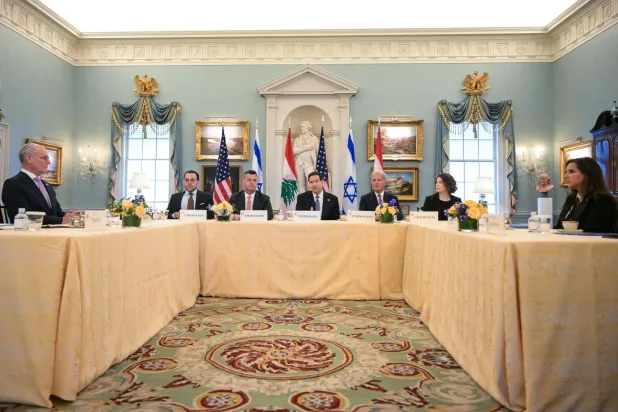
The Lebanese delegation participating in the Washington negotiations at the beginning of this month (Reuters)
No contradiction in goals
In contrast, former MP Fares Said does not see a real contradiction between the US and Israeli positions regarding the implementation of the framework agreement, considering that any discrepancy in details does not negate the fundamental point of convergence between Washington and Tel Aviv, which is reaching a final solution to the file of Hezbollah's weapons.
Said told Asharq Al-Awsat: 'I do not see a real contradiction between the US and Israeli positions regarding the implementation of the framework agreement in Lebanon, and any discrepancy in details does not negate the fundamental point of convergence between Washington and Tel Aviv, which is reaching a final solution to the file of Hezbollah's weapons.'
He added that 'a clash between the Lebanese army and Hezbollah would be costly, and any new Israeli confrontation with the party would be devastating for Lebanon,' considering that 'the decisive factor remains Iran, which is negotiating with the United States and seeking to establish its position in drawing the new regional architecture, and it is, in his view, the party that holds the actual decision regarding Hezbollah's weapons.'
He continued: 'The party's obsession is that its weapons become a key bargaining chip on the US-Iranian negotiation table, so that it becomes part of the regional settlements being negotiated.'
Said believed that 'implementing the framework agreement requires two basic conditions: first, Israel's withdrawal from Lebanese territory, which remains linked to the Lebanese state extending its full sovereignty over all its territory, and second, addressing the file of Hezbollah's weapons.'
He noted that the issue of weapons is no longer just an internal Lebanese matter, but has become 'a common point for Lebanon, the US, Israel, and Iran,' considering that 'Tehran, by virtue of its influence over the party, is the party capable of negotiating on this file in the context of regional negotiations.'
He concluded: 'I do not believe there is a division of roles between the United States and Israel, but rather a clear intersection of goals, while the implementation of what Washington proposes remains conditional on reaching a final solution to the weapons file across all Lebanese territory.'
"); googletag.cmd.push(function() { onDvtagReady(function () { googletag.display('div-gpt-ad-3341368-4'); }); }); }
Original source: Asharq Al-Awsat


Comments (0)
Be the first to comment.